Introduction
If you’re preparing for a teaching exam or simply comparing career options, understanding Teacher Salary in India 2026 in detail can change how you plan your next few years. Teaching remains one of the most stable and socially respected government career paths in the country, yet most aspirants only have a vague idea of what a PRT, TGT, or PGT actually earns once allowances, increments, and state-specific variations are added in. This guide breaks down teacher salary in India 2026 post by post and level by level, so you know exactly what to expect at each stage of a teaching career, from your first appointment letter to your senior pay scale after years of service. Whether you’re eyeing a state government school, a Kendriya Vidyalaya, or a private-aided institution, this guide covers the full picture.
Why This Matters
Teacher Salary in India 2026 isn’t a single number, and understanding that early saves a lot of confusion later. It depends on your post (Primary, Trained Graduate, or Post Graduate Teacher), whether you work under a state government, the central government, or a private-aided school, and which pay commission structure your state has adopted. Many candidates prepare for months for a teaching exam without ever comparing the actual take-home pay across these categories, and end up surprised either positively or negatively once the appointment letter arrives. Knowing the real structure ahead of time helps you set realistic expectations, negotiate confidently where possible, and plan your long-term finances around a role that, while stable, has a slower pay progression curve than many private-sector jobs.
PRT (Primary Teacher) Salary Structure
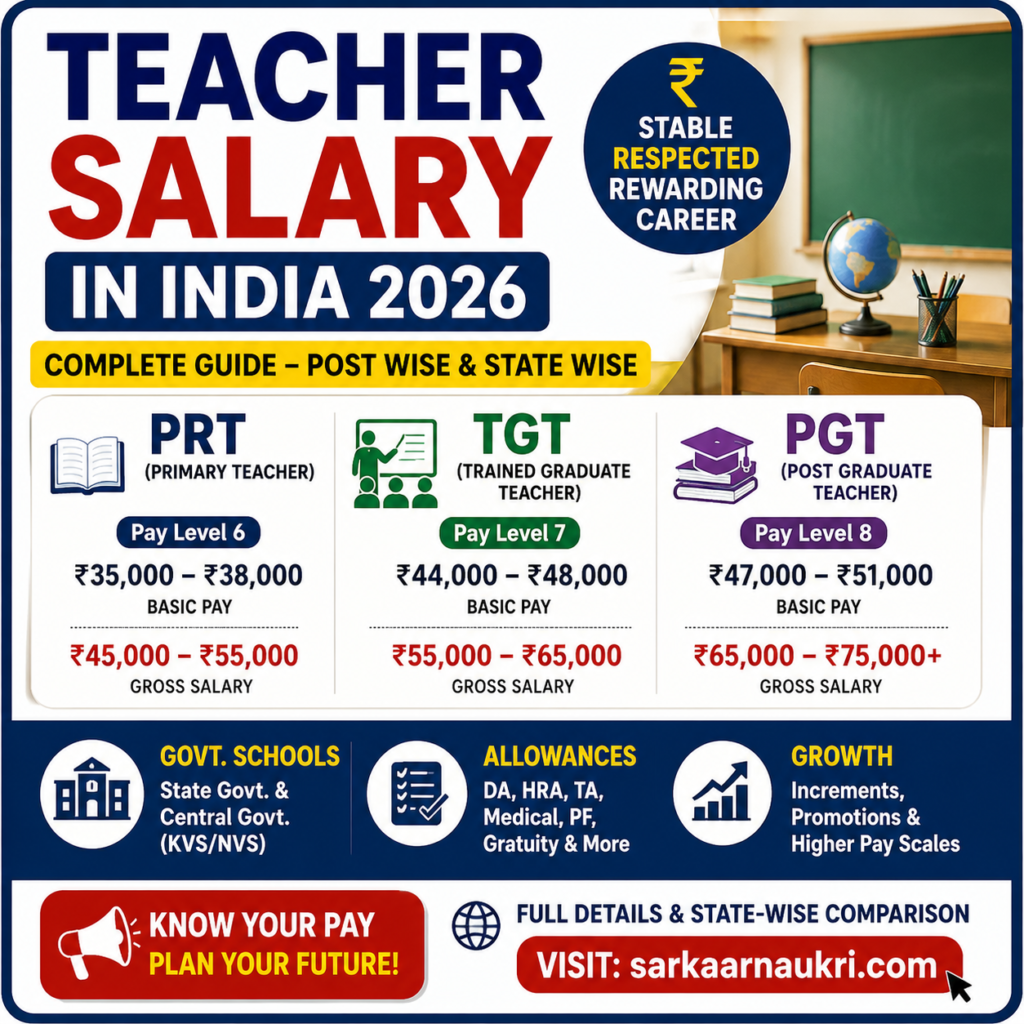
A Primary Teacher, commonly called PRT, typically sits at Pay Level 6 of the 7th Central Pay Commission matrix in most central and state government schools that have adopted CPC-aligned scales, roughly translating to a starting basic pay in the ballpark of ₹35,000 to ₹38,000 per month before allowances. With Dearness Allowance, House Rent Allowance, and Transport Allowance added, gross monthly pay for a fresher PRT under Teacher Salary in India 2026 commonly works out to somewhere between ₹45,000 and ₹55,000, depending on the city classification. Teacher Salary in India 2026 at the PRT level tends to grow through periodic increments and, in many states, an additional grade pay bump after a set number of years of service, though exact figures vary meaningfully by state, so always check your specific state’s latest pay circular rather than relying on a national average.
TGT (Trained Graduate Teacher) Salary Structure
The TGT post, which requires a graduate degree plus a B.Ed, generally sits one notch higher in the Teacher Salary in India 2026 hierarchy, typically at Pay Level 7, with a starting basic pay in the range of ₹44,000 to ₹48,000 per month. Once you add allowances, gross monthly pay for a TGT commonly lands between ₹55,000 and ₹65,000 in most states and central institutions. This is one of the more competitive tiers of Teacher Salary in India 2026, since TGT posts are advertised in high volume by state education boards, Kendriya Vidyalaya Sangathan, and Navodaya Vidyalaya Samiti, and the pay gap between a PRT and a TGT is often meaningful enough to influence which exam candidates prioritize.
PGT (Postgraduate Teacher) Salary Structure
A Post Graduate Teacher, who typically teaches senior secondary classes in a specialised subject, sits at Pay Level 8 within the Teacher Salary in India 2026 structure, with a starting basic pay commonly in the range of ₹47,000 to ₹51,000 per month, and gross monthly pay after allowances often crossing ₹65,000 to ₹75,000 depending on posting location. PGT is generally the highest-paying classroom-teaching post before you move into administrative roles like Vice Principal or Principal, and Teacher Salary in India 2026 at this level reflects both the subject specialisation required and the added responsibility of preparing students for board and competitive exams.
State Government vs Central Government (KVS/NVS) Teacher Salary Differences
Central government teaching postings, through KVS and NVS, tend to follow the 7th CPC pay matrix uniformly across India, along with standard central government allowances and transferability across states. State government teacher salaries, on the other hand, vary far more widely, since some states have fully adopted 7th CPC-equivalent scales while others still run older or state-specific pay structures with different allowance rates. This is one of the most important nuances of Teacher Salary in India 2026: two teachers at the same post level, one in a central school and one in a state school, can have a noticeably different take-home salary purely because of which pay commission structure their employer follows. Private-aided schools add another layer of variation, since some follow government-aided pay scales closely while others set independent pay bands that may sit below government levels.
Allowances and Benefits Beyond Basic Pay
Basic pay is only part of the Teacher Salary in India 2026 picture. Dearness Allowance, revised twice a year in most government structures, can add a substantial percentage on top of basic pay over time. House Rent Allowance varies by city classification, typically highest in metro cities and lowest in rural postings. Transport Allowance, medical benefits, and in many states, a specific rural or hill allowance for teachers posted in remote areas, all add to the effective Teacher Salary in India 2026 figure. Government teachers also generally get pension benefits under the New Pension Scheme, provident fund contributions, and gratuity after a qualifying period of service, benefits that are frequently underweighted when candidates compare gross salary figures across the public and private sector.
Common Mistakes and Misconceptions
Many aspirants misjudge Teacher Salary in India 2026 by comparing only the basic pay figure across states or posts, ignoring that Dearness Allowance and HRA can shift gross pay significantly. Another common mistake is assuming central government teacher pay is always higher than state government pay, when in reality several states with revised pay matrices offer competitive or even higher gross pay than some central postings, especially in metro city classifications. A third misconception is treating Teacher Salary in India 2026 as static; increments, periodic pay commission revisions, and promotional pay level jumps (from PRT to TGT to PGT to administrative posts) mean actual career earnings look very different from a single year’s opening salary. Finally, candidates sometimes overlook that private-aided school pay, even when government-aided, can lag behind full government-employee pay scales, so it’s worth confirming the exact aid and pay-scale status of an institution before assuming equivalence.
Practical Tips
Before appearing for any teaching exam, look up the specific state or organization’s latest official pay circular for accurate Teacher Salary in India 2026 figures rather than relying on last year’s numbers, since Dearness Allowance revisions and occasional pay commission implementations change the numbers. Factor in city classification when comparing postings, since HRA differences alone can meaningfully change your gross Teacher Salary in India 2026 figure between a metro and a rural posting. If you’re choosing between a state PRT/TGT exam and a central KVS/NVS exam, weigh transferability and long-term promotional avenues alongside starting pay, not just the opening number. Keep your B.Ed, TET, and subject-specific certifications updated and ready, since eligibility documentation delays are one of the most common reasons candidates lose out on timely appointment even after clearing an exam.
Frequently Asked Questions
Q1. What is the average Teacher Salary in India 2026 for a fresher PRT?
A fresher Primary Teacher typically earns a gross monthly salary in the range of ₹45,000 to ₹55,000, including basic pay and allowances, though this varies by state and city classification.
Q2. Do KVS and NVS teachers earn more than state government teachers?
Not always. Central government schools follow a uniform 7th CPC structure, but several states with revised pay matrices offer comparable or sometimes higher gross pay, especially in metro postings.
Q3. How much does a TGT earn compared to a PGT?
A TGT typically starts around ₹55,000 to ₹65,000 gross per month, while a PGT, being one pay level higher, often starts around ₹65,000 to ₹75,000 gross per month, though both figures depend heavily on location and employer.
Q4. Is Dearness Allowance included in the basic teacher salary figures usually quoted?
No, most quoted “basic pay” figures exclude Dearness Allowance, House Rent Allowance, and Transport Allowance, which together can add a significant amount to gross monthly pay.
Q5. Does teacher salary increase automatically every year?
Yes, government teachers generally receive periodic increments on their basic pay, along with Dearness Allowance revisions typically issued twice a year, in addition to any pay level promotions over a career.
Q6. Are private-aided school teachers paid the same as government teachers?
Not always. Some private-aided schools follow government-aided pay scales closely, while others set independent pay structures that can fall below full government-employee scales, so it’s worth verifying an institution’s exact aid status.
Q7. Which factors cause the biggest difference in Teacher Salary in India 2026 across states?
The biggest factors are whether a state has adopted a 7th CPC-equivalent pay matrix, the city classification for HRA purposes, and any state-specific allowances for rural or hill postings.
Conclusion
Teacher Salary in India 2026 varies significantly by post, employer type, and location, but understanding the PRT, TGT, and PGT pay structures, along with how allowances and pay commission adoption affect gross pay, gives you a realistic picture before you commit to an exam or accept a posting. Use this guide as a starting reference, then always cross-check the latest official pay circular for your specific state or organization before making a final decision. For current openings in this space, browse our Latest Government Jobs & Teacher Jobs section, or check ongoing vacancies under Graduate Jobs if you’re preparing for a TGT or PGT-level exam.
