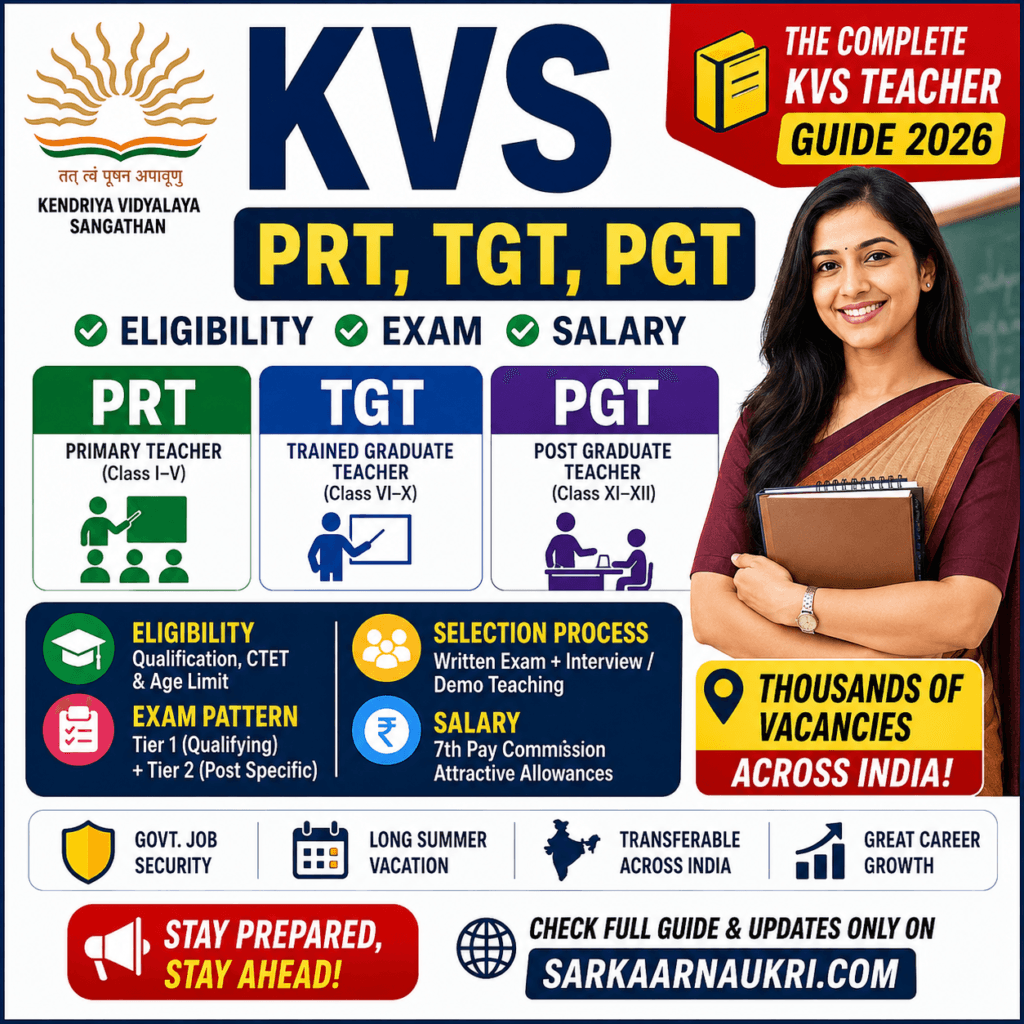
Every year, lakhs of graduates and postgraduates aim for a teaching career under Kendriya Vidyalaya Sangathan, and this KVS Teacher Guide 2026 exists to answer the questions that scattered notification PDFs rarely explain clearly. What actually separates a PRT vacancy from a TGT vacancy? Is CTET compulsory for your target post? How does the final merit list get calculated? This guide walks through everything from eligibility to salary in one place, so you are not piecing information together from ten different sources.
Why This KVS Teacher Guide 2026 Matters
Kendriya Vidyalaya Sangathan is an autonomous body under the Ministry of Education that runs one of India’s largest school networks, originally set up to serve the children of transferable central government employees but now open to the general public wherever seats are available. A teaching post at KVS is attractive for reasons that go beyond just the salary. Teachers get 7th Pay Commission scales, a long summer vacation, transferable postings across India, and genuine job security that is hard to find in private schooling. That combination is exactly why KVS drives routinely draw several lakh applicants for a few thousand seats, and why this KVS Teacher Guide 2026 focuses on getting the fundamentals right rather than just listing rules.
KVS Posts Explained: PRT, TGT, PGT and More
The teaching cadre covered in this KVS Teacher Guide 2026 is organized into three main levels, each tied to specific classes and specific qualifications.
PRT (Primary Teacher): Teaches classes I to V and forms the largest chunk of vacancies in most KVS cycles. PRTs are generalists responsible for foundational literacy, numeracy, and early learning.
TGT (Trained Graduate Teacher): Teaches classes VI to X in a specific subject such as Hindi, English, Mathematics, Science, or Social Science. TGT vacancies are usually the second largest category after PRT.
PGT (Post Graduate Teacher): Teaches classes XI and XII in a specialized subject and requires a postgraduate degree in that subject.
Beyond these three, this KVS Teacher Guide 2026 would be incomplete without mentioning Principal, Vice Principal, Librarian, Computer Instructor, Special Educator, and a range of non teaching posts like Assistant Section Officer and Junior Secretariat Assistant, since KVS recruitment drives are broader than just classroom teaching roles.
Eligibility Criteria and Age Limit
Eligibility is structured around three things: educational qualification, professional teaching certification, and age. This section is the core of any useful KVS Teacher Guide 2026.
Educational Qualification:
- PRT: Senior Secondary or graduation with a diploma or degree in elementary education, along with a pass in CTET Paper I.
- TGT: A bachelor’s degree with at least 50% marks in the relevant subject combination, along with a B.Ed or equivalent degree, and a pass in CTET Paper II.
- PGT: A master’s degree in the relevant subject with at least 50% marks, along with a B.Ed or equivalent degree. CTET is generally not compulsory for PGT posts, though it can strengthen your profile.
CTET Requirement: This is one of the most misunderstood parts covered in this KVS Teacher Guide 2026. CTET Paper I is mandatory for PRT, CTET Paper II is mandatory for TGT, and CTET is typically not required for PGT. Candidates who have not cleared the relevant CTET paper by the application deadline are not eligible to apply, regardless of how strong their degree marks are.
Age Limit: The upper age limit is typically 30 years for PRT, 35 years for TGT, and 40 years for PGT, calculated as on the closing date of the application. Standard central government age relaxation applies for SC, ST, OBC, PwBD, and ex-servicemen candidates, and several cycles have also offered additional relaxation for women candidates on certain posts. Always verify the exact cut off date against the live notification, since it can shift slightly between cycles even though this KVS Teacher Guide 2026 reflects the general pattern.
Exam Pattern: Tier 1 and Tier 2
Most teaching posts follow a two tier written examination structure.
Tier 1 is a common qualifying paper covering General Awareness, Reasoning, Mathematics, and General English, along with a Child Pedagogy section that is especially important for PRT candidates. Tier 1 is largely a screening stage.
Tier 2 is post specific and subject specific. For TGT and PGT posts, Tier 2 focuses heavily on the subject the candidate wishes to teach, tested at a depth appropriate to the class level they will handle. For PRT posts, Tier 2 leans more on pedagogy, child psychology, and general teaching aptitude. There is generally no negative marking in the written papers, which is a meaningful difference from many other competitive government exams and something every KVS Teacher Guide 2026 should flag clearly, since it changes how you should attempt the paper.
Selection Process and Merit Calculation
Once the written stages are cleared, the process moves into a final evaluation stage that varies slightly by post. For TGT posts, selection is usually based purely on Tier 2 marks with no separate interview. For PRT and PGT posts, a demo teaching round or interview typically follows Tier 2 and carries meaningful weightage, often in the range of 15 to 30 percent of the final score depending on the specific cycle. The final merit list combines the written test score with the interview or demo teaching score, and candidates are ranked category wise against the number of vacancies notified for their post and subject combination.
Common Mistakes and Misconceptions
A surprising number of otherwise well qualified candidates lose out due to avoidable errors rather than lack of subject knowledge, which is why this section belongs in any serious KVS Teacher Guide 2026.
Assuming CTET can be cleared later: Many candidates apply for PRT or TGT posts while still preparing for CTET, expecting to clear it before the interview stage. In most notifications, CTET must already be qualified by the application closing date, not by the interview date.
Ignoring the subject combination rules: TGT and PGT eligibility is often tied to specific subject combinations in your bachelor’s or master’s degree, not just the subject name. A Mathematics graduate without the required allied subjects may not qualify for a Mathematics TGT post, even though the subject match looks obvious on paper.
Treating Tier 1 casually: Because Tier 1 is a qualifying paper, some candidates under prepare for it, then run out of time to properly prepare for the subject heavy Tier 2. Both stages deserve dedicated preparation time.
Missing the age cut off date: Age is calculated as on the closing date of the specific notification, not the date you actually submit your form, so candidates close to the upper limit should check this carefully before assuming they qualify.
Practical Tips
Start subject revision from NCERT textbooks at the class level you intend to teach, since subject papers are known for testing concepts close to the actual school syllabus rather than abstract postgraduate theory. Build a dedicated Child Pedagogy preparation block if you are targeting PRT or TGT, since this section carries consistent weightage across cycles but is often the most neglected by candidates focused only on subject knowledge. Keep your CTET certificate, degree marksheets, and category certificates scanned and ready well before applications open, since document upload issues are one of the most common reasons candidates miss the deadline. Finally, treat the demo teaching round seriously if your post requires one. Candidates who prepare a short, clear lesson plan in advance consistently perform better than those who try to improvise on the day. This is the kind of practical detail a rules-only KVS Teacher Guide 2026 usually misses.
Frequently Asked Questions
1. Is CTET compulsory for every KVS teaching post?
No. CTET Paper I is compulsory for PRT and CTET Paper II is compulsory for TGT, but it is generally not compulsory for PGT posts.
2. Can final year students apply for KVS teaching posts?
No. Candidates must have completed and been awarded their qualifying degree by the application closing date; provisional or ongoing final year status is usually not accepted.
3. How much age relaxation is available for reserved category candidates?
Standard central government norms apply, typically 5 years for SC/ST, 3 years for OBC, and additional relaxation for PwBD and ex-servicemen candidates, on top of the base age limit for each post.
4. Is there negative marking in the KVS written exam?
Most cycles do not carry negative marking in the written examination, though candidates should always confirm this against the live notification.
5. Can one candidate apply for multiple posts in the same cycle?
Yes, candidates meeting the eligibility criteria for more than one post can usually apply for each separately, but this typically requires separate applications and separate fees, and exam dates for different posts may occasionally clash.
6. What is the typical salary range for KVS teachers?
Salary follows 7th Pay Commission scales, with PRT starting around Pay Level 6, TGT around Pay Level 7, and PGT around Pay Level 8, plus dearness allowance, house rent allowance, and transport allowance on top of the basic pay.
Conclusion
This KVS Teacher Guide 2026 covers what actually decides whether an application succeeds: confirming your CTET status early, understanding exactly which subject combination qualifies you for your target post, and preparing for both exam tiers rather than just one. Treat eligibility verification as seriously as subject preparation, and you avoid the most common reason capable candidates get rejected at the document stage. For live openings as they get notified, check our Latest Government Jobs section, and if you are exploring options beyond teaching, our Graduate Jobs category covers other central and state postings suited to degree holders.
