Every year, lakhs of candidates appear for government exams — and every year, a good number of them end up with the exact same total score as someone else. If you’ve ever wondered how a recruitment board decides who ranks higher when two candidates are dead level on marks, you’re asking about one of the most overlooked parts of the selection process: tie-breaking rules. These rules quietly decide waitlist positions, final selections, and even who gets the last available seat in a vacancy — so understanding them can matter as much as your actual score.
Tie-breaking rules in government exams aren’t random. Every recruiting body—SSC, UPSC, IBPS, state PSCs, railways—publishes its own tie-breaking rules, usually buried inside the exam notification under a section like “Resolution of Tie” or “Merit List Preparation”. Most candidates skip this section entirely, right up until they find themselves stuck at the bottom of a waitlist wondering why someone with the “same score” got in ahead of them.
This guide breaks down exactly how tie-breaking rules work across major government recruitment exams, the criteria used most often, common misconceptions, and practical tips to make sure a tie never costs you your rank.
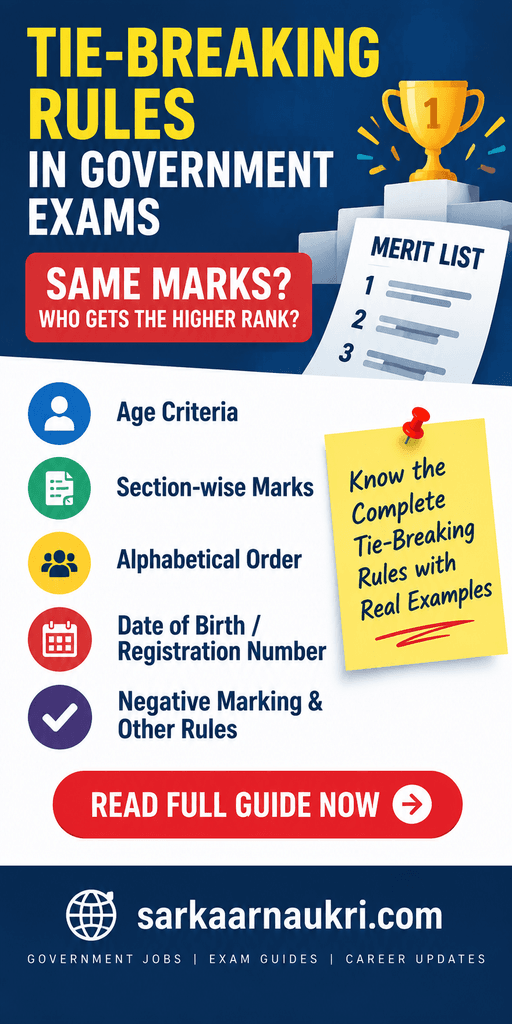
Why Tie-Breaking Rules Matter
A merit list is only useful if every rank is unambiguous. When hundreds of candidates take an exam, it’s mathematically inevitable that some will land on identical total scores — especially in exams with objective, negative-marking formats where scores cluster around common values. Without clear tie-breaking rules, recruiting bodies would have no defensible way to decide who gets the job, who goes on the waitlist, and who misses out entirely.
This matters most at the margins: the last one or two seats in a category, cutoff-adjacent scores, and reserved-category vacancies where the number of eligible candidates is small. A single one of these tie-breaking rules can be the difference between a confirmed appointment and a rejection letter.
The Most Common Tie-Breaking Rules Used in Government Exams
1. Age of the Candidate
Age-based tie-breaking rules are by far the most widely used across Indian government recruitment. The general rule — followed by SSC, most state PSCs, and several railway recruitment boards — is that the older candidate is ranked higher when total marks are equal. The logic given in most notifications is that an older candidate has “waited longer” or has fewer future attempts left, so they’re given priority. A few state-level exams reverse this and favor the younger candidate instead, so it’s worth checking the specific notification rather than assuming.
2. Marks in a Specific Section or Subject
Many exams don’t stop at overall marks — their tie-breaking rules go one level deeper and compare marks in a designated tie-breaking subject. For example:
- Banking exams (IBPS, SBI) often use marks scored in the Quantitative Aptitude section as the first tiebreaker, followed by Reasoning.
- Some technical recruitment exams (railways, PSUs) prioritise marks in the core technical subject over general awareness or reasoning.
- Teaching recruitment exams frequently use marks in Child Development & Pedagogy (CDP) as the deciding section.
This is why two candidates can have the same total score but very different final ranks — the exam board is looking past the total to a specific component.
3. Alphabetical Order of Name
When neither age nor sectional marks resolve the tie, several recruiting bodies fall back on alphabetical-order tie-breaking rules as a final catch-all clause, typically A to Z. This is more common in state-level and lower-tier recruitment exams than in large national ones, but it does appear in many notifications.
4. Date of Birth or Registration Number
Some boards build their tie-breaking rules around the exact date of birth (not just age band), while others — particularly for exams with very large applicant pools — default to the registration or roll number as a last-resort, purely administrative tiebreaker. This method carries no merit-based logic; it exists purely to produce a final, unambiguous list.
5. Negative Marking Adjustment
In a small number of exams, the tie-breaking rules check the number of wrong answers first when two candidates have equal raw scores — a candidate with fewer incorrect attempts (and hence fewer negative marks canceled out) may be ranked higher, on the reasoning that they demonstrated more accurate knowledge with fewer guesses.
6. State-Specific and Category-Specific Variations
State Public Service Commissions frequently design their own hybrid tie-breaking rules. It’s common to see a notification specify a full cascading order, such as: (1) marks in the main written exam, (2) marks in the optional subject, (3) age, (4) alphabetical order. Reserved category tie-breaks can also differ from the general category — for example, some states apply age-based tie-breaking only within a specific caste or PwD category list rather than across the whole merit list.
Common Mistakes and Misconceptions About Tie-Breaking Rules
Mistake 1: Assuming the same tie-breaking rules apply to every exam. There is no single, universal rule across all government exams in India. Each recruiting body sets its own criteria in the specific notification, and it can change from one recruitment cycle to the next for the same board.
Mistake 2: Ignoring the tie-breaking clause while reading the notification. Most candidates read the exam pattern, syllabus, and eligibility criteria closely but skip the “resolution of tie” clause entirely — usually because it’s placed near the end of the document in small print.
Mistake 3: Believing higher age always helps. While age-based tie-breaking usually favors older candidates, this is not universal. A handful of exams — particularly those targeting entry-level technical or defence-adjacent posts — explicitly favor younger candidates instead.
Mistake 4: Assuming a tie in the written exam carries over to interview-based selection. In exams with an interview or physical test stage, a tie at the written stage is often irrelevant, since the final merit list is based on combined marks across all stages, not the written exam alone. The tie-break clause usually applies only to the final consolidated score.
Mistake 5: Thinking sectional cutoffs and tie-breaking are the same thing. Sectional cutoffs decide whether you qualify at all; tie-breaking only comes into play after you’ve qualified, to rank you against others with an identical final score. Confusing the two leads to unnecessary panic when candidates see “equal marks” discussions online.
Practical Tips for Candidates
- Read the tie-breaking rules in every notification before the exam, not after results are declared — they tell you which sections deserve extra focus if your overall score ends up close to the cutoff.
- Don’t neglect the tie-breaking subject. If a notification states that quantitative aptitude or a technical subject will be used as the first tiebreaker, treat accuracy in that section as seriously as your overall score.
- Keep your application details accurate, especially date of birth — since age is a common tiebreaker, even a data-entry error here can affect your final rank.
- Track official answer keys and objection windows carefully. Since ties often occur near cutoff marks, a single question re-evaluated after an objection can shift you from “tied” to “clearly above” or “clearly below” the cutoff.
- Don’t rely on unofficial forums for this information. Always confirm the exact criteria from the official notification or corrigendum for that specific exam year, since rules can be revised between cycles.
Frequently Asked Questions
1. What is the most common tie-breaking rule in government exams? Age is the most widely used tie-breaker in Indian government recruitment, with the older candidate generally ranked higher when total marks are equal, though this varies by exam.
2. Does SSC give preference to older or younger candidates in case of a tie? SSC’s general practice has been to rank the older candidate higher in a tie, but candidates should always verify this against the specific exam’s notification, since criteria can change.
3. Can two candidates get the exact same rank in a government exam? No — recruiting bodies apply a defined sequence of tie-breaking criteria specifically to avoid two candidates sharing the same final rank on an official merit list.
4. Is alphabetical order used in all government exams for tie-breaking? No, alphabetical order is typically used only as a last-resort criterion, applied after age, sectional marks, and other factors have already been considered and still result in a tie.
5. Does tie-breaking apply before or after the interview round? Tie-breaking is generally applied to the final consolidated score after all stages (written exam, skill test, interview) are combined, not to any single stage in isolation.
6. How can I check the tie-breaking rule for a specific exam? The tie-breaking or “resolution of tie” clause is published in the official exam notification, usually in the section covering merit list preparation — always refer to that specific year’s notification rather than assuming it matches a previous year.
7. Does a tie-breaking rule affect reserved category candidates differently? In many states, yes — reserved category merit lists can apply the same tie-breaking sequence within the category-specific list rather than the general list, so it’s worth checking category-specific clauses separately.
Conclusion
Tie-breaking rules may seem like a minor technicality buried at the end of an exam notification, but they can decide real outcomes for candidates sitting right at the cutoff line. Since there’s no single rule that applies across every government exam, the safest approach is to read the specific notification’s “resolution of tie” clause before you sit for the exam — not after the results are out. If you’re preparing for an upcoming recruitment cycle, it’s also worth reviewing our guide on [Age Relaxation Rules in Government Jobs] and [How Are Government Job Cutoff Marks Decided?] to make sure you’re not missing other small-print details that can affect your final selection.
