Document Verification is the stage in a government recruitment process where a candidate’s original certificates and identity proofs are physically or digitally checked against the details submitted in the application form. It usually comes after a candidate has cleared the written exam, skill test, or interview, and it exists purely to confirm that the person who applied is eligible, real, and telling the truth on paper. No matter how high your score is, a failed document verification can end your selection instantly — which is why this stage deserves as much attention as your exam preparation.
This stage is not optional and it is not a formality. Recruiting bodies such as SSC, UPSC, and the various Railway Recruitment Boards under the RRCB treat this stage as a legal checkpoint, and candidates are disqualified every year for issues that had nothing to do with their exam performance — a mismatched name, an expired category certificate, or a missing original mark sheet.
Why Document Verification Matters So Much
This verification stage protects the integrity of the entire selection process. Without it, a recruitment board would have no way to confirm age, educational qualification, category status, or identity beyond what a candidate typed into an online form. Every certificate you upload during application is provisional until Document Verification confirms it against the original.
This is also the stage where category benefits — EWS, OBC-NCL, SC/ST, PwBD — are formally validated. A candidate can qualify on merit and still be rejected at Document Verification if the category certificate does not meet the exact format or validity period the notification demands.
How the Document Verification Process Works
- Shortlisting Notice: Once results are declared, the recruiting authority publishes a list of candidates called for the verification round, along with the schedule and venue.
- Call Letter: Candidates download a DV call letter or e-summon letter, which specifies the date, time, and reporting instructions.
- Document Submission: Candidates carry original certificates plus self-attested photocopies, exactly as listed in the notification.
- Physical or Online Check: An officer compares each original document against the uploaded scanned copies and the application form data. Some boards, including several RRBs, now run part of this document verification digitally through the DigiLocker platform before the physical round.
- Provisional Acceptance or Rejection: Based on the outcome, the candidate is provisionally accepted, asked for a correction, or rejected on the spot.
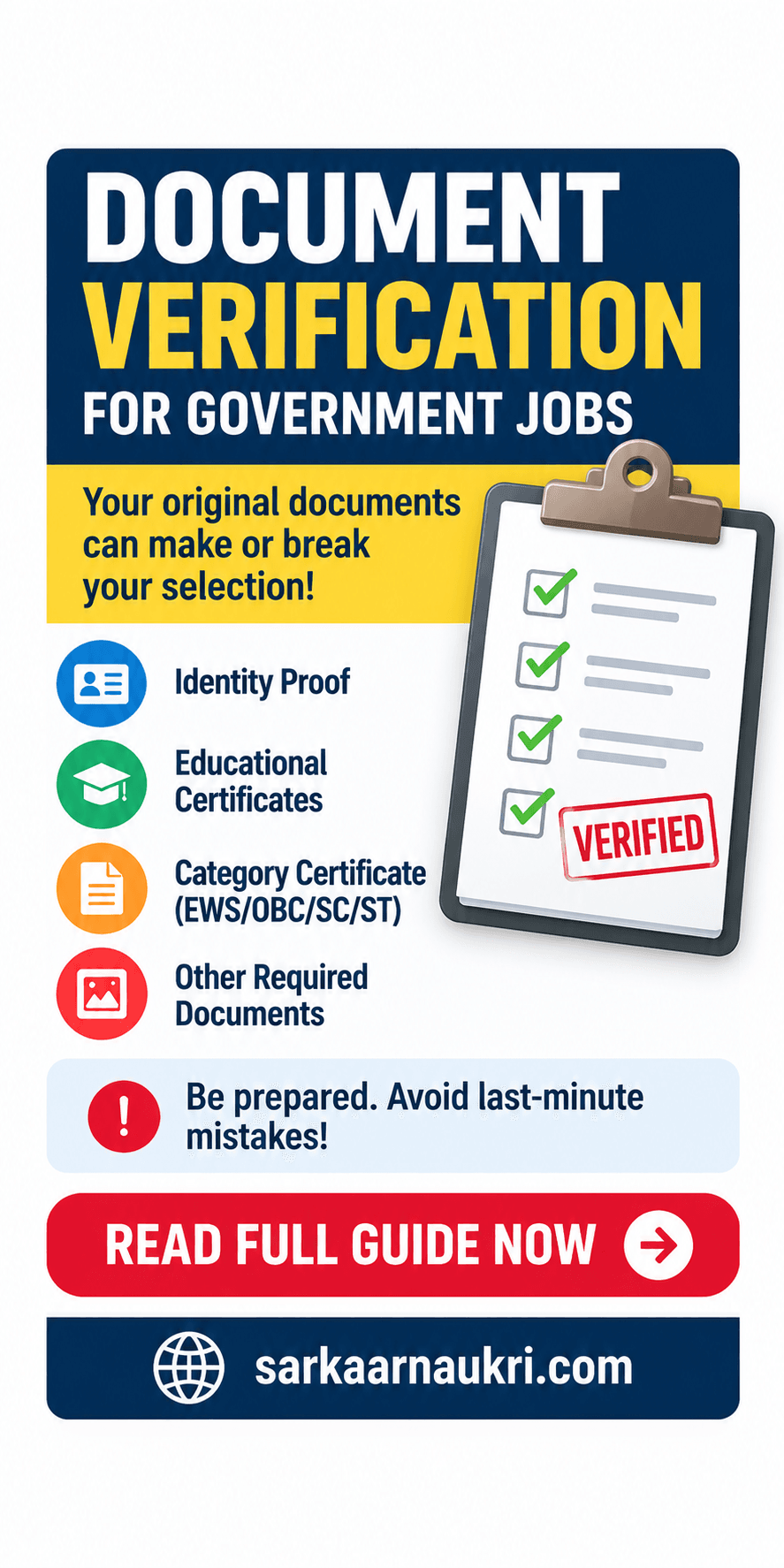
Documents Commonly Required
- Class 10 certificate (proof of date of birth and, often, name)
- Class 12 and graduation/post-graduation certificates and mark sheets
- Category certificate (EWS, OBC-NCL, SC/ST, as applicable)
- PwBD certificate, where relevant
- A valid photo ID (Aadhaar, PAN, passport, voter ID)
- Recent passport-size photographs
- Admit card and the DV call letter itself
- Experience certificates, if the post requires prior work experience
Requirements differ by exam, so always cross-check the specific list published for your recruitment cycle — SSC, UPSC, and each RRB publish their own version of this checklist alongside the shortlisting notice.
Common Reasons Candidates Fail Document Verification
- Name mismatch across the Class 10 certificate, graduation degree, and Aadhaar card
- Date of birth mismatch between the matriculation certificate and other documents
- Expired category certificate — most OBC-NCL and EWS certificates are valid for only one financial year
- Missing original documents, with only photocopies or scanned copies brought to the venue
- Incomplete photo ID proof, or a photo ID that doesn’t match the photograph on the application form
- Late arrival at the verification center, missing the assigned reporting slot entirely
Tips to Clear Document Verification Smoothly
- Start collecting original certificates the moment your written result is declared — don’t wait for the call letter.
- If your name or date of birth differs across documents, get a gazette notification or affidavit corrected well in advance; this cannot be resolved on the day of the DV round.
- Renew category certificates every year so they stay valid through your entire recruitment cycle.
- Keep both physical and digital copies — many boards now accept documents fetched through DigiLocker as a backup to physical originals.
- Arrive at least 45–60 minutes before your slot; latecomers are often turned away regardless of merit.
- Read the specific Document Verification instructions in your own notification — checklists vary between SSC, UPSC, Railways, and state PSCs.
Frequently Asked Questions
1. What happens if I fail Document Verification? If your documents don’t match the eligibility criteria or contain unresolved discrepancies, you can be disqualified from the recruitment process even after clearing the written exam.
2. Can I submit photocopies instead of originals for Document Verification? No. Almost every recruiting body requires original certificates for verification, along with self-attested photocopies to be submitted or retained by the department.
3. Is Document Verification done online or offline? It depends on the recruiting body. Traditionally it’s a physical, in-person process, but several boards, including some RRBs and UPSC’s DAF-II stage, now combine an online document upload step with a final physical check.
4. How long does Document Verification take? For an individual candidate it usually takes a few minutes to an hour, but the overall Document Verification schedule for a large exam can run across several days or weeks depending on the number of shortlisted candidates.
5. Can a name spelling difference disqualify me at Document Verification? It can, if the difference is significant and unexplained. Minor spelling variations are usually accepted with a supporting affidavit, but candidates should try to keep names consistent across all documents well before applying.
State PSC and Category-Specific Nuances
Not every recruiting body runs this stage the same way. State Public Service Commissions often layer in extra local requirements on top of the standard checklist — domicile certificates, local-language proficiency proofs, or state-specific caste certificate formats that differ from the central government’s OBC-NCL format. A category certificate that works perfectly for an SSC or UPSC exam can be rejected outright by a state board simply because the issuing authority or format doesn’t match what that state’s notification specifies. If you’re applying across multiple states or both central and state-level exams in the same cycle, don’t assume one set of certificates covers everything — check each notification’s checklist independently.
Reserved-category candidates face an additional layer of scrutiny. EWS and OBC-NCL certificates typically carry a strict one-year validity tied to the financial year, so a certificate issued in April may already be stale by the time your verification round arrives the following January. PwBD candidates are usually asked for a disability certificate issued by a designated medical board, and some recruiting bodies now also require a UDID (Unique Disability ID) card as supporting proof. Building a habit of renewing these certificates on a fixed annual schedule — rather than only when an exam is imminent — removes one of the most common last-minute panic points candidates report.
How Technology Is Changing the Verification Process
The shift toward digital-first verification is one of the more significant changes in Indian government recruitment over the past few years. Platforms like DigiLocker now let issuing authorities — school boards, universities, and government departments — push authenticated digital copies of certificates directly into a candidate’s account, which recruiting bodies can then check in real time without relying solely on a physical original. Several Railway Recruitment Boards have already integrated Aadhaar-based biometric checks into their shortlisting and verification workflow, partly to reduce impersonation cases that used to slip through purely paper-based checks.
This doesn’t mean physical checks are disappearing. Most boards still run a hybrid model: an online upload and scrutiny phase first, followed by a final in-person round where original documents are physically inspected before a candidate is confirmed. UPSC’s DAF-II process for the Civil Services Examination is a good example — candidates upload scanned certificates weeks in advance, but officials still examine and return originals on interview day itself. The practical takeaway for candidates is that the paperwork trail now starts much earlier in the process than it used to, so a digital copy that’s blurry, cropped incorrectly, or missing a page can trigger a discrepancy flag long before you ever reach the physical desk.
What to Do If You Spot a Discrepancy Before the Verification Date
If you notice a mismatch between your certificates while preparing for your slot, don’t wait for verification day to raise it. Most boards provide a representation or objection window after the shortlisting notice is published, specifically so candidates can flag genuine clerical errors — a misspelled name on an admit card, an incorrect category marked during application — before they turn into disqualification grounds. Submitting a written representation with supporting documents through the official channel, rather than trying to explain it verbally at the venue, gives you a paper trail and a far better chance of a favorable outcome.
Conclusion
Document Verification is the final gatekeeper between a good exam result and an actual government job offer, and it trips up far more candidates than most people expect — not because they lack merit, but because they underestimate the paperwork. Treat your verification checklist with the same seriousness as your syllabus: keep originals ready, correct mismatches early, and confirm the exact requirements from the official notification of your recruiting body — whether that’s SSC, UPSC, or your zonal Railway Recruitment Board — rather than relying on last year’s checklist.
