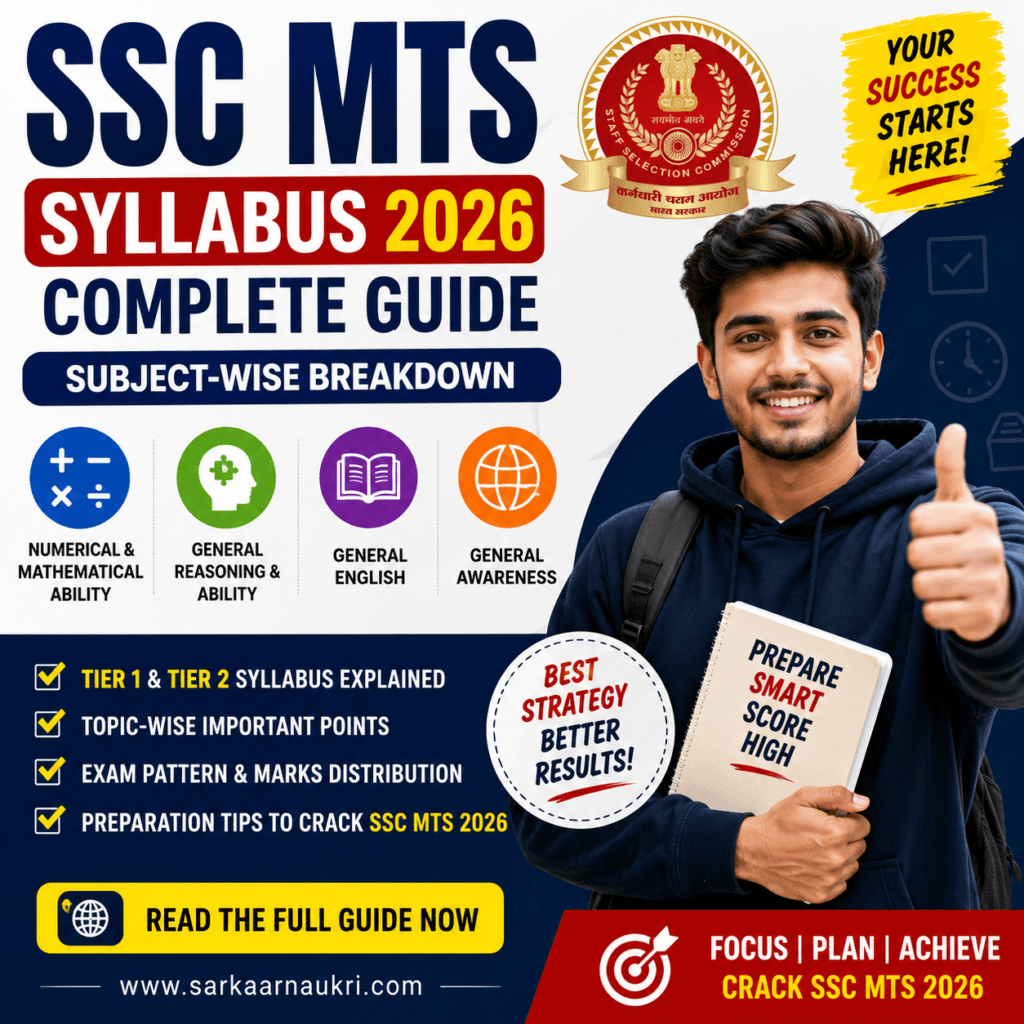
SSC MTS Syllabus 2026 ,Every year, lakhs of candidates start their preparation by typing “SSC MTS Syllabus” into a search bar and landing on a scattered PDF that lists topics without explaining how to use them. That’s the real problem — having the syllabus isn’t the same as knowing how to prepare from it. This guide breaks it down subject by subject, tier by tier, so you know exactly what to study, in what order, and why.
The Staff Selection Commission conducts the Multi-Tasking Staff exam in two stages, and each stage tests a different mix of skills. Candidates who treat the SSC MTS Syllabus as a checklist to memorize, rather than a map of skill areas, tend to over-prepare in one section and under-prepare in another. This guide fixes that by walking through it the way a serious aspirant should approach it — with weightage, difficulty level, and practical strategy built in.
Why Understanding the SSC MTS Syllabus Matters
The SSC MTS Syllabus isn’t just a list of chapter names — it’s a reflection of what the exam is actually designed to measure: basic numerical ability, logical reasoning, functional English, and general awareness relevant to everyday administrative work. Because SSC MTS is an entry-level exam, the difficulty of each topic is deliberately kept at a Class 8–10 level. That’s good news for aspirants, but it also means competition is intense, and small scoring gaps decide selection. A clear grasp of it early in your preparation prevents wasted time on topics that rarely appear and helps you prioritize the ones that do.
SSC MTS Exam Pattern: The Structure Behind the Syllabus
Before diving into topics, it helps to understand how the SSC MTS is tested. The exam has two tiers:
- Tier 1 is a Computer Based Test (CBT) with objective, multiple-choice questions covering four sections.
- Tier 2 is a descriptive test that checks basic language and writing ability in English or any language listed in the 8th Schedule of the Constitution.
Tier 1 is where most of the SSC MTS Syllabus is concentrated, and it’s the stage that determines who moves forward. Tier 2 is qualifying in nature but still requires preparation, since a poor script can affect your final outcome even after clearing Tier 1.
SSC MTS Syllabus: Numerical and Mathematical Ability
This section of the SSC MTS tests basic arithmetic and applied mathematics rather than advanced concepts. Core topics include:
- Number systems, whole numbers, and decimals
- Percentages, ratio and proportion
- Profit, loss, and discount
- Simple and compound interest
- Time, work, and distance
- Basic algebra and mensuration
- Data interpretation from simple tables, bar graphs, and pie charts
Within the Syllabus, this section rewards speed and accuracy more than depth, since most questions are direct applications of formulas rather than multi-step problems.
SSC MTS Syllabus: General Reasoning and Ability
The reasoning portion of the SSC MTS checks how well a candidate can spot patterns, classify information, and think logically under time pressure. Key areas include:
- Analogies and similarities/differences
- Space visualization and spatial orientation
- Problem-solving and analysis
- Visual memory and discrimination
- Relationship concepts and arithmetical reasoning
- Non-verbal series and figure-based questions
This part of the SSC MTS Syllabus tends to be scoring for candidates who practice figure-based and series questions regularly, since the question style repeats across years.
SSC MTS Syllabus: General English
The English section of the SSC MTS Syllabus is designed to test basic understanding, not literary knowledge. It typically covers:
- Vocabulary, synonyms, and antonyms
- Spot-the-error and sentence correction
- Fill in the blanks
- Basic comprehension passages
- One-word substitution and idioms
Candidates preparing from the SSC MTS Syllabus often underestimate this section, but it’s one of the easiest to score well in with consistent daily reading and grammar revision.
SSC MTS Syllabus: General Awareness
General Awareness is the most dynamic part of the SSC MTS Syllabus, since it draws from current events alongside static topics such as:
- History, geography, and Indian polity
- Economic scenes and general policy
- Scientific research and everyday science
- Sports, culture, and important days
- Current affairs from the preceding 6–8 months
Because this section of the SSC MTS Syllabus changes with the news cycle, it needs continuous attention rather than one-time revision closer to the exam.
SSC MTS Syllabus: Tier 2 Descriptive Paper
Once Tier 1 is cleared, focus shifts to Tier 2, a short descriptive writing test. Candidates write an essay or letter/application in English or a chosen regional language, generally within 150 and 250 words. Unlike Tier 1, this stage is qualifying, but a poorly structured or grammatically weak script can still affect the final result, so basic writing practice matters.
SSC MTS Syllabus: Marks Distribution and Weightage
Understanding how marks are distributed across the SSC MTS Syllabus helps you allocate study hours sensibly instead of spreading effort evenly across every topic. Tier 1 is typically divided into four sections of roughly equal marks, but the difficulty and scoring speed differ a lot between them. Numerical Ability and Reasoning tend to take longer per question but offer more predictable scoring once formulas and patterns are internalized. General English and General Awareness, by contrast, are faster to attempt but depend heavily on retention — vocabulary and current affairs fade quickly without revision. A candidate preparing seriously should treat these differences as a scheduling tool: heavier, slower sections get dedicated practice blocks, while lighter, faster sections get short daily revision slots instead of long study sessions.
Common Mistakes and Misconceptions About the SSC MTS Syllabus
- Treating Tier 2 as unimportant: Because it’s qualifying, many candidates skip preparing for it entirely and end up struggling with basic essay structure.
- Ignoring current affairs until the last month: General Awareness rewards steady, long-term reading, not last-minute cramming.
- Assuming reasoning questions repeat exactly: Patterns repeat, but exact questions rarely do — practice variety matters more than memorizing past papers.
- Overlooking mental math practice: Since calculators aren’t allowed, candidates who skip daily mental math drills lose valuable time in the numerical section.
- Studying topics equally instead of by weightage: Not every topic in the SSC MTS Syllabus carries equal weight in the actual paper, so blind, equal-effort preparation is inefficient.
Practical Tips to Prepare From the SSC MTS Syllabus
- Map each subject in the SSC MTS Syllabus against previous years’ papers to identify which topics appear most often.
- Set a fixed daily slot for current affairs so General Awareness doesn’t pile up before the exam.
- Practice at least one full-length mock test weekly once the initial syllabus coverage is complete.
- Keep a formula sheet for the numerical section and revise it daily instead of relearning formulas from scratch.
- For Tier 2, write at least two practice essays or letters per week and get them checked for grammar and structure.
- Revise reasoning topics through timed question sets rather than untimed reading, since speed is the real differentiator.
Frequently Asked Questions on SSC MTS Syllabus
1. Is the SSC MTS Syllabus the same every year? The core structure of the SSC MTS Syllabus has remained largely consistent, though the Commission can update exam patterns through official notifications, so it’s worth checking the latest notice before starting preparation.
2. How many sections does the SSC MTS Syllabus cover in Tier 1? The SSC MTS Syllabus for Tier 1 covers four sections: Numerical and Mathematical Ability, Reasoning Ability, General English, and General Awareness.
3. Is there negative marking as per the SSC MTS Syllabus and exam pattern? Yes, Tier 1 typically carries negative marking for incorrect answers, so accuracy matters as much as speed when applying it to your preparation.
4. Does the SSC MTS Syllabus include a physical test? No, MTS is a non-technical, non-physical-standard post, so it does not include a physical efficiency or physical standard test.
5. How difficult is the SSC MTS Syllabus compared to other SSC exams? The SSC MTS Syllabus is considered easier than exams like SSC CGL or CHSL since it’s pegged at a matriculation level, though competition remains high due to the large number of applicants.
6. Can I prepare for the SSC MTS Syllabus in three months? Yes, since the SSC MTS Syllabus covers foundational topics, focused preparation of two to three months with daily practice and regular mock tests is usually sufficient for most candidates.
7. Is coaching necessary to cover the SSC MTS Syllabus? Not necessarily — the SSC MTS Syllabus is largely self-study friendly, and many selected candidates prepare using free resources, NCERT books, and online mock tests without formal coaching.
Conclusion
The SSC MTS Syllabus rewards consistency far more than intensity. Spreading preparation evenly across Numerical Ability, Reasoning, English, and General Awareness — while treating Tier 2 as a real stage rather than an afterthought — gives candidates a realistic shot at clearing both tiers. For related preparation resources, see our guide on [SSC MTS Exam Pattern and Marking Scheme] and [Government Job Age Relaxation Rules], both of which complement this syllabus breakdown
