Every year, thousands of aspirants get confused about one simple question: am I still eligible to sit for the UPSC exam? The confusion isn’t really about numbers—it’s about how the UPSC age limit interacts with category, attempts, and cut-off dates that most guides gloss over. A candidate might know their category’s upper age limit but not realize that the exam date used for calculation isn’t their birthday-based age at all—it’s a fixed reference date set every year.
This guide breaks down the UPSC age limit exactly as it applies in practice: minimum and maximum age by category, how relaxations stack (or don’t), how attempts interact with age, and the mistakes that quietly disqualify otherwise well-prepared candidates. Whether you’re General, OBC, SC/ST, PwBD, or an ex-serviceman, you’ll find the exact numbers and the reasoning behind them here.
Why the UPSC Age Limit Matters More Than You Think
The UPSC age limit isn’t just an eligibility checkbox — it determines your entire preparation timeline. Aspirants who misjudge their remaining window often either rush their preparation or, worse, discover after months of study that they’ve already crossed their eligible age. Since age is counted as of August 1 of the examination year, a candidate can appear eligible by their actual birthday but be ineligible under UPSC’s calculation, or vice versa. Getting this date logic right at the start saves aspirants from a very avoidable heartbreak later.
General and EWS Category: The Baseline Rule
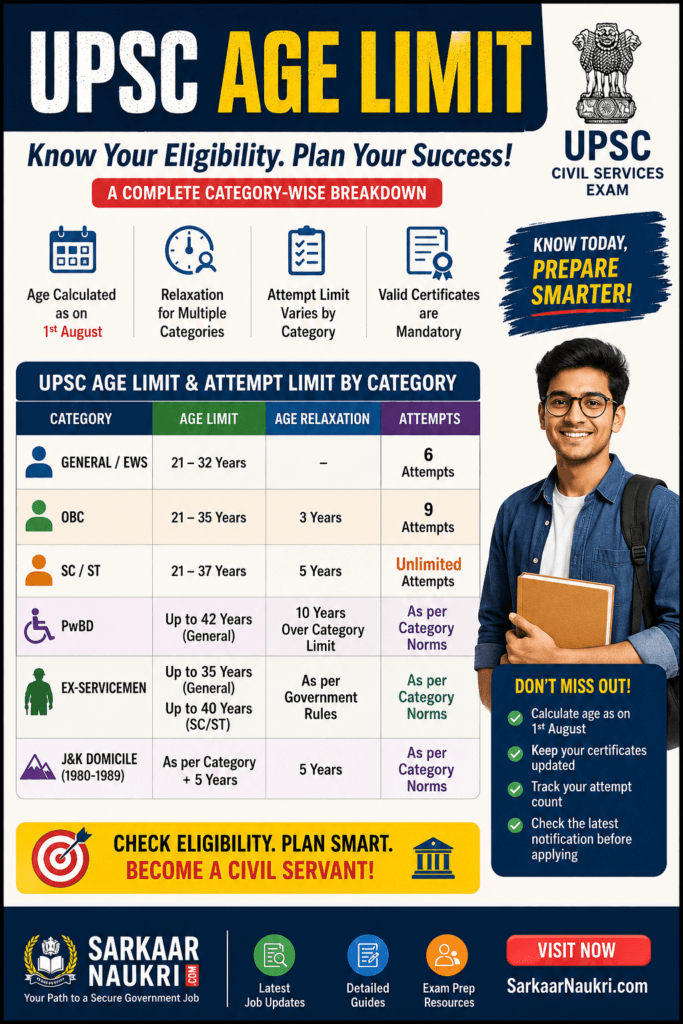
The UPSC age limit for general category candidates is 21 to 32 years, with age measured against the August 1 cut-off of the exam year. EWS candidates share the same age limit as General; the EWS category was introduced after the 103rd Constitutional Amendment in 2019, but UPSC does not add extra age relaxation for it. In practical terms, an EWS candidate gets reserved seats, not extra years. General and EWS candidates are also capped at 6 attempts within this window, so the UPSC age limit and attempt limit work together — whichever runs out first ends your eligibility.
OBC Relaxation: Three Extra Years, Three Extra Attempts
OBC (non-creamy layer) candidates get a 3-year relaxation on the upper age limit, bringing it to 35 years, along with 9 attempts instead of 6. The catch that trips up many aspirants is the “non-creamy layer” condition—this isn’t automatic just because you belong to an OBC community. The non-creamy layer income ceiling currently stands at ₹8 lakh per annum in family income, and candidates must produce a valid, current certificate to claim this relaxation. An expired or incorrectly issued certificate can invalidate the claim even if the candidate genuinely qualifies.
SC/ST Relaxation: The Widest Window
SC/ST candidates get a UPSC age limit of 21 to 37 years, a 5-year relaxation over the general, and unlike general or OBC, the number of attempts is not capped for SC/ST candidates—they can attempt the exam as many times as they wish within their age window. This makes the SC/ST category unique: age, not attempt count, is the binding constraint.
PwBD Relaxation: The Largest Single Category Benefit
Candidates with benchmark disabilities receive the most generous relaxation. Candidates with benchmark disabilities—at least 40% disability as defined under the Rights of Persons with Disabilities Act, 2016—get a 10-year relaxation over and above their category limit, meaning a general category PwBD candidate can appear up to age 42. This benefit stacks on top of category relaxation, so an SC/ST PwBD candidate would extend even further. Attempt limits for PwBD candidates follow their base category’s rules, with additional flexibility per government norms.
Ex-Servicemen and Special Category Relaxations
Ex-servicemen and defense-commissioned officers also receive meaningful relaxation, though the rules are more specific than most guides let on. Ex-servicemen and commissioned officers who have rendered at least 5 years of military service and were released on medical grounds get relaxation up to 35 years for the general category and 40 years for SC/ST candidates. Separately, candidates domiciled in the erstwhile state of Jammu & Kashmir between 1 January 1980 and 31 December 1989 receive a flat 5-year relaxation regardless of category.
It’s worth noting explicitly: no separate age relaxation exists for women candidates—they follow the same age rules as their respective categories, a point that surprises many first-time aspirants who assume gender-based relaxation applies as it does in some state-level exams.
Common Mistakes and Misconceptions
Assuming your age is calculated on your actual birthday. It isn’t—UPSC calculates age strictly as of August 1 of the examination year, regardless of when your birthday actually falls in that year.
Believing an unsuccessful prelims attempt doesn’t count. It does. Once a candidate enters the exam hall on Prelims Day, that counts as one attempt—even if they appear for only one paper or fail to clear it.
Assuming EWS candidates get the same relaxation as OBC. They don’t—EWS shares the general category’s age ceiling with no additional years, unlike OBC’s 3-year benefit.
Not renewing category certificates before applying. Age relaxation claims for OBC, PwBD, or ex-servicemen categories require valid, current certificates—an outdated document can cost a candidate their relaxation benefit entirely.
Ignoring that age and attempts are two separate ceilings. Even within your age window, once your attempt count is exhausted, you’re no longer eligible—the two limits don’t reset independently.
Practical Tips for Aspirants Nearing the Limit
- Calculate your exact age as of August 1 of your intended exam year well before applying — don’t rely on your regular birthday-based age.
- Keep category and relaxation certificates updated and ready before the application window opens, since processing delays are common.
- If you’re an OBC candidate close to the income ceiling, verify your family income status early, since non-creamy layer status can change year to year.
- Track your attempt count carefully—every Prelims appearance counts, regardless of how the exam actually went.
- If you qualify for more than one relaxation category (for example, PwBD and SC/ST), confirm with the official notification exactly how these stack, since exact combinations are specified there each year.
Frequently Asked Questions
Is there a separate UPSC age limit for women candidates?
No, women follow the same age limit as their respective categories—there is no additional relaxation based on gender.
Does the UPSC age limit change every year?
The age limit for the UPSC Civil Services Exam has remained unchanged since 2015, though candidates should always verify against the current year’s official notification.
How is my age calculated for the UPSC exam if my birthday falls after August?
Your age is fixed as of August 1 of the exam year, not your actual birthday—so a candidate turning 32 in September would still be considered 31 for that year’s cut-off.
Can OBC candidates lose their age relaxation eligibility?
Yes—if family income exceeds the non-creamy layer ceiling or the certificate has lapsed, the candidate is treated as general category for age and attempt purposes.
Do PwBD candidates get relaxation on both age and number of attempts?
Yes, PwBD candidates receive relaxation on age (10 years over their base category) and additional flexibility on attempts as per current rules.
What happens if I exceed my category’s maximum attempts but I’m still within the UPSC age limit?
You become ineligible to apply, regardless of remaining age headroom—attempts and age are independent ceilings, and either one being exhausted ends eligibility.
Conclusion
The UPSC age limit isn’t a single number—it’s a layered system where category, certificates, attempt counts, and a fixed calculation date all interact. Getting even one of these wrong can mean losing an attempt you thought you still had. Before you begin serious preparation, it’s worth cross-checking your exact eligibility window against the latest UPSC notification rather than relying on last year’s figures.
For a deeper look at how these rules apply across different government exams, see our guide on Age Relaxation Rules for Government Jobs or explore Best Government Jobs for Women for other paths with different eligibility structures.
