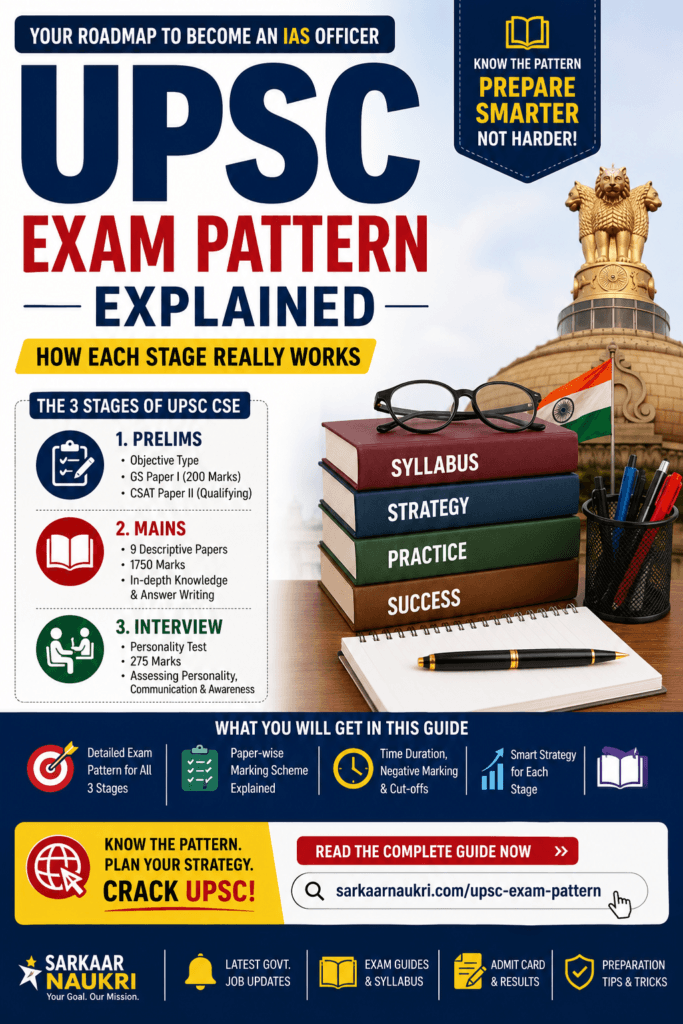
Here’s a number that surprises most first-time aspirants: out of nearly ten lakh candidates who apply for the UPSC Civil Services Examination every year, fewer than 15,000 clear Prelims, and only around 1,000 make it to the final list. Understanding the UPSC Exam Pattern properly — not just the syllabus, but how each stage is structured, scored, and weighted — is one of the biggest factors that separates candidates who survive each filter from those who get eliminated by surprise. This guide walks through the exact pattern of all three stages so you know precisely what to expect before you sit for the exam.
The UPSC Exam Pattern is deliberately designed as a three-tier filter: Preliminary Examination, Main Examination, and a Personality Test. Each stage of the UPSC Exam Pattern tests a different skill — objective knowledge and aptitude in Prelims, analytical writing in Mains, and communication and personality traits in the interview. Many aspirants prepare only for content without understanding how marks are actually allocated at each stage, which leads to poor time management and avoidable mistakes on exam day.
Why Understanding the Exam Pattern Matters
Knowing the UPSC Exam Pattern in detail is not a formality — it directly shapes how you allocate study time, how you attempt questions under pressure, and how you interpret your own performance after each stage. Candidates who understand the negative marking system built into the UPSC Exam Pattern, for instance, approach guesswork very differently from those who don’t. Similarly, knowing that Mains answers are evaluated on structure and presentation, not just factual accuracy, changes how aspirants practice writing. A pattern-first approach to preparation tends to produce more consistent scores than a purely content-first approach.
This becomes especially clear when comparing two candidates with similar subject knowledge. One studies the syllabus in isolation, while the other studies it alongside the pattern’s marking scheme, time limits, and question format. In mock tests, the second candidate almost always scores higher — not because they know more, but because they’ve internalized how the exam actually rewards answers, not just information.
Stage One of the UPSC Exam Pattern: Preliminary Examination
The Preliminary stage of the UPSC Exam Pattern consists of two objective-type papers, both mandatory:
- General Studies Paper I: 100 questions, 200 marks, 2 hours. Covers current events, history, geography, polity, economy, environment, and general science.
- General Studies Paper II (CSAT): 80 questions, 200 marks, 2 hours. Tests comprehension, logical reasoning, decision-making, and basic numeracy. This paper is qualifying in nature, requiring a minimum of 33% to clear.
Only marks from Paper I are used to determine the Prelims cutoff and shortlist candidates for Mains — Paper II simply needs to be cleared, not maximized. Each wrong answer in both papers carries a penalty of one-third of the marks allotted to that question, so the negative marking structure of the UPSC Exam Pattern plays a major role in deciding how aggressively a candidate should attempt borderline questions.
Stage Two of the UPSC Exam Pattern: Main Examination
Once a candidate clears Prelims, the Mains stage of the UPSC Exam Pattern follows a completely different structure — nine descriptive papers spread across several days, testing depth of knowledge rather than speed of recall.
Two qualifying papers (Indian Language and English, 300 marks each) must be cleared with minimum marks but are not counted for ranking. The remaining seven papers — Essay, four General Studies papers, and two Optional Subject papers — are each worth 250 marks and are added together for the final merit calculation, bringing the total to 1750 marks. Every Mains paper is time-bound at three hours, and most papers contain 20 questions of varying word limits and mark weightage, requiring candidates to manage both content and time simultaneously.
UPSC Exam Pattern: Personality Test (Interview)
Candidates who clear Mains are called for a Personality Test worth 275 marks, the final stage of the UPSC Exam Pattern, conducted by a board of subject experts and civil service veterans. Unlike a typical interview, this stage does not test rote knowledge; it evaluates mental alertness, clarity of thought, balance of judgment, and depth of interest in current affairs. The final marks from Prelims are not added at any stage beyond the initial shortlisting — the actual merit list is prepared using only Mains and interview marks combined, out of a total of 2025.
How the UPSC Exam Pattern Has Evolved
The current three-stage structure of the UPSC Exam Pattern has remained fundamentally stable for over a decade, but individual components have changed periodically. CSAT, for instance, was introduced as a Prelims paper only in 2011 and later made purely qualifying after concerns that it disadvantaged candidates from humanities backgrounds. The number of Mains General Studies papers, the marks allotted to the interview, and even the essay format have all seen adjustments in past cycles based on recommendations from expert committees.
This matters for two practical reasons. First, aspirants relying on outdated coaching material sometimes prepare for a version of the pattern that no longer exists in its old form, so cross-checking every detail against the official UPSC notification before finalizing a strategy is essential. Second, understanding that the pattern evolves gradually rather than overnight helps candidates avoid panic over rumored changes that circulate every year without official confirmation.
Common Mistakes and Misconceptions About the UPSC Exam Pattern
- Assuming Prelims marks count toward the final rank. They don’t — Prelims is purely a qualifying stage, and only Mains plus interview marks decide the final merit position.
- Treating CSAT as unimportant. While it is qualifying, several capable candidates have been eliminated purely for not clearing this paper, so it deserves genuine practice.
- Ignoring negative marking while attempting Prelims. Blind guessing without any elimination strategy often does more harm than leaving a question unattempted.
- Underestimating the interview stage. Some candidates assume Mains performance alone secures a good rank, overlooking that 275 interview marks can meaningfully shift a candidate’s final position.
- Not practicing within actual time limits. Many aspirants read well but have never simulated the real three-hour Mains paper format defined by the UPSC Exam Pattern, leading to rushed or incomplete answers on exam day.
Practical Tips to Master the UPSC Exam Pattern
- Take at least a few full-length Prelims mock tests under strict two-hour timing to build comfort with the negative marking trade-off.
- Practice CSAT regularly even if you’re confident about clearing it, since a bad day on this paper alone can end an otherwise strong attempt.
- Simulate real Mains conditions — three hours, twenty questions, no reference material — at least once every two weeks closer to the exam.
- Review previous years’ cutoffs for both Prelims and Mains to calibrate realistic scoring targets rather than guessing blindly.
- Prepare for the interview stage well before Mains results are declared, since the gap between result and interview date is often short.
- Keep a running log of your mock test scores across both Prelims and Mains-style tests so you can spot patterns in your own weak areas rather than relying on general impressions.
- Read the official UPSC notification for your exam cycle line by line at least once, rather than depending entirely on secondhand summaries from coaching material or online forums.
Frequently Asked Questions
How many stages are there in the UPSC exam?
The UPSC Exam Pattern is built around three stages — the Preliminary Examination, the Main Examination, and the Personality Test (Interview).
Does the UPSC Exam Pattern include negative marking?
Yes, both Prelims papers carry a penalty of one-third of the marks for every wrong answer, while there is no negative marking in the descriptive Mains papers.
Are Prelims marks added to the final UPSC merit list?
No, Prelims marks are used only to shortlist candidates for Mains and are not counted toward the final ranking.
How much time is given for each paper in the UPSC exam?
Each Prelims paper is two hours long, and each Mains paper is three hours long, except for visually impaired candidates and those with certain disabilities, who receive extra time as per official provisions.
Is CSAT really just a qualifying paper?
Yes, GS Paper II (CSAT) requires only 33% to qualify and its marks are not used for the Prelims merit ranking, though failing to clear it eliminates a candidate regardless of Paper I performance.
What is the total marks distribution across the UPSC exam stages?
Mains carries 1750 marks across seven ranked papers, and the Personality Test carries 275 marks, making the total marks considered for final merit 2025.
Can the exam pattern change without prior notice?
Major structural changes are rare and typically announced well in advance through official notifications, though minor procedural updates can appear from one cycle to the next, which is why checking the current year’s notification is always advisable.
Is there any difference in pattern for optional subject papers compared to General Studies papers?
Both follow a similar descriptive format with three-hour durations, but optional subject papers go into significantly greater depth on a single subject chosen by the candidate, compared to the broader coverage expected in General Studies papers.
Conclusion
The UPSC Exam Pattern is built as a three-stage filter, and understanding exactly how each stage is scored — from Prelims negative marking to Mains time management to interview weightage — is just as important as covering the syllabus itself. Build your preparation strategy around the UPSC Exam Pattern rather than around content alone, and revisit our detailed UPSC Mains Syllabus guide for a paper-by-paper breakdown of what to study once you clear Prelims
