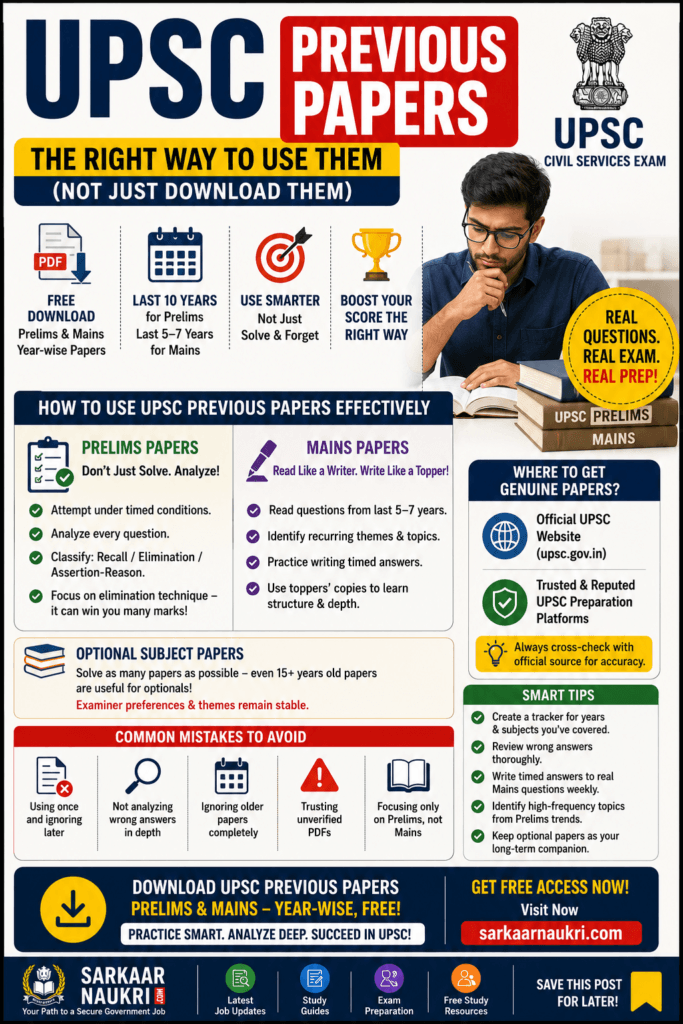
Every UPSC aspirant downloads a folder of UPSC previous papers within their first week of preparation—and most of them barely touch half of it. That’s not a discipline problem; it’s a strategy problem. Previous papers are the single most reliable window into how UPSC actually tests a topic, but simply solving them cover to cover without a system wastes their real value.
This guide covers where to find genuine UPSC previous papers for Prelims and Mains, how far back you actually need to go, and — more importantly — the specific ways toppers use them that most aspirants never learn. By the end, you’ll know exactly how to turn a stack of old question papers into a structured part of your preparation instead of a box you tick once and forget.
Why UPSC Previous Papers Matter More Than Any Mock Test
Mock tests simulate the exam; UPSC previous papers are the exam—actual questions UPSC has asked, in the actual style and difficulty UPSC uses. No coaching institute’s mock test perfectly replicates the Commission’s specific way of framing questions, the subtlety of its options in Prelims, or the exact expectations behind a Mains question’s keywords (“critically analyze” vs “discuss” vs “examine”). Studying UPSC previous papers closely trains you to recognize UPSC’s actual patterns—recurring themes, favorite angles on static topics, and how current affairs get woven into seemingly unrelated questions.
Where to Get Genuine UPSC Previous Papers
The only fully reliable source is the official UPSC website, which hosts question papers for recent years directly. Beyond the official site, most serious aspirants also rely on well-established UPSC preparation platforms that compile UPSC previous papers going back a decade or more, often with answer keys and difficulty-tagged questions. When downloading from any third-party source, cross-check a few questions against the official set for that year—small transcription errors do occasionally creep into unofficial compilations.
How Far Back Should You Actually Go?
For Prelims, the last 10 years of UPSC previous papers is generally considered the useful window—UPSC’s question style has evolved meaningfully since the pattern changes introduced in the early 2010s, so papers older than that reflect a noticeably different exam. For Mains, the last 5–7 years matter most, since the syllabus structure (particularly GS Papers II–IV) has shifted enough that older papers can be less representative of current expectations, though they remain useful for practicing analytical writing.
Prelims Papers: What to Actually Do With Them
Don’t just solve Prelims UPSC previous papers under timed conditions and check your score—that’s the least valuable way to use them. Instead, after attempting a paper, go question by question and categorize each one: was it a factual recall question, an elimination-based question, or an assertion-reason type? UPSC previous papers reveal that a significant share of Prelims questions are winnable through elimination technique rather than pure knowledge, and recognizing which questions fall into that category is a skill you build only by dissecting old papers closely, not by casually attempting them.
Mains Papers: Reading Them as a Writer, Not a Solver
Mains UPSC previous papers deserve a different approach entirely. Rather than attempting full answers to every question, spend time simply reading through several years of GS papers and noting recurring themes — certain topics (federalism, disaster management, ethics case studies) reappear in different phrasings almost every year. This pattern recognition helps you prioritize which topics deserve deeper preparation. When you do write full answers, use previous years’ toppers’ copies alongside the question papers themselves — seeing how a 150-word answer actually gets structured under time pressure teaches far more than the question alone.
Using Previous Papers for Optional Subject Preparation
UPSC previous papers for your optional subject deserve focused, separate attention from GS papers. Since optional subjects are more static and less current-affairs-dependent, older previous papers (even 15+ years back) remain genuinely useful for optional preparation, unlike GS papers where recency matters more. Many optional subject toppers report solving every available previous paper for their subject as a core part of their strategy, since examiner preferences and recurring themes within a specific option are often more stable over time.
Common Mistakes and Misconceptions
Treating previous papers as a one-time diagnostic rather than a repeated resource. Serious aspirants revisit UPSC previous papers multiple times across their preparation cycle—once early for orientation, once mid-preparation for pattern recognition, and once close to the exam for final practice.
Solving papers without reviewing wrong answers in depth. Simply noting a wrong answer and moving on wastes the paper’s real value—understanding why an option was wrong and what UPSC intended by the framing is where the actual learning happens.
Ignoring older papers because “the syllabus has changed.” While true for GS Mains to an extent, the underlying reasoning skills and question-framing style UPSC uses stay remarkably consistent—dismissing older papers outright throws away valuable pattern insight.
Using unofficial compilations without any verification. Errors in third-party PDFs are uncommon but real, and blindly trusting an incorrect answer key can quietly reinforce a wrong understanding of a concept.
Focusing only on Prelims papers and neglecting Mains. Many aspirants over-invest in previous Prelims papers since they’re easier to self-check, while Mains papers—which require more effort to use well—get comparatively neglected despite being equally, if not more, important.
Practical Tips for Using UPSC Previous Papers Effectively
- Build a simple tracker noting which years and subjects you’ve reviewed, so you’re not repeatedly covering the same ground while skipping others.
- After each Prelims paper attempt, spend at least as much time reviewing wrong answers as you spent solving the paper itself.
- For Mains, practice writing timed answers to at least a few real previous questions each week rather than only reading model answers.
- Cross-reference recurring prelims themes across the last 5 years to identify high-frequency static topics worth prioritizing.
- Keep your optional subject’s previous papers as an ongoing companion resource throughout preparation, not a one-time solve.
Frequently Asked Questions
Are UPSC previous papers enough on their own to clear Prelims?
No—they’re an essential tool for understanding pattern and difficulty but need to be paired with strong conceptual clarity and current affairs coverage to be effective.
How many years of UPSC previous papers should a first-time aspirant solve?
Most preparation strategies recommend starting with the last 5 years for a realistic sense of current difficulty, then expanding to 10 years as preparation progresses.
Do UPSC previous papers repeat questions across years?
Exact repeats are rare, but recurring themes, static topics, and question-framing styles do show up consistently across years.
Where can I verify that a previous paper PDF is accurate?
Cross-check a sample of questions against the official UPSC website‘s archive, which is the only fully authoritative source.
Should I solve previous papers under timed conditions or untimed?
Both serve a purpose—early in preparation, untimed review helps with learning; closer to the exam, timed attempts build the pacing and pressure handling previous papers can help simulate.
Are Mains’ previous papers still useful if the syllabus has changed slightly?
Yes—while some topics shift, the reasoning style, keyword expectations, and answer-writing patterns UPSC rewards remain largely consistent across years.
Conclusion
UPSC previous papers are one of the few genuinely reliable windows into how the Commission actually tests candidates, but their value depends entirely on how deliberately you use them—as a tool for pattern recognition and error analysis, not just a stack of practice questions to tick off. Used well across your preparation cycle, they can sharpen both your Prelims elimination skills and your Mains answer-writing far more than generic mock tests.
For more on structuring your preparation timeline, see our guide on UPSC Attempt Limit or explore UPSC Age Limit to plan your exam strategy around your eligibility window.
