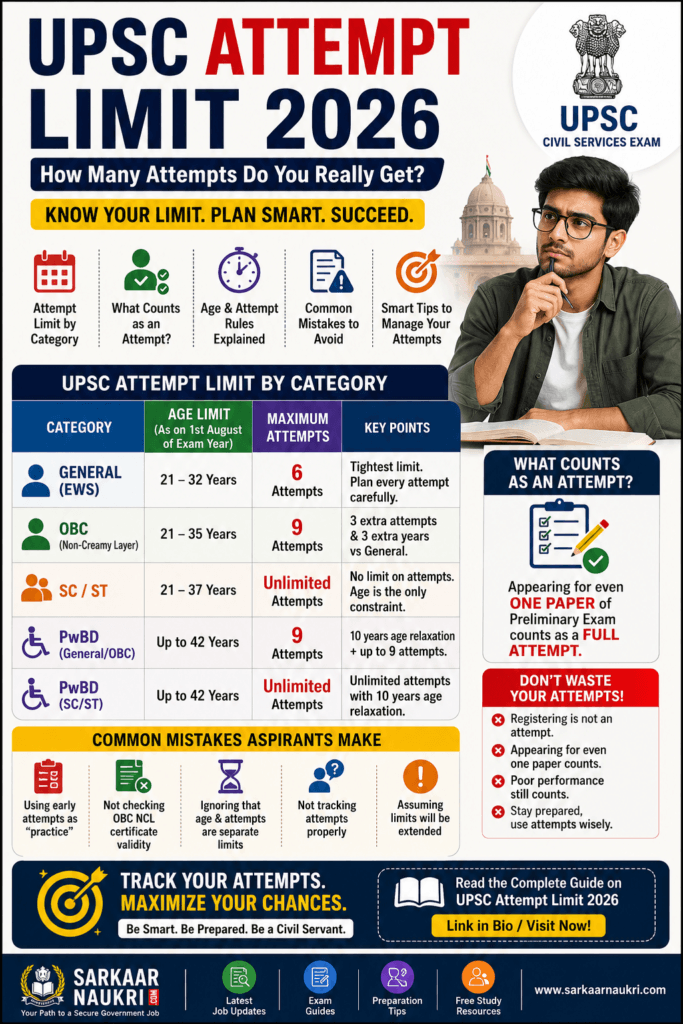
Most UPSC aspirants can recite their category’s age limit without hesitation, but ask them how many attempts they actually have left, and the answer gets fuzzy fast. That confusion is expensive—misjudging your UPSC attempt limit means either burning an attempt too casually early on or discovering with dread that you’re out of chances while you still technically have years left on your age clock. The two limits don’t move together, and treating them as interchangeable is one of the most common planning mistakes aspirants make.
This guide lays out exactly how the UPSC attempt limit works for every category, what officially counts as an “attempt” (the answer surprises a lot of first-timers), how attempts interact with your age window, and the mistakes that quietly cost candidates chances they didn’t know they’d used. Whether you’re General, OBC, SC/ST, or PwBD, you’ll find the precise numbers and the reasoning behind them here.
Why the UPSC Attempt Limit Matters More Than Most Aspirants Realize
Age and attempts sound like two versions of the same restriction, but they’re independent ceilings that can each end your eligibility on their own for every notification. A general category candidate could be 28 years old—well inside the 32-year age window—but already out of attempts if they’ve sat for Prelims six times. Conversely, an SC/ST candidate with unlimited attempts is still bound entirely by the 37-year age ceiling. Understanding exactly where your category’s UPSC attempt limit sits and how it interacts with your age is what allows you to plan a preparation timeline instead of discovering the rules the hard way mid-journey.
General and EWS Category: Six Attempts, No Exceptions
The UPSC attempt limit for General category candidates is capped at 6 attempts, usable any time before the candidate turns 32 (calculated as of August 1 of the exam year). EWS candidates fall under the identical rule—6 attempts, 32-year ceiling—since the EWS category shares General’s age and attempt structure despite being a separate reservation category for vacancies. In practice, this makes General and EWS the tightest categories to plan around: every attempt has real weight, and there’s no cushion for a “trial run” attempt taken before a candidate feels genuinely ready.
OBC Category: Nine Attempts and a Wider Window
OBC (non-creamy layer) candidates get a more generous UPSC attempt limit—9 attempts, usable up to age 35. That’s three extra attempts and three extra years compared to General, a meaningful strategic advantage. The catch many aspirants overlook: this only applies to non-creamy layer OBC candidates. If a candidate’s family income exceeds the current ₹8 lakh per annum ceiling, they’re treated as General category for both age and attempt purposes—meaning an outdated or lapsed OBC certificate can silently cost a candidate three attempts and three years of eligibility they assumed they had.
SC/ST Category: Unlimited Attempts, Age Is the Only Real Constraint
SC and ST candidates face no cap on the number of attempts at all — the UPSC attempt limit for this category is effectively unlimited, bound only by the 37-year age ceiling. From the minimum eligible age of 21 to 37, that’s a theoretical window of up to 16 consecutive attempts. For SC/ST aspirants, attempt-counting becomes almost irrelevant to planning; the real strategic question isn’t “how many tries do I have left” but “how many years remain before I age out.”
PwBD Category: Relaxation Layered on Top of Base Category
Candidates with benchmark disabilities get attempt relaxation stacked on top of their base category’s rules. General and OBC category PwBD candidates get up to 9 attempts, with the age ceiling extended to 42 years — while SC/ST PwBD candidates retain unlimited attempts, also up to age 42. This is the most generous combination available under current rules, reflecting the additional 10-year age relaxation PwBD candidates receive regardless of category.
What Actually Counts as an “Attempt”—The Rule Most Aspirants Get Wrong
This is where the UPSC attempt limit trips up even well-prepared candidates. An attempt is counted the moment a candidate appears for any single paper of the Preliminary examination—not the full exam, not both papers, just showing up for one. This means:
- Filling out the application form but not appearing for Prelims does not count as an attempt
- Appearing for even one paper of Prelims, even if the candidate leaves early or fails badly, does count as a full attempt
- There’s no partial-credit system—a half-hearted appearance counts exactly the same as a fully prepared one
This single rule causes more accidental attempt wastage than any other factor, since many aspirants assume registering “just to see the exam pattern” is a safe, cost-free trial.
Common Mistakes and Misconceptions – UPSC Attempt Limit
Assuming attempts and age reset independently. They don’t. Whichever ceiling you hit first ends your eligibility, regardless of how much room remains on the other.
Believing a poor or incomplete A prelim’s appearance doesn’t count. It counts in full the moment you sit for one paper, even if you leave without finishing.
Not verifying OBC non-creamy layer status before relying on the 9-attempt window. An expired or income-ineligible certificate quietly drops a candidate back to General’s 6-attempt, 32-year rule.
Treating an early “practice” attempt as free. Many aspirants use 2–3 attempts before they’re genuinely exam-ready, then face real pressure once fewer attempts remain—every attempt should be treated as a genuine one, not a warm-up.
Assuming attempt limits might be extended. Aside from a one-time COVID-era exception in 2020–21, no additional attempts beyond category-wise limits have been granted, and no current notification proposes changing the standard limits.
Practical Tips for Managing Your Attempts
- Track your UPSC Attempt Limits against your age window from day one—a simple table of “age this year vs. attempts used” avoids nasty surprises later.
- Don’t register for Prelims unless you intend to actually appear—an unused application costs nothing, but appearing without real preparation costs a full attempt.
- If you’re OBC, reverify your non-creamy layer income status each year before applying, since family income can shift the certificate’s validity.
- For General/EWS candidates especially, treat the first attempt seriously rather than as a trial—with only 6 attempts total, there’s limited room for attempts taken purely to “get a feel” for the exam.
- If you qualify for PwBD relaxation, confirm your benchmark disability certification is current and matches the definition under the Rights of Persons with Disabilities Act, 2016, before relying on the extended attempt count.
Frequently Asked Questions
Does submitting the UPSC application form count as an attempt if I skip Prelims?
No—an attempt is only counted if you physically appear for at least one paper of the preliminary examination.
Can General category candidates get extra attempts beyond the standard six?
No standard provision exists for additional attempts beyond category limits, aside from the one-time COVID-19 exception granted in 2020–21.
If I fail Prelims badly or leave early, does it still count as a full attempt?
Yes—appearing for even one paper counts as a complete attempt regardless of performance or whether you finish the exam.
How many total attempts can an SC/ST candidate theoretically use?
Since SC/ST candidates have no attempt cap and can apply from age 21 to 37, that’s a theoretical maximum of around 16 attempts, one per year.
Do OBC candidates lose their 9-attempt limit if their certificate lapses?
Yes—without a valid non-creamy layer certificate, an OBC candidate is treated as a general category, dropping to 6 attempts and a 32-year age ceiling.
Is the UPSC attempt limit the same across all services under the Civil Services Examination?
Yes—the attempt limit applies uniformly to the Civil Services Examination as a whole, regardless of which specific service (IAS, IPS, IFS, etc.) a candidate is ultimately allocated.
Conclusion – UPSC Attempt Limit
The UPSC attempt limit isn’t just a number to memorize—it’s a resource that needs active management alongside your age window, since either one can end your eligibility independently of the other. Knowing exactly what counts as an attempt, verifying your category status stays current, and treating every appearance at Prelims as a real, prepared attempt rather than a trial run are the habits that protect your chances rather than quietly erode them.
For more on how age and attempts interact by category, see our guide on UPSC Age Limit or explore Age Relaxation Rules for Government Jobs for how these provisions compare across other competitive exams.
