Introduction
If you can type fast and take dictation accurately, SSC Stenographer might be the most direct government job route available to you, yet most candidates only discover this exam after months of chasing more crowded options like SSC CGL. Conducted annually by the Staff Selection Commission, this recruitment fills Stenographer Grade ‘C’ and Grade ‘D’ posts across central government ministries and departments, and it rewards a very specific skill set that most other SSC exams don’t test at all. This guide covers everything about the SSC Stenographer exam — eligibility, exam pattern, the all-important skill test, common mistakes, and practical tips to help you clear it on your first attempt. By the end, you should have a clear sense of whether this route fits your strengths and, if it does, exactly how to structure your preparation from here.
Why This Exam Matters
Government departments need trained stenographers for court proceedings, ministerial offices, and administrative correspondence, and SSC Stenographer is the primary channel through which these posts get filled. Unlike typing-only roles, a stenographer’s job combines shorthand dictation with typed transcription, which is why the selection process for SSC stenographers weighs the skill test as heavily as the written exam. For candidates who already have shorthand training or are willing to build that skill, this exam offers comparatively lower competition per vacancy than SSC CGL or SSC CHSL.
Eligibility Criteria
Eligibility for SSC Stenographer is more specific than most SSC exams because of the shorthand skill requirement.
- Educational Qualification: 12th pass (10+2) from a recognized board is the minimum requirement for both Grade ‘C’ and Grade ‘D’ posts.
- Age Limit: 18–30 years for Grade ‘C’ posts and 18–27 years for Grade ‘D’ posts, though this varies slightly by recruiting department.
- Age Relaxation: Standard SSC norms apply—5 years for SC/ST, 3 years for OBC, and additional relaxation for PwD and ex-servicemen candidates.
- Nationality: Indian citizens, along with the usual SSC provisions for candidates from Nepal, Bhutan, and Tibetan refugees settled in India before January 1962.
There is no mandatory shorthand certificate required at the application stage for SSC Stenographer—candidates are trained and tested on speed during the skill test itself, so beginners with strong typing fundamentals can still apply.
Exam Pattern
The exam for SSC Stenographer is conducted in two stages:
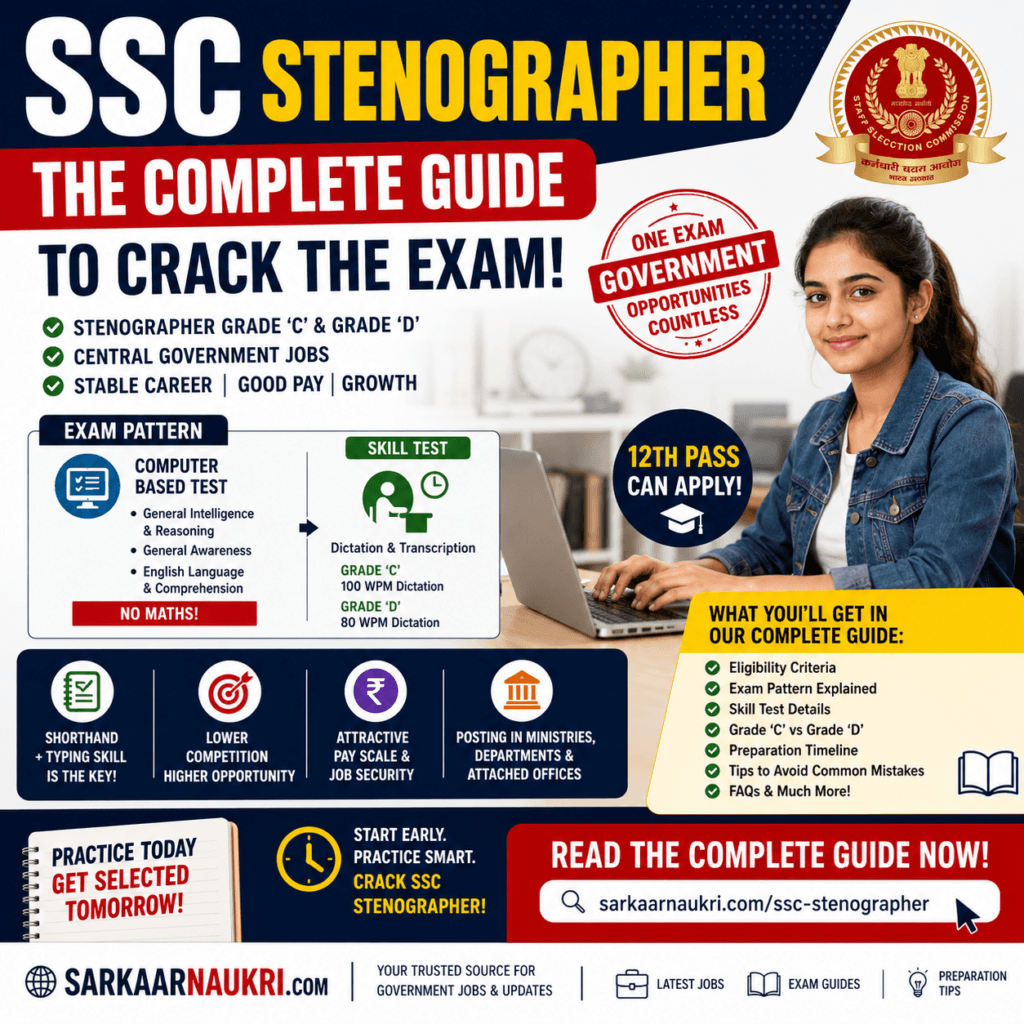
- Computer-Based Test (CBT): Objective-type questions covering general intelligence and reasoning, general awareness, and English language and comprehension. There’s no quantitative aptitude section, which sets this apart from most other SSC recruitment exams.
- Skill Test (Stenography): Candidates who clear the CBT take dictation at a prescribed speed — typically 100 words per minute for Grade ‘C’ and 80 words per minute for Grade ‘D’ — and then transcribe it within a fixed time limit.
Negative marking of 0.50 marks applies for each wrong answer in the CBT stage of SSC Stenographer, so accuracy matters more than attempting every question.
The Skill Test: What Actually Decides Selection
The skill test is where most SSC Stenographer candidates either qualify comfortably or fall short because it tests a physical skill that can’t be crammed in the final weeks:
- Dictation is given at the prescribed speed for a set duration, usually 10 minutes.
- Candidates then get a fixed transcription window—longer for Grade ‘D’ than Grade ‘C’—to convert their shorthand notes into typed text.
- Errors beyond a permitted threshold, including spelling and punctuation mistakes, can disqualify an otherwise well-attempted transcript.
Because the skill test carries this much weight, serious SSC Stenographer aspirants typically start shorthand practice months before the CBT, not after.
Grade ‘C’ vs Grade ‘D’: Key Differences
- Pay Scale: Grade ‘C’ posts carry a higher pay level than Grade ‘D’ posts, reflecting the higher dictation speed requirement.
- Dictation Speed: Grade ‘C’ requires 100 words per minute; Grade ‘D’ requires 80 words per minute.
- Posting Departments: Grade ‘C’ stenographers are typically posted with senior officers, while Grade ‘D’ posts are more evenly spread across departments.
- Competition Level: Grade ‘D’ generally sees a higher number of applicants relative to vacancies, since the entry speed bar is lower.
Common Mistakes and Misconceptions
- Underestimating the skill test: Many candidates clear the CBT comfortably but fail the skill test because they treated shorthand practice as an afterthought.
- Practicing speed without accuracy: Building raw dictation speed without controlling transcription errors is a common trap — examiners penalize mistakes heavily, not just missed words.
- Assuming Grade ‘D’ is “easier”: Lower dictation speed doesn’t mean lower competition; vacancy-to-applicant ratios often make Grade ‘D’ just as competitive.
- Ignoring the English comprehension section: Since there’s no quant section, candidates sometimes under-prepare English, which actually carries proportionally more weight in the CBT.
Practical Tips for Candidates
- Start shorthand practice at least four to five months before your target SSC Stenographer CBT date — speed builds gradually, not overnight.
- Practice transcription on a keyboard layout identical to what you’ll use in the actual test to avoid last-minute adjustment issues.
- Time your dictation practice sessions strictly, since real exam conditions won’t allow extra minutes.
- Focus equally on general awareness and English, since the absence of a quant section shifts more weight onto these two areas.
- Review previous years’ cut-off speeds and error tolerances for both Grade ‘C’ and Grade ‘D’ before deciding which one to target.
- Simulate full skill-test conditions periodically, including the exact transcription time limit, rather than practicing dictation and typing separately.
A Realistic Preparation Timeline
Most successful SSC Stenographer candidates don’t treat this as a short-cycle exam, and pacing preparation properly makes a real difference.
- Months 1–2: Build shorthand fundamentals from scratch if you’re a beginner, alongside daily CBT-level practice for general awareness and English.
- Months 3–4: Push dictation speed toward the target for your chosen grade while keeping transcription accuracy under close review, since SSC stenographer selection hinges on both together.
- Month 5 (closer to the exam): Shift to full mock CBTs and complete skill-test simulations, timing every stage exactly as the real SSC Stenographer exam would.
Candidates who compress this timeline into a few weeks before the exam tend to clear the CBT but struggle at the skill test stage, since dictation speed and transcription accuracy both need sustained repetition to become reliable under pressure.
Frequently Asked Questions
1. What is the typing speed required to become an SSC Stenographer? Grade ‘C’ requires 100 words per minute in dictation, while Grade ‘D’ requires 80 words per minute, both followed by a timed transcription stage.
2. Is there a quantitative aptitude section in the SSC Stenographer exam? No, the CBT covers only general intelligence and reasoning, general awareness, and English language, with no quant section.
3. Can a 12th-pass candidate apply for SSC Stenographer without prior shorthand training? Yes, there’s no shorthand certificate requirement at the application stage; candidates typically build the skill before the dictation test.
4. What’s the difference between SSC Stenographer Grade ‘C’ and Grade ‘D’? Grade ‘C’ requires a higher dictation speed and offers a better pay scale, while Grade ‘D’ has a lower entry speed but comparable competition.
5. How many attempts are given for the skill test? Generally, candidates get one attempt at the dictation and transcription stage per exam cycle; there’s no built-in retry within the same cycle.
6. What happens if I clear the CBT but fail the skill test? Candidates who fail the skill test aren’t selected for that cycle, since both stages are qualifying and skill-test performance directly determines the final result.
7. Is negative marking applicable in the SSC Stenographer CBT? Yes, 0.50 marks are deducted for every incorrect answer in the computer-based test stage.
8. Which departments recruit through SSC Stenographer? Selected candidates are posted across various central government ministries, attached offices, and subordinate offices that require stenographic support, with actual postings decided after the final result.
Conclusion
SSC Stenographer rewards a very specific combination of typed accuracy and shorthand speed, which is exactly why it sees comparatively less crowding than exams like SSC CGL despite offering solid central government posts. Success here depends less on last-minute cramming and more on months of consistent dictation and transcription practice, paired with steady preparation on the General Awareness and English sections. Choosing between Grade ‘C’ and Grade ‘D’ early also helps, since it lets you calibrate your dictation-speed target from day one instead of switching goals midway through preparation. If you’re considering this route, start your shorthand practice early and treat the skill test as the real deciding factor it is. For related preparation, see our guides on [SSC CHSL Eligibility and Exam Pattern] and [Age Relaxation Rules for Government Jobs].
