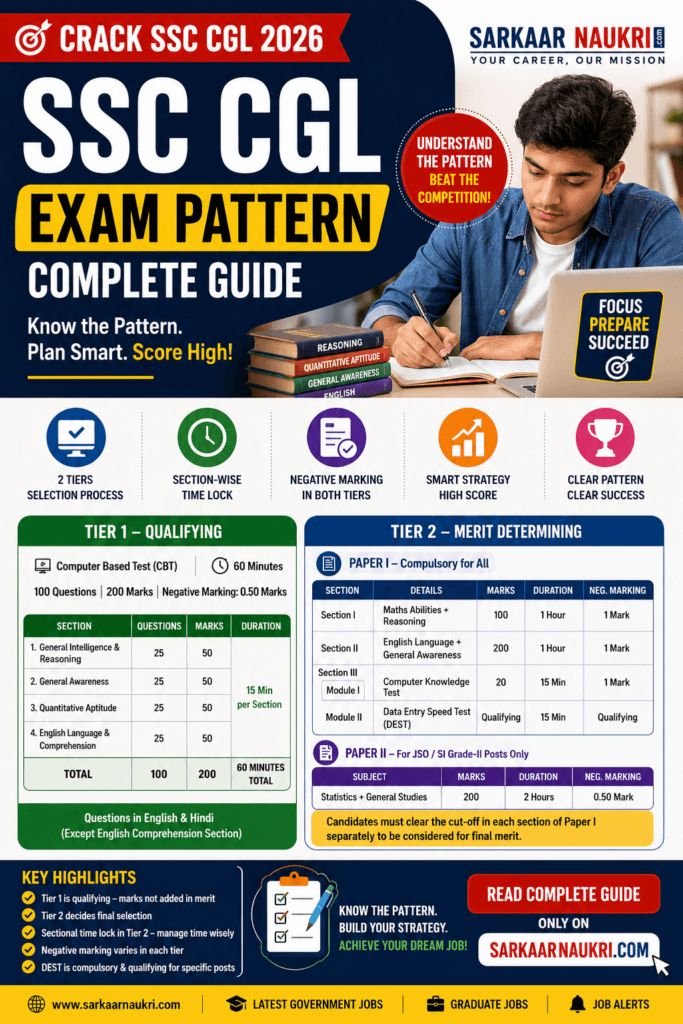
Most SSC CGL aspirants start their preparation by picking up a syllabus PDF without ever sitting down to properly study the SSC CGL exam pattern first—and that single gap costs them marks they never needed to lose. Knowing your syllabus tells you what to study, but the SSC CGL exam pattern tells you how the exam will actually test you: how many questions, how much time per section, and exactly what a wrong guess costs you. This guide walks through the complete structure of both tiers, the marking scheme, the timing rules that trip up even well-prepared candidates, and practical ways to use this pattern to build a smarter attempt strategy.
Why Understanding the SSC CGL Exam Pattern Matters
A large number of candidates who know the syllabus inside out still underperform simply because they misjudge how sections are weighted or how negative marking eats into their score. The SSC CGL exam pattern isn’t just administrative detail—it directly shapes your attempt strategy, your time allocation, and even which subjects deserve the most practice hours. Two candidates with identical subject knowledge can post very different scores purely because one understood the pattern’s timing and marking rules better than the other. Before you build a study plan, you need to know exactly what the exam will demand of you on the day itself.
SSC CGL Exam Pattern for Tier 1: Structure, Marks and Timing
The SSC CGL Exam Pattern for Tier 1 is a computer-based objective test consisting of 100 multiple-choice questions worth 200 marks in total. The paper is divided into four sections — General Intelligence & Reasoning, General Awareness, Quantitative Aptitude, and English Language & Comprehension — with 25 questions and 50 marks allotted to each section. The overall exam duration is 60 minutes, but SSC has introduced sectional time locks of 15 minutes per section, meaning you cannot spend extra time on one section by borrowing minutes from another. Questions are set in both English and Hindi, except for the English comprehension section. Tier 1 is qualifying in nature, so the marks you score here are not carried forward to the final merit list, but you must clear the qualifying cutoff to move on to Tier 2.
SSC CGL Exam Pattern for Tier 2: Paper I and Paper II Explained
This is where the SSC CGL Exam Pattern becomes more layered, and where most confusion sets in. Tier 2 consists of two papers. Paper I is compulsory for every candidate regardless of the post applied for and is split into three sections: Section I covers Mathematical Abilities and Reasoning & General Intelligence; Section II covers English Language & Comprehension and General Awareness, and Section III is split into two modules—Module I is a Computer Knowledge Test, and Module II is the Data Entry Speed Test (DEST). Paper II applies only to candidates who have applied for Junior Statistical Officer (JSO) or Statistical Investigator Grade-II posts and tests statistics and general studies relevant to those roles. Candidates must clear each section of Paper I individually, so a strong overall score cannot compensate for a weak performance in any single section.
Negative Marking in the SSC CGL Exam Pattern
Negative marking is one of the most misunderstood parts of the SSC CGL exam pattern, and getting it wrong can cost you far more than a few marks. In Tier 1, every wrong answer deducts 0.50 marks, and unattempted questions carry no penalty. In Tier 2 Paper I, the penalty is steeper—Section I, Section II, and Module I of Section III each carry a deduction of 1 full mark per wrong answer, while Paper II carries a lighter deduction of 0.50 marks per wrong answer. This means the guessing strategy that works reasonably well in Tier 1 can actively damage your score in Tier 2 if you carry it over without adjusting. Always recalibrate your attempt strategy between tiers rather than assuming the same approach applies throughout.
Section-Wise Time Locks: A Recent Change in the SSC CGL Exam Pattern
One update that many aspirants studying from older material still haven’t fully registered is the section-wise time lock. Under the current SSC CGL Exam Pattern, Tier 2 Paper I’s Section I and Section II each come with a fixed one-hour window, and any unused time in one section cannot be carried over to the next. This is a meaningful departure from older exam formats where candidates could freely move between sections and manage time as they pleased. If your mock test practice doesn’t simulate this section-locked format, you’re likely to be caught off guard on exam day, so make sure your practice tests replicate this structure exactly.
Common Mistakes and Misconceptions About the SSC CGL Exam Pattern
Several avoidable errors show up repeatedly among SSC CGL aspirants:
- Assuming Tier 1 marks matter for merit: They don’t. Tier 1 is purely qualifying, and only Tier 2 marks decide your final rank.
- Treating the DEST as optional: The Data Entry Speed Test is qualifying in nature but mandatory to attempt for all candidates, and specific posts like Tax Assistant require you to clear it to be considered.
- Ignoring sectional cutoffs in Tier 2: Scoring well overall while failing to clear one section’s individual cutoff can disqualify you from the merit list entirely.
- Applying the same guessing strategy across tiers: As covered above, the heavier penalty in Tier 2 Paper I makes indiscriminate guessing far riskier than in Tier 1.
- Skipping official notification updates: SSC periodically revises components of the pattern, so relying on outdated blog posts instead of the current official notification can leave you unprepared for structural changes.
Practical Tips to Prepare Using the SSC CGL Exam Pattern
Once you understand this structure in full, you can build your preparation around it rather than around generic advice:
- Practice full-length mock tests with the exact sectional time locks enforced, not just an overall timer.
- Track your accuracy percentage separately for each section, since a single weak section can pull down an otherwise strong Tier 2 attempt.
- Build a subject-wise priority list based on which sections carry the heaviest negative marking, so you attempt those more cautiously.
- Simulate the DEST separately if you’re targeting a post that requires it, since typing speed under time pressure needs dedicated practice.
- Re-check the official SSC notification each cycle for any changes to paper structure, since minor revisions do occur between exam years.
Frequently Asked Questions
1. How many tiers are there in the SSC CGL Exam Pattern? There are two tiers — Tier 1, which is qualifying, and Tier 2, which decides the final merit list. Some posts also require a qualifying Data Entry Speed Test.
2. Is Tier 1 negative marking the same as Tier 2? No. Tier 1 deducts 0.50 marks per wrong answer, while Tier 2 Paper I deducts 1 mark in most sections and 0.50 marks in Paper II.
3. Do Tier 1 marks count toward the final SSC CGL merit list? No, Tier 1 is qualifying only. Final selection is based entirely on Tier 2 performance.
4. What is the Data Entry Speed Test (DEST) in SSC CGL? The DEST checks typing speed and accuracy on a computer, requiring candidates to type a given passage within a fixed time limit. It’s compulsory to attempt and mandatory to clear for specific posts like Tax Assistant.
5. Can I move between sections freely during Tier 2 Paper I? No. Section I and Section II each have a fixed, separately timed window, and unused time cannot be transferred between sections.
6. Who needs to attempt Paper II in Tier 2? Only candidates applying for Junior Statistical Officer or Statistical Investigator Grade-II posts need to attempt Paper II.
7. Does clearing the overall Tier 2 cutoff guarantee selection? Not necessarily. Candidates must also clear the individual cutoff for each section within Paper I, regardless of their overall score.
8. How often does the SSC CGL exam pattern change? SSC does not overhaul the pattern every year, but it has made structural revisions in recent cycles, including sectional time locks and changes to Tier 2’s paper structure. Always verify the current SSC CGL exam pattern against the official notification for your exam year rather than relying solely on last year’s format.
Conclusion
The SSC CGL exam pattern is the foundation on which every effective preparation strategy is built—it determines your time management, your section-wise focus, and how cautiously you should attempt each part of the paper. Rather than treating it as background information, use it actively to structure your mock tests and revision plan. For deeper preparation support, check our Latest Government Jobs section for current SSC notifications and our Graduate Jobs section for other degree-eligible openings you may want to apply for alongside SSC CGL.
