Most SSC CHSL aspirants start their preparation by hunting for question banks and mock tests without first sitting down with the actual syllabus—and that’s usually where months of effort get wasted on the wrong sections. The SSC CHSL syllabus covers four core subjects across two tiers, plus a mandatory skill or typing test that trips up more candidates than the written papers combined. If you’re preparing for Lower Division Clerk, Junior Secretariat Assistant, Data Entry Operator, or Postal/Sorting Assistant posts, this guide walks through the entire SSC CHSL syllabus section by section, along with the exam pattern, common preparation mistakes, and a practical study plan you can actually follow.
Why the SSC CHSL Syllabus Matters More Than You Think
The SSC CHSL exam is one of the most heavily attempted government recruitment exams in the country, and the gap between candidates who clear it and those who don’t usually comes down to syllabus discipline, not raw intelligence. The SSC CHSL syllabus is deliberately broad across four subjects, which means candidates who study randomly end up spreading themselves thin across topics that carry very different weightage. Understanding the exact structure of the SSC CHSL syllabus before you start preparing lets you prioritize scoring sections, spot which topics repeat most often, and avoid the common trap of over-preparing General Awareness while under-preparing Quantitative Aptitude, which typically has fewer topics but higher marks per topic mastered.
SSC CHSL Exam Pattern Overview
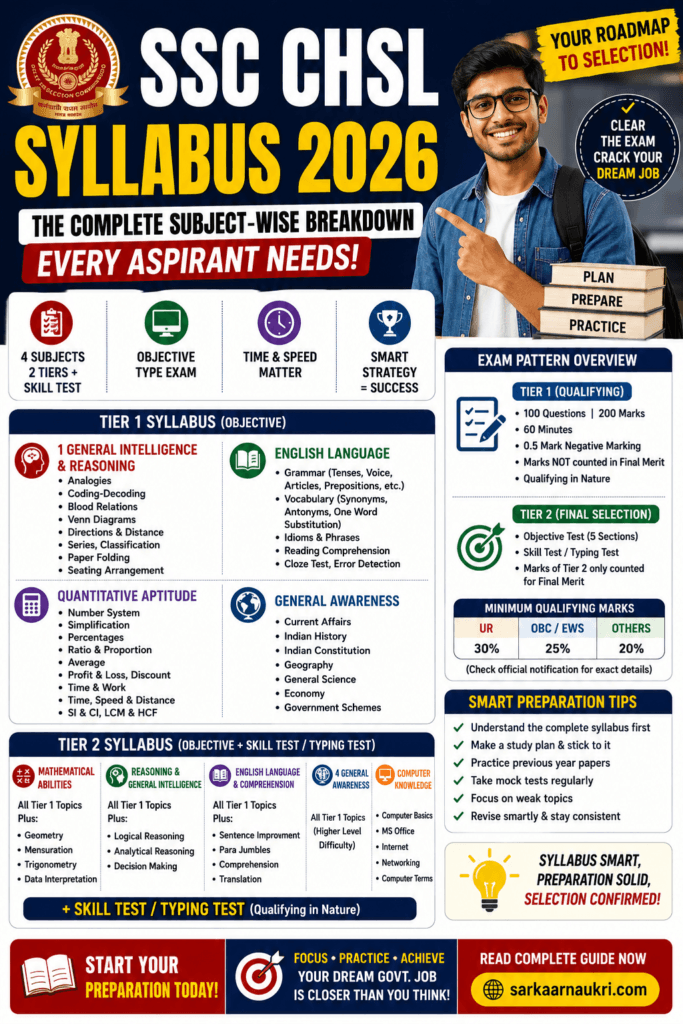
The SSC CHSL exam is conducted in two tiers, and understanding how they connect is the first step to using the SSC CHSL syllabus effectively. Every serious aspirant should map the SSC CHSL syllabus against this tier structure before opening a single question bank:
- Tier 1 is a qualifying computer-based test with 100 questions worth 200 marks, to be completed in 60 minutes. Each question carries 2 marks, with a penalty of 0.5 marks for every wrong answer. Tier 1 marks are not counted toward the final merit list—they only decide who advances to Tier 2.
- Tier 2 is the stage that actually determines your final selection. It includes an objective test covering mathematical abilities, reasoning and general intelligence, English language and comprehension, general awareness, and computer knowledge, along with a mandatory skill test or typing test depending on the post applied for.
Minimum qualifying marks apply at both stages — typically 30% for UR candidates, 25% for OBC/EWS, and 20% for all other reserved categories, though candidates should always verify the exact percentages against the current official notification.
SSC CHSL Tier 1 Syllabus: Subject-Wise Breakdown
The Tier 1 stage of the SSC CHSL Syllabus is split into four equal sections of 50 marks each:
General Intelligence & Reasoning—This section tests both verbal and non-verbal reasoning ability, including classification, analogy, coding-decoding, paper folding, matrix-based questions, word formation, Venn diagrams, direction and distance problems, blood relations, series completion, and seating arrangement puzzles. Candidates who practice pattern recognition daily tend to find this the fastest-scoring section in the entire SSC CHSL syllabus.
English Language — Covers grammar fundamentals such as parts of speech, tenses, active-passive voice conversion, direct-indirect speech, articles, prepositions, subject-verb agreement, and error detection, alongside vocabulary-based questions like synonyms, antonyms, one-word substitution, idioms, phrases, and spelling correction. Reading comprehension and cloze tests round out this section.
Quantitative Aptitude — Includes number systems, simplification, LCM and HCF, percentages, ratio and proportion, averages, profit and loss, discount, simple and compound interest, time and work, and time-speed-distance problems. This is the section within the SSC CHSL Syllabus most candidates find time-consuming, since it demands calculation speed alongside conceptual clarity.
General Awareness — Covers current affairs along with static general knowledge topics like Indian history, the Constitution, geography, science, and government schemes. Because this section has the widest possible topic pool, candidates preparing the SSC CHSL Syllabus often find it the hardest to fully cover, even though individual questions are usually straightforward.
SSC CHSL Tier 2 Syllabus: What Changes at This Stage
Tier 2 of the SSC CHSL Syllabus covers largely the same subjects as Tier 1, but at a noticeably higher difficulty level, with one additional module:
- Mathematical Abilities—Builds on Tier 1’s Quantitative Aptitude topics with more advanced problem-solving, including geometry, mensuration, trigonometry, and data interpretation in addition to the arithmetic topics already covered.
- Reasoning & General Intelligence — Extends the Tier 1 reasoning syllabus with additional emphasis on logical and analytical reasoning, along with questions designed to test decision-making ability.
- English Language & Comprehension — Goes deeper into sentence formation, translation, and comprehension passages compared to the Tier 1 English section.
- General Awareness — Same broad subject area as Tier 1, but questions are typically framed at a slightly higher difficulty.
- Computer Knowledge — A module unique to Tier 2, covering basic computer hardware and software concepts, MS Office fundamentals, internet and networking basics, and general computer terminology relevant to a clerical or data-entry role.
Since the SSC CHSL Syllabus for Tier 2 builds directly on Tier 1 rather than introducing entirely new subjects, candidates who build a strong foundation at the first stage generally find Tier 2 preparation far more manageable.
Skill Test and Typing Test Requirements
This is the part of the SSC CHSL syllabus that catches the most candidates off guard, because it’s easy to focus entirely on the written papers and forget that the skill or typing test is mandatory and qualifying in nature—failing it eliminates you regardless of your written score.
- Data Entry Operator posts require a Data Entry Speed Test, typically ranging from 8,000 to 15,000 key depressions per hour depending on the specific department.
- LDC/JSA and Postal/Sorting Assistant posts require a typing test, with candidates able to choose between English at 35 words per minute or Hindi at 30 words per minute.
Because the written syllabus is identical across all these posts, the real differentiator often comes down to typing speed — so candidates should start practicing on a physical keyboard well before the exam rather than treating this as an afterthought once the written stage is cleared.
Common Mistakes and Misconceptions
- Treating Tier 1 marks as final — Many candidates don’t realize Tier 1 is purely qualifying; obsessing over a high Tier 1 score at the cost of Tier 2 preparation is a wasted effort.
- Ignoring the typing test until the last month — Typing speed builds gradually over weeks, not days, and candidates who leave it too late often clear the written stages only to fail the qualifying skill test.
- Studying General Awareness without a system—Because this section of the SSC CHSL syllabus has no fixed boundary, random reading without a structured current-affairs and static-GK routine leads to poor retention.
- Assuming the syllabus is different for each post—The written exam topics are the same for all CHSL posts, whether you’re applying for LDC, JSA, or DEO; only the skill test requirement differs by post.
Practical Tips for Covering the SSC CHSL Syllabus
These tips work best when applied consistently against the actual SSC CHSL syllabus structure rather than a generic study routine:
- Get the official syllabus, previous year papers, and mock tests together before you start so you’re studying against the actual structure rather than a secondhand summary.
- Use the SSC exam calendar to calculate how much time you realistically have, and divide your study hours across sections based on your personal strengths and weaknesses rather than an even split.
- Give quantitative aptitude and English extra weight, since they carry substantial marks in Tier 2 and directly influence your final merit position.
- Take mock tests regularly and spend real time reviewing mistakes afterward — identifying why an answer went wrong matters more than the number of tests attempted.
- Practice typing daily on a physical keyboard from the start of your preparation, not just in the final weeks before Tier 2.
- Revise current affairs in short daily sessions rather than long infrequent ones, since retention for general awareness works best with repetition over time.
Frequently Asked Questions
1. Are Tier 1 marks counted in the SSC CHSL final merit list? No. Tier 1 marks are used only to qualify for Tier 2. Final selection is based on Tier 2 performance and clearing the qualifying skill test.
2. Is the SSC CHSL Syllabus the same for LDC, JSA, and DEO posts? Yes, the written exam syllabus is identical across posts. The difference lies in the skill test — DEO posts require a data entry speed test, while LDC/JSA posts require a typing test.
3. How much negative marking applies in the SSC CHSL exam? Tier 1 deducts 0.5 marks for each wrong answer. Tier 2 negative marking is specified in the official notification for the relevant cycle, and candidates should always confirm the current figure before the exam.
4. What typing speed is required for SSC CHSL posts? Candidates opting for the typing test can choose English at 35 words per minute or Hindi at 30 words per minute, while DEO posts require a data entry speed of roughly 8,000 to 15,000 key depressions per hour depending on the department.
5. How many subjects are covered in the SSC CHSL Syllabus overall? Tier 1 covers four subjects: General Intelligence & Reasoning, English Language, Quantitative Aptitude, and General Awareness. Tier 2 covers the same four areas at a higher difficulty level, plus an additional Computer Knowledge module.
6. Can candidates clear SSC CHSL using only free resources? Yes. Many candidates succeed using the official syllabus document alongside free previous year papers and mock tests, provided their preparation is structured and consistent.
Conclusion
The SSC CHSL Syllabus may look wide at first glance, but it becomes manageable once you break it into its four core subjects across two tiers and treat the typing or skill test as a parallel priority rather than an afterthought. Candidates who study the syllabus structure before diving into question banks tend to prepare far more efficiently than those who don’t. For more exam-specific breakdowns, check our Latest Government Jobs section, or explore our Graduate Jobs category for other 12th-pass and graduate-level recruitment opportunities.
