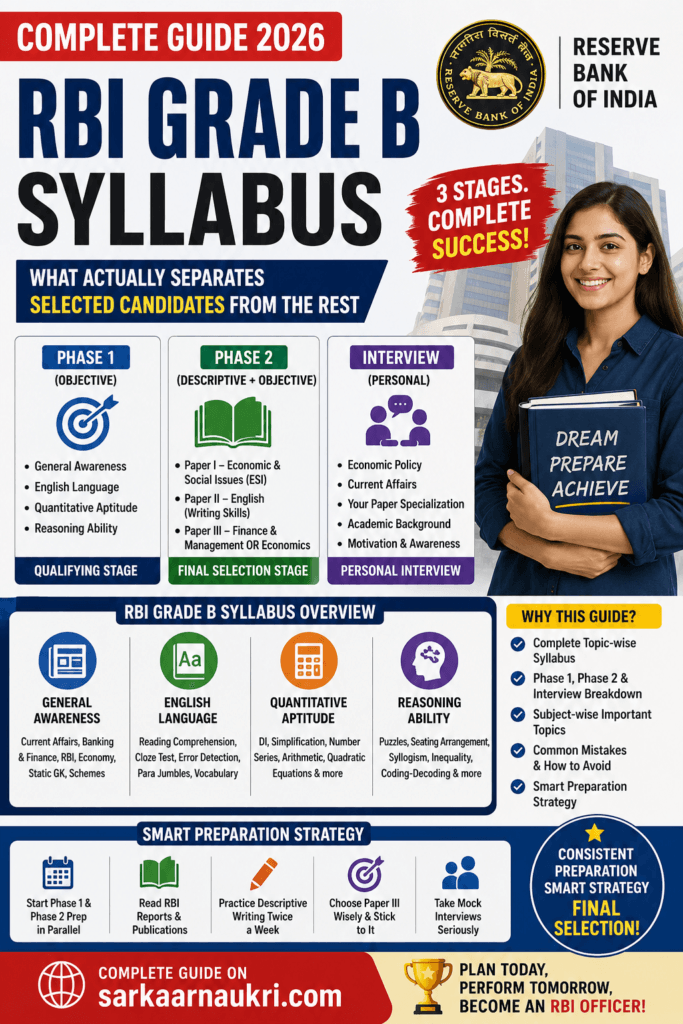
Introduction – RBI Grade B Syllabus
Ask ten RBI Grade B aspirants what the toughest part of the exam is, and most will point to the same thing—not the difficulty of any single topic, but the sheer spread of the RBI Grade B syllabus across three very different stages. Phase 1 tests speed and accuracy, Phase 2 tests depth in economics, finance, and English writing, and the interview tests how well you can defend your own opinions on policy. Candidates who treat this as one syllabus to “cover” instead of three distinct syllabi to master usually end up under-prepared for at least one stage.
This guide breaks the RBI Grade B Syllabus down stage by stage—what’s tested, how it’s weighted, where candidates typically go wrong, and how to build a preparation plan that doesn’t leave any phase as an afterthought.
Why the RBI Grade B Syllabus Deserves a Different Approach
Unlike most banking exams, RBI Grade B isn’t purely objective-type from start to finish. The RBI Grade B Syllabus includes descriptive writing, essay-based economics and social issues papers, and a personal interview—which means rote practice alone won’t get you through. It rewards candidates who can read, understand, and articulate economic and financial concepts, not just recall formulas or solve puzzles quickly. That shift in approach needs to happen early in preparation, not after Phase 1 results are out.
Phase 1 Syllabus: Section-Wise Breakdown
Phase 1 is objective and qualifying, with four sections under a composite time limit approach (each section has its own sub-timer):
General Awareness—Current affairs (especially banking, finance, and economy-related news from the last 6–8 months), static GK, banking terms, financial institutions, government schemes, and RBI-specific knowledge including its structure, functions, and recent policy actions.
English Language—Reading comprehension, cloze test, error detection, para jumbles, and vocabulary usage are broadly similar to other banking exams but often with denser, economy-themed passages.
Quantitative Aptitude — Data interpretation, simplification, number series, quadratic equations, and arithmetic word problems (average, ratio, percentage, profit and loss, time and work).
Reasoning—Puzzles, seating arrangement, syllogism, inequality, coding-decoding, and blood relations.
General Awareness typically carries outsized importance in the RBI Grade B Syllabus at this stage, since it also lays the foundation for Phase 2’s Paper II.
Phase 2 Syllabus: Section-Wise Breakdown
This is where the exam becomes genuinely distinct from other government job exams.
Paper I — Economic and Social Issues (ESI) — Growth and development concepts, Indian economy (structure, planning, sectors), social structure in India, globalization, and economic reforms since 1991. This paper leans heavily on conceptual clarity rather than memorized facts.
Paper II—English (Writing Skills)—Essay writing, precis writing, and comprehension are all descriptive. This paper tests structured argumentation and clarity of expression, not vocabulary alone.
Paper III—Finance and Management, or Economics (candidate’s choice)—Finance and Management covers financial markets, risk management, corporate governance, and management theory; the Economics option covers microeconomics, macroeconomics, and international economics in more analytical depth. Choosing between the two early—and sticking with dedicated preparation for one—matters more than trying to cover both.
Interview Stage: What Actually Gets Tested
The interview isn’t part of the written RBI Grade B Syllabus in the traditional sense, but it draws directly from Phase 2 content—expect questions on current economic policy, your Paper III specialization, and general banking awareness, along with questions about your academic background and motivation for joining RBI. Panels tend to probe how well you can explain your Paper II and Paper III answers if asked to elaborate, so genuine understanding during Phase 2 preparation pays off again here.
SC/ST, OBC, PwD, and Ex-Servicemen Relaxation in Eligibility
Eligibility relaxations affect who can attempt the exam and how many attempts they get, not the syllabus content itself. SC/ST candidates receive higher age relaxation and additional attempts, OBC (non-creamy layer) candidates get moderate relaxation; PwD candidates get relaxation on top of their category-based benefit, and Ex-servicemen get relaxation based on years of service. Every candidate, regardless of category, prepares the same RBI Grade B Syllabus across all three phases.
Common Mistakes and Misconceptions – RBI Grade B Syllabus
Starting Phase 2 preparation only after Phase 1 results. Given how conceptually heavy Paper I and Paper III are, candidates who wait until after Phase 1 often run out of time before Phase 2.
Choosing Paper III based on “which is scoring” rather than background. Candidates from a finance or commerce background often do better sticking with finance and management, while those from economics or a strong analytical background may find the economics option more natural—chasing whichever option “seems easier” without matching it to your strengths tends to backfire.
Treating Paper II as a vocabulary test. Descriptive writing is scored on structure, argument, and clarity — not on how advanced the vocabulary is.
Ignoring RBI-specific current affairs. General current affairs isn’t enough; RBI’s own recent policy decisions, reports, and organizational updates are frequently tested and often missed by candidates preparing generically.
Skipping mock interviews. Many candidates clear the written stages but underperform at interviews simply because they never practiced articulating their views out loud.
Practical Preparation Tips – RBI Grade B Syllabus
Build your Phase 1 and Phase 2 preparation in parallel rather than sequentially, since the RBI Grade B Syllabus for ESI and general awareness overlaps significantly—strong current affairs habits early on serve both stages. Read RBI’s own publications and reports regularly rather than relying only on third-party current affairs digests, since interview panels often reference them directly. Practice descriptive writing under timed conditions at least twice a week well before Phase 2 approaches, since writing speed and structure both take time to develop. Pick your Paper III specialization early and stay with it instead of switching close to the exam. Finally, treat the interview as a natural extension of Phase 2 preparation rather than a separate last-minute exercise—revisiting your own Paper I and Paper III answers is one of the most effective ways to prepare for it.
Frequently Asked Questions
Is the RBI Grade B Syllabus the same for General and DEPR/DSIM cadres? No, the General cadre follows the standard three-phase pattern described here, while DEPR and DSIM have separate, more specialized syllabi focused on economics and statistics respectively.
How is Phase 2 different from Phase 1 in terms of question type? Phase 1 is entirely objective, while Phase 2 combines objective questions (in ESI and Finance/Economics) with fully descriptive papers (English Writing Skills).
Which Paper III option is easier, Finance and Management or Economics? Neither is inherently easier—the better choice depends on your academic background, since Finance and Management suits commerce/finance graduates while Economics suits those with an economics or strong quantitative background.
Do Phase 1 marks count toward the final RBI Grade B merit list? No, Phase 1 is qualifying only; final selection is based on Phase 2 and interview performance combined.
How important is current affairs in the RBI Grade B Syllabus? Very important—it feeds into General Awareness in Phase 1, economic and Social Issues in Phase 2, and interview questions, making it one of the highest-leverage areas to prepare consistently.
Is there negative marking in RBI Grade B Phase 1 and Phase 2? Yes, objective sections in both phases carry negative marking for incorrect answers, while descriptive papers are evaluated on content and structure rather than penalized per question.
Conclusion
The RBI Grade B Syllabus isn’t difficult because any one topic is obscure—it’s difficult because it demands three different skill sets across three stages, and most preparation strategies only account for one. Candidates who start Phase 2-style reading and writing practice early, rather than after Phase 1 results, consistently perform better across the board. For a closer look at eligibility relaxations by category, check our [RBI Grade B Age Relaxation Rules] guide, and for a stage-by-stage walkthrough of the application process, see our [RBI Grade B Application Guide].
