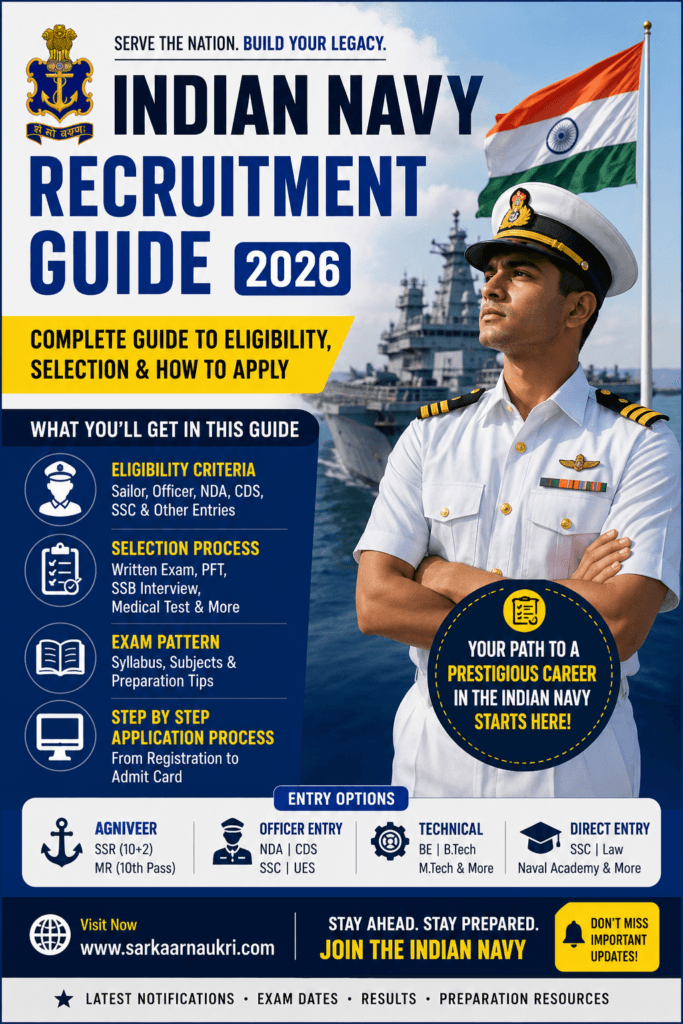
Every year, lakhs of aspirants search for a reliable Indian Navy Recruitment Guide because the entry system covers dozens of different paths, from sailor entries after Class 10 to officer entries through NDA, CDS, and direct short service commissions. This Indian Navy Recruitment Guide is built to clear that confusion in one place, walking you through eligibility, selection stages, exam pattern, and application steps so you know exactly where you stand and what to do next. Whether you are a fresh Class 12 pass out or a graduate exploring a technical branch, this guide answers the questions candidates ask most often about joining the Navy.
Why This Matters
This Indian Navy Recruitment Guide exists because the Indian Navy is one of the most sought-after government employers in the country, offering job security, a defined pay structure, medical benefits, and a clear promotion ladder. But unlike many civilian government jobs, Navy entries are split across multiple categories, sailor entries, officer entries, technical branches, and non-technical branches, each with its own eligibility rules and exam pattern. Reading a single notification without understanding the bigger picture often leads candidates to apply for the wrong entry or miss a deadline. A structured Indian Navy Recruitment Guide helps you map your own qualification, age, and interest to the entry that actually fits, instead of applying at random and hoping for the best.
Indian Navy Recruitment Guide: Eligibility Criteria Explained
Eligibility is the starting point of any Indian Navy recruitment guide, and it depends on the specific scheme, but most entries fall into a few broad categories.
Sailor entries (Agniveer): Candidates who have passed Class 10 or Class 12 from a recognized board, generally aged between 17 and 21 years, are eligible for Agniveer entries in the Senior Secondary Recruits (SSR) and Matric Recruits (MR) categories. Specific subject combinations in Class 12, particularly Physics, Chemistry, and Mathematics, are required for the SSR technical stream.
Officer entries through NDA: Unmarried male and female candidates who have cleared or are appearing in Class 12 with physics and mathematics can apply through the National Defence Academy exam, generally between the ages of 16.5 and 19.5 years at the time of joining.
Officer entries through CDS: Graduates in relevant streams, typically engineering graduates for technical branches, can apply through the Combined Defence Services exam conducted twice a year.
Direct entries: Categories such as Short Service Commission, University Entry Scheme, and Naval Academy entries have their own qualifications and age criteria, usually tied to a specific degree stream such as engineering, naval architecture, or law. This Indian Navy Recruitment Guide recommends confirming your exact stream against the current notification before you plan your preparation.
Because age and qualification rules change with each notification cycle, always cross-check the latest official notification alongside this Indian Navy Recruitment Guide before applying.
Selection Process
As this Indian Navy Recruitment Guide explains, the Navy selection process is broadly the same across entries, though the exact stages differ by category.
Written exam or online exam: Most sailor entries begin with a computer-based written exam covering general knowledge, science, mathematics, and reasoning. Officer entries through NDA or CDS require clearing a separate national level written exam before the interview stage.
Physical fitness test: Candidates who clear the written stage undergo a physical fitness test involving a 1.6 kilometer run, push-ups, sit-ups, and squats with defined time and repetition benchmarks.
Services Selection Board (SSB) interview: For officer entries, the SSB interview spans several days and includes psychological tests, group tasks, and a personal interview to assess leadership and personality traits.
Medical examination: A detailed medical test checks vision, hearing, height, weight, and overall fitness against Navy standards. This stage disqualifies more candidates than people expect, so understanding the medical benchmarks early is a key part of using this Indian Navy Recruitment Guide effectively.
Final merit list: Candidates who clear every stage are ranked on a combined merit list based on written marks, fitness scores, and interview performance, and offers are issued accordingly.
How to Apply: Step by Step
This section of the Indian Navy Recruitment Guide breaks the application into simple steps.
- Visit the official Indian Navy recruitment website or Join Indian Navy portal and register with a valid email ID and mobile number.
- Read the specific notification for your entry carefully to confirm eligibility, age limit, and qualification requirements.
- Fill in personal, educational, and category details accurately in the online application form.
- Upload scanned copies of your photograph, signature, and required certificates in the specified format and size.
- Pay the application fee, if applicable, through the available online payment methods.
- Download and save a copy of the submitted application and the fee receipt for future reference.
- Track your application status and admit card release through the official website or registered email.
- Prepare for the written exam using the syllabus published in the notification, then proceed through fitness, SSB, and medical stages as scheduled.
Following these steps carefully is the practical core of any Indian Navy recruitment guide, since a single error at the application stage can lead to outright rejection later.
Exam Pattern Overview
Sailor entry written exams typically cover science, mathematics, general knowledge, and reasoning, with objective-type questions and negative marking for wrong answers. Officer entries through NDA include separate papers for mathematics and general ability, while CDS includes English, general knowledge, and elementary mathematics for the relevant branches. Exact weightage and duration vary by notification, so candidates should always download the latest syllabus PDF rather than relying on old exam patterns, since even a reliable Indian Navy Recruitment Guide cannot substitute for the current official document.
Common Mistakes and Misconceptions
Candidates who skip this part of the Indian Navy Recruitment Guide tend to repeat the same avoidable errors.
Assuming one notification covers all entries: Many candidates think a single Indian Navy Recruitment Guide notification applies to every branch, when, in fact, sailor and officer entries are released separately with different timelines.
Ignoring category-specific age relaxation: SC, ST, OBC, and other reserved categories get defined age relaxation, but candidates often either forget to claim it or apply the wrong relaxation figure.
Underestimating the physical fitness test: Candidates who focus only on written preparation and skip regular running practice frequently fail the fitness stage despite scoring well on the exam.
Submitting incorrect documents: Mismatched names, unclear photographs, or wrong certificate formats are a common reason for application rejection at the scrutiny stage.
Missing the correction window: Most application portals open a short correction window after submission, and candidates who skip checking it lose the chance to fix genuine errors.
Practical Tips for Candidates
Start physical fitness preparation at least three months before applying, since running timing is one of the most common reasons candidates get eliminated. Keep scanned documents, photographs, and signatures ready in advance so the application process does not get delayed at the last moment. Revise Class 10 and Class 12 level science and mathematics thoroughly for sailor entries, since the written exam rarely goes beyond school-level concepts. For officer entries, practice previous year NDA or CDS papers under timed conditions to build speed and accuracy. Finally, treat every stage of this Indian Navy Recruitment Guide as equally important, since clearing the written exam alone does not guarantee selection.
Frequently Asked Questions
What is the age limit for Indian Navy sailor entry? Age limits vary by entry but generally fall between 17 and 21 years, with relaxation available for reserved categories as per government rules.
Can girls apply for Indian Navy sailor entries? Currently, most sailor entries such as SSR and MR are open to male candidates, while Agniveer entries in select trades and officer entries through NDA and other schemes are open to women, so checking the specific notification is essential.
What is the minimum qualification for Indian Navy officer entry? Officer entries generally require Class 12 with physics and mathematics for NDA or a relevant graduate degree for CDS and technical direct entries.
How many attempts are allowed for Indian Navy recruitment exams? As this Indian Navy Recruitment Guide notes, there is generally no fixed limit on attempts as long as the candidate meets the age and qualification criteria for that specific entry in a given year.
Is there negative marking in the Indian Navy written exam? Yes, most sailor and officer-level written exams include negative marking for incorrect answers, so guessing randomly can reduce your overall score.
What documents are required for an Indian Navy recruitment application? Candidates typically need a passport-size photograph, signature, Class 10 and Class 12 mark sheets, category certificate (if applicable), and valid ID proof for registration.
How physically fit do I need to be before applying? You should be able to comfortably meet the running, push-up, and sit-up benchmarks listed in the notification, so starting practice several months in advance is strongly recommended.
Conclusion
Joining the Navy is a multistage journey. This Indian Navy Recruitment Guide is meant to give you a clear map of eligibility, selection, and application steps so you can prepare with confidence rather than confusion, and referring back to this Indian Navy Recruitment Guide at each stage can help you stay on track. Cross-check every detail against the latest official notification before applying, since dates and criteria are updated periodically. For entry-specific requirements, you can also read our detailed guide on Age Relaxation Rules in Government Jobs and our roundup of high-paying government jobs for science students.
