Introduction
Every year, lakhs of candidates sit for the Central Teacher Eligibility Test, and almost all of them ask the same question first: which CTET books should I actually buy? With dozens of publishers claiming to offer the “best” material, choosing the wrong titles can waste weeks of preparation time and money. This guide cuts through the noise and lists the CTET books that consistently help candidates clear both Paper 1 and Paper 2, along with subject-wise recommendations, buying tips, and common mistakes to avoid. Whether you’re a first-time aspirant or someone retaking the exam, picking the right study material, combined with a disciplined plan, can make the difference between a borderline score and a comfortable clear.
Why Choosing the Right Study Material Matters
The CTET syllabus is vast — it covers Child Development and Pedagogy, Language I and II, Mathematics, Environmental Studies, Science, and Social Studies, depending on whether you’re attempting Paper 1 (classes 1–5) or Paper 2 (classes 6–8). Generic guides that don’t align with the latest NCERT-based pattern often lead candidates astray. Good CTET books are structured around the actual exam pattern, include previous years’ solved papers, and explain pedagogy-based questions rather than just rote facts. Since CDP (Child Development and Pedagogy) alone carries 30 marks and trips up most candidates, the quality of your reference material in this section alone can shift your final result significantly.
Best CTET Books for Paper 1 (Classes 1–5)
For Paper 1 aspirants, the titles that come up again and again in topper recommendations include
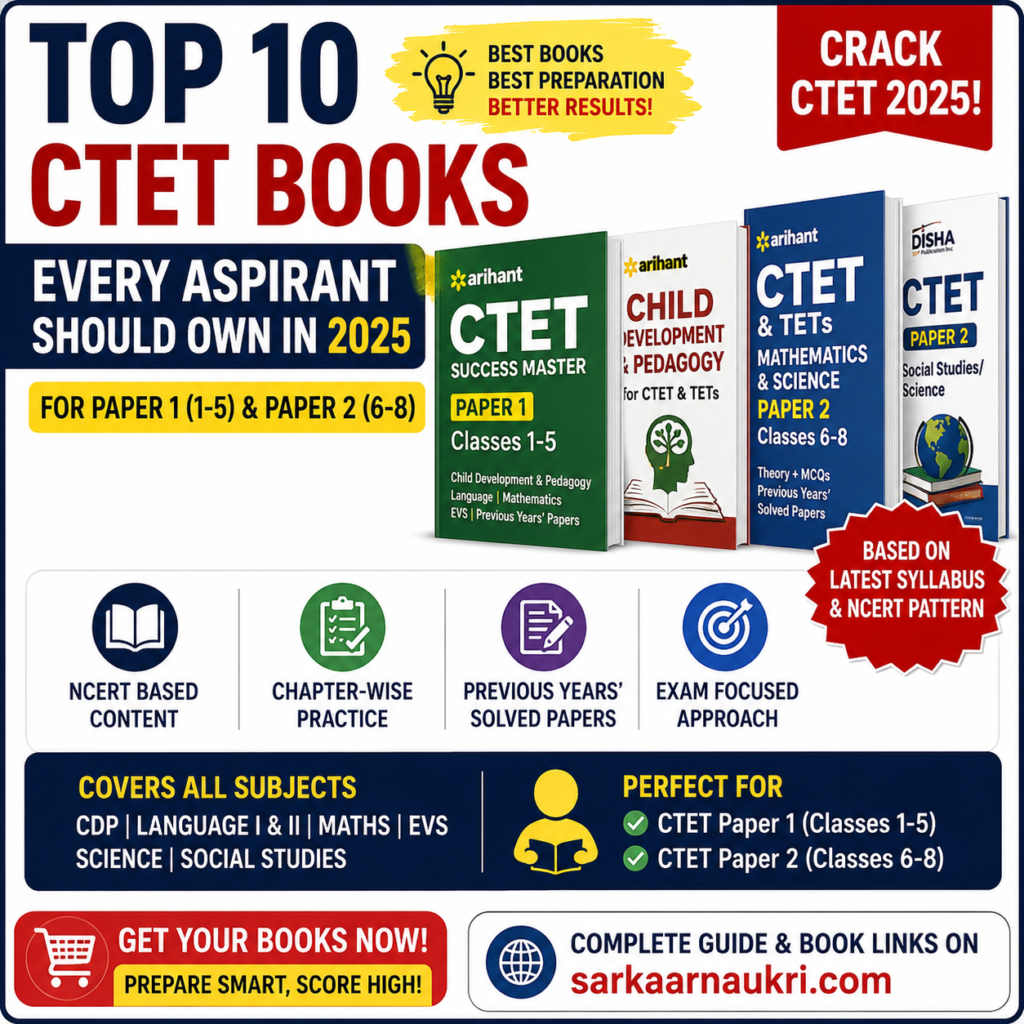
- Child Development and Pedagogy by Arihant Publications – Widely regarded as one of the most exam-focused CTET books for CDP, with topic-wise MCQs and past-year trends analyzed.
- CTET Success Master Paper 1 by Arihant – A comprehensive all-subject bundle, one of the most popular choices because it covers Hindi, EVS, and Maths in a single volume.
- NCERT Textbooks (Class 1–5) – Not commercial guides in the traditional sense, but every serious aspirant treats these as the foundation, since 60–70% of Paper 1 questions are NCERT-inspired.
- Disha Publication’s CTET Paper 1 Guide – Known for detailed solutions and chapter-wise practice sets that mirror the actual exam difficulty.
Best CTET Books for Paper 2 (Classes 6–8)
Paper 2 requires subject-specific depth, so the recommended reading here differs based on whether you’re a Maths-Science or Social Science candidate:
- CTET & TETs Mathematics & Science by Arihant—One of the go-to picks for candidates targeting the Maths-Science stream, with strong pedagogy-linked question banks.
- CTET Social Studies/Science by Disha Experts – Covers History, Geography, Political Science, and Economics pedagogy in a single reference, making it efficient for Social Science aspirants.
- Pedagogy of Language Development by Arihant—Essential for the Language I and II sections, especially for candidates weak in grammar-based pedagogy questions.
- Previous Year Solved Papers (any reputed publisher)—Regardless of which CTET books you pick for theory, at least one solved-paper compilation is non-negotiable for pattern familiarity.
Free vs Paid Study Material: What Actually Helps
Not every useful resource has to be a purchased title. NCERT PDFs are available free on the official NCERT website and cover the same syllabus that most commercial guides are built around. Several coaching institutes also release free previous-year question papers with solutions on their websites and YouTube channels, which can supplement your paid material without extra cost. That said, a well-organized paid guide still has an edge for one reason: it compiles years of pattern analysis, chapter-wise weightage, and pedagogy explanations in one place, saving you the time of piecing together scattered free resources. A practical approach many toppers follow is to use free NCERT content for concept-building and reserve budget for one or two solved-paper compilations that are harder to find for free in a well-organized format.
Digital Resources and Apps Worth Considering
Alongside printed material, several apps now offer chapter-wise mock tests, timed quizzes, and instant analysis of weak areas—useful for candidates who want to test themselves outside of a physical book. Apps from established test-prep companies often mirror the same content found in printed guides but add features like adaptive difficulty and progress tracking. These shouldn’t replace focused reading, but they work well as a revision layer once you’ve built your base with proper reading material and NCERT texts. If you’re someone who studies during a commute or has limited time for sitting with a physical book, a good app can help you fit in extra practice sessions without disrupting your main study schedule.
How to Shortlist the Right Titles Without Getting Overwhelmed
With so many options on the market, narrowing down your CTET books doesn’t have to be complicated. A simple filter works well: check the edition year first, since outdated editions miss recent syllabus tweaks; check whether the book includes solved previous-year papers, since that’s often more valuable than fresh theory; and check reviews from candidates who actually cleared the exam, not just star ratings. Many aspirants make the mistake of buying five or six different guides hoping more material means better preparation — in reality, two or three well-chosen resources, revised multiple times, beat a stack of unused ones.
Common Mistakes While Choosing CTET Books
- Buying too many titles at once—This leads to shallow reading across multiple sources instead of deep mastery of one.
- Ignoring NCERT texts—Some candidates jump straight to commercial guides and skip NCERT, missing the actual source of most Paper 1 and Paper 2 questions.
- Choosing outdated editions—Old material may not reflect the current exam pattern or recent changes in the CDP section.
- Skipping solved papers—Theory-only books without practice sets leave candidates unprepared for the actual question style.
- Not cross-checking pedagogy explanations—Some cheaper guides offer weak explanations for pedagogy-based questions, which is where most candidates lose marks.
Practical Tips to Study Effectively
- Start with NCERT textbooks before moving to any commercial CTET books—this builds the conceptual base the exam questions are drawn from.
- Use one CDP-focused book and one all-subject bundle rather than switching between too many titles mid-preparation.
- Solve at least five years of previous papers from your chosen material before attempting mock tests.
- Revise CDP and pedagogy chapters at least three times, since this section decides most close results.
- Keep a separate notebook for formulas and diagrams while studying Maths and Science, rather than relying purely on memory.
Frequently Asked Questions
Q1. Which CTET books are best for beginners? For beginners, NCERT textbooks combined with an Arihant or Disha all-in-one guide are considered the most balanced starting point currently available.
Q2. Are CTET books enough, or do I need coaching too? Most candidates clear the exam using only self-study material, provided they solve enough previous-year papers and stay consistent with revision.
Q3. How many CTET books should I buy for Paper 1? Two to three titles are usually sufficient—one CDP-specific guide, one all-subject bundle, and one solved-paper compilation.
Q4. Do CTET books get updated every year? Reputed publishers usually release updated editions annually or whenever the exam pattern changes, so always check the print year before buying.
Q5. Which CTET books are best for the CDP section specifically? Arihant’s dedicated Child Development and Pedagogy title is among the most recommended options for this section due to its topic-wise breakdown.
Q6. Can I prepare for CTET without buying physical books? Yes, many aspirants now use digital versions of the same CTET books or app-based question banks, though physical copies remain popular for annotation and revision.
Q7. Are Paper 1 and Paper 2 CTET books different? Yes, since the subjects and pedagogy focus differ by age group, most publishers release separate editions for Paper 1 and Paper 2 rather than a single combined volume.
Q8. Should I buy the latest edition even if a friend has an older copy I can borrow? It’s usually worth spending on the latest edition if the exam pattern or syllabus has changed recently, since even minor shifts in weightage can affect how you prioritize chapters; for stable sections like language pedagogy, an older copy is often fine.
Q9. How do I know if a guide’s difficulty level matches the real exam? Compare a few solved questions from the book against the previous year’s actual paper, available on the official CTET website—if the phrasing and difficulty feel close, the material is a reliable match.
Conclusion
Picking the right CTET books is less about quantity and more about consistency—a small, well-chosen set, revised thoroughly alongside NCERT textbooks and previous years’ papers, will take you further than a shelf full of unread guides. Once you’ve finalized your study material, pair your preparation with our detailed guide on CTET Exam Pattern and check our Latest Teaching Job Notifications & Latest Jobs to plan your application timeline alongside your study schedule.
