If you have ever stared at a GPSC advertisement PDF and felt lost within the first paragraph, this guide is for you. This GPSC Recruitment Guide breaks down how the Gujarat Public Service Commission actually selects candidates, in plain language, without assuming you already know the jargon. Every year, thousands of graduates across Gujarat apply for Class 1 and Class 2 posts without a clear sense of how the three-stage selection works, and many end up over-preparing for one stage while badly under-preparing for another.
This guide is not tied to a single notification cycle. Whether you are looking at the current GPSC Class 1 & 2 advertisement or one that comes out two years from now, the structure covered here stays largely the same. Treat it as your reference point before you dive into the specific notification in front of you.
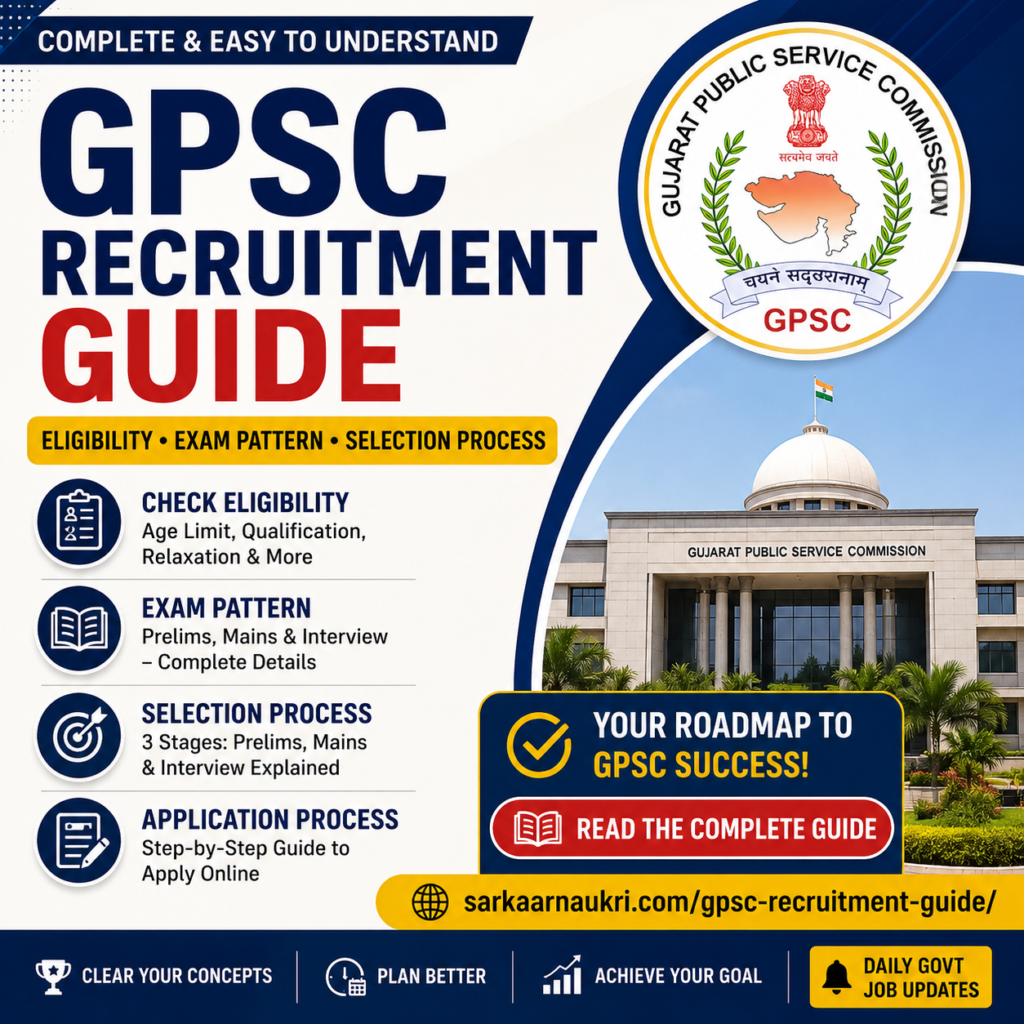
Why Understanding the GPSC Selection Process Matters
Most candidates jump straight into subject preparation without first understanding the shape of the exam itself, and that is exactly the gap this GPSC Recruitment Guide is meant to close. GPSC conducts recruitment for Class 1 and Class 2 posts across Gujarat’s administrative, police, revenue, and allied services, and the selection runs across three distinct stages spread over many months. Candidates who plan stage by stage, rather than treating the whole exam as one undifferentiated block, consistently perform better.
One thing that makes GPSC different from many other state PSC exams is how heavily it weighs Gujarat-specific content. A generic all-India current affairs approach will only get you partway; a genuinely useful GPSC Recruitment Guide has to account for the Gujarat History, Geography, Culture, and Governance component that appears throughout both Prelims and Mains. This is one area where a topic-specific GPSC Recruitment Guide beats a generic all-India PSC guide, since the two exams reward very different preparation habits.
Eligibility Criteria: Who Can Apply
Eligibility is the first checkpoint, and getting it wrong means rejection regardless of how well you eventually perform in the exam itself.
- Nationality: Applicants must be Indian citizens.
- Educational Qualification: A bachelor’s degree in any discipline from a UGC or AICTE recognised university is the general requirement for core administrative posts such as Deputy Collector, Mamlatdar, or Deputy Superintendent of Police. Certain technical or specialised GPSC exams, such as Assistant Engineer, naturally require a relevant engineering degree instead.
- Age Limit: The general age band for most GPSC Class 1 and Class 2 posts is roughly 20 to 35 years, though this can vary by post and category.
- Category Relaxation: SC, ST, SEBC, EWS, PwBD, and ex-servicemen candidates receive age relaxation as per Gujarat government norms, with exact years specified in each notification.
- Language Requirement: GPSC’s Mains includes qualifying papers in both Gujarati and English, so working knowledge of Gujarati matters even if your educational background is entirely in English medium.
- Domicile Note: Candidates from other Indian states can generally apply, but certain reservation benefits and age relaxation provisions remain tied to Gujarat-specific category certificates. Any thorough GPSC Recruitment Guide will flag this distinction early, since it trips up out-of-state applicants more often than any other eligibility clause.
A dependable GPSC Recruitment Guide always ends this section the same way: treat the criteria above as a starting point, and cross-check the post-wise eligibility table in the actual notification before applying, since specific posts can carry additional requirements.
Exam Pattern: Prelims, Mains, and Interview
This is the section most candidates skim past too quickly, and it shapes everything about how you should structure your preparation.
Stage 1: Preliminary Examination. GPSC Prelims is objective-type, held across two papers, General Studies Paper I and General Studies Paper II, each carrying 200 marks for a combined 400 marks. Wrong answers attract a one-third negative marking penalty, so guessing carelessly can cost you more than leaving a question blank. Prelims marks are used only to shortlist candidates for Mains and do not carry forward into the final merit list, a point this GPSC Recruitment Guide wants to stress because many first-time aspirants assume otherwise.
Stage 2: Main Examination. Candidates who clear Prelims sit for Mains, a descriptive exam consisting of six papers, English, English Essay, Gujarati, General Studies I, General Studies II, and General Studies III, each worth 150 marks for a total of 900 marks. Mains carries the overwhelming share of weight in the final merit list, which is why any serious GPSC Recruitment Guide will tell you to begin Mains-level answer writing well before the Prelims result is even out, rather than waiting for confirmation that you have cleared the first stage.
Stage 3: Interview / Personality Test. Candidates who clear Mains are called for a 100-mark Personality Test, where the board evaluates general awareness, expression, character, and overall suitability for administrative roles. Interview marks are added to Mains marks to prepare the final merit list.
Understanding this three-stage funnel is the single most practical thing an aspirant can take from any GPSC Recruitment Guide, because it directly determines how many months you should give to each phase.
Selection Process and Merit List
Final selection is based on cumulative Mains plus Interview marks; Prelims acts purely as a qualifying, non-cumulative filter. Category-wise cutoffs are announced separately for each stage and shift from year to year depending on vacancy count, paper difficulty, and how many candidates appear. This is another reason a GPSC Recruitment Guide is more useful as an ongoing preparation companion than any single year’s notification, since cutoff trends across past cycles tell you far more about a realistic target than one year’s paper alone.
How to Apply: Step-by-Step
- Visit the official GPSC website at gpsc.gujarat.gov.in and locate the current advertisement.
- Register with a valid email ID and mobile number to generate your login credentials.
- Log in and complete your profile details in the Profile Creation section.
- Upload your passport-size photograph, signature, and any category or domicile certificates in the prescribed format.
- Fill out the application form carefully, matching every field with your original documents.
- Where applicable, complete any required consent form and deposit for the specific advertisement, since some GPSC posts make this a distinct, exam-specific procedural step.
- Pay the application fee online; reserved categories from Gujarat are generally exempted from the fee.
- Review the completed form, submit it, and download the confirmation page for your own records.
Following this sequence carefully is a small but frequently overlooked part of any GPSC Recruitment Guide, since many rejected applications trace back to missed consent forms or document mismatches rather than actual ineligibility.
Common Mistakes and Misconceptions
- Underestimating the Gujarat-specific portion: History, Geography, Culture, and Governance of Gujarat make up a large share of both Prelims and Mains. Candidates who prepare only generic, all-India content often score well on general GS but still miss the cutoff.
- Treating Prelims marks as final: Only Mains and Interview marks count toward the merit list; Prelims is qualifying only.
- Skipping Gujarati-language practice: The Gujarati paper is compulsory, and candidates from an English-medium background sometimes leave this preparation until far too late.
- Ignoring the negative marking rule in Prelims: A one-third penalty for wrong answers means indiscriminate guessing can actively hurt your score rather than help it.
- Missing post-specific consent or deposit requirements: Some GPSC advertisements require a prior consent form and deposit; skipping this step, even accidentally, can make an otherwise eligible candidate ineligible to sit for the exam.
Avoiding these mistakes matters just as much as subject preparation, and that is a point this GPSC Recruitment Guide keeps coming back to, because they cost candidates marks that have nothing to do with how well they know the syllabus. No GPSC Recruitment Guide can substitute for reading the actual advertisement carefully, but it can stop you from making the same avoidable errors year after year.
Practical Tips for GPSC Aspirants
- Build a year-long study calendar rather than a Prelims-only one; Mains needs a much longer runway given its six-paper structure.
- Use GCERT textbooks and a Gujarat-focused newspaper as your base for the state-specific portion, since generic national-level material will not cover it adequately.
- Start Gujarati-language answer writing early if it is not your first language, rather than treating it as a formality.
- Keep scanned documents, certificates, and category proof ready in the exact format GPSC specifies, so you are never rushing during the application window.
- Track previous years’ cutoffs and vacancy trends as a realistic benchmark, not as a source of pressure.
- Re-read the exam pattern section of this GPSC Recruitment Guide every time a new advertisement is out, since paper weightage and marks distribution are easy to misremember months into preparation.
Frequently Asked Questions
Is the GPSC Prelims exam qualifying in nature? Yes. As covered earlier in this GPSC Recruitment Guide, Prelims marks are used only to shortlist candidates for Mains and are not added to the final merit list.
What is the general age limit for GPSC Class 1 and Class 2 posts? The general age band is typically 20 to 35 years, with relaxation for reserved categories, though exact limits are confirmed in each notification.
Is knowledge of Gujarati compulsory for GPSC exams? Yes, GPSC Mains includes a qualifying Gujarati paper alongside English, and Gujarat-specific content also features heavily across both Prelims and Mains.
How many stages does the GPSC selection process have? Three stages: Preliminary Examination, Main Examination, and Interview/Personality Test, as detailed in the exam pattern section of this GPSC Recruitment Guide.
Can candidates from outside Gujarat apply for GPSC recruitment? Generally yes, as long as they meet nationality, educational, and age requirements, though certain reservation and relaxation benefits remain tied to Gujarat-specific category certificates.
How is the final merit list prepared for GPSC exams? The final merit list is based on the combined marks of the Main Examination and the Interview; Prelims marks are not included.
Does negative marking apply in the GPSC Prelims exam? Yes, one-third of the marks allotted to a question is deducted for each wrong answer, a detail this GPSC Recruitment Guide flags because it directly affects guessing strategy.
Conclusion
Clearing GPSC is less about last-minute intensity and more about understanding the shape of the process early and preparing accordingly. This GPSC Recruitment Guide has walked through eligibility, the three exam stages, the application steps, and the mistakes that quietly cost candidates their rank every year. Bookmark this GPSC Recruitment Guide and revisit it each time a new advertisement drops, so you are reacting to dates and vacancies, not relearning the basics from scratch.
For post-specific details, check our Gujarat Government Jobs, PSC Jobs & Latest Jobs category, and for step-by-step application help on live notifications, see our [How to Apply for Government Jobs] guide.
