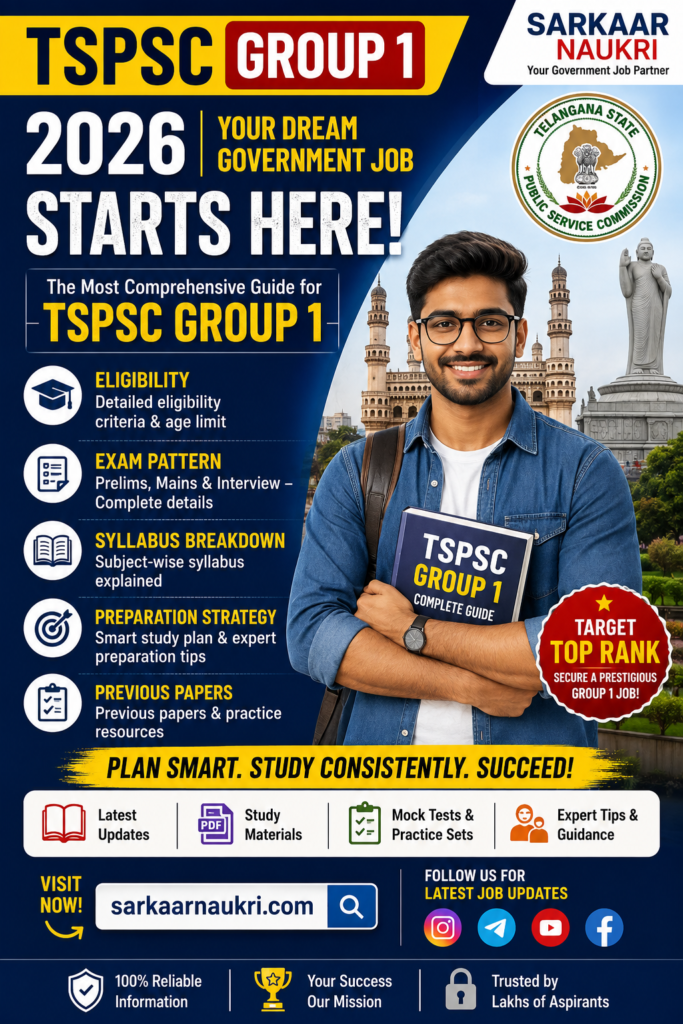
Every year, lakhs of graduates in Telangana set their sights on one exam that can change the direction of their career: TSPSC Group 1. It’s one of the most prestigious state-level exams because it opens doors to posts like Deputy Collector, Deputy Superintendent of Police, Commercial Tax Officer, and several other Group 1 administrative and executive roles under the Telangana State Public Service Commission. But with a three-stage selection process and a syllabus that spans general studies, general abilities, and Telangana-specific subjects, most first-time candidates find themselves unsure of where to even begin. This guide breaks down everything you need to know, from eligibility and exam pattern to a preparation plan that actually works.
Why TSPSC Group 1 Matters
This exam is more than just another state government test. It’s a gateway into some of the most respected administrative and executive posts in Telangana’s state services. Unlike many recruitment exams that fill a single post type, it covers a bouquet of roles across departments such as Revenue, Police, Commercial Taxes, Panchayat Raj, and Cooperative Societies. That variety is exactly why it attracts such a large and diverse applicant pool every recruitment cycle. Candidates who understand the exam’s structure early on, rather than jumping straight into rote preparation, tend to perform noticeably better in the final selection.
TSPSC Group 1 Eligibility Criteria
Before diving into preparation, confirm you meet the basic eligibility for TSPSC Group 1.
Educational Qualification: A bachelor’s degree from a recognized university is mandatory. There’s no restriction on stream, so candidates from arts, science, commerce, or professional courses can all apply.
Age Limit: The general age bracket is 18 to 44 years, though this varies slightly depending on the specific post and category. Reserved categories such as SC, ST, BC, and PwD receive age relaxation as per state government norms, and this relaxation is one of the most searched details among aspirants each year.
Nationality and Residency: Applicants must be Indian citizens, and most posts require local candidature or domicile in Telangana, though the exact requirement can vary by post code.
Number of Attempts: There is no fixed cap on attempts; instead, the age limit itself governs how many times a candidate can appear.
TSPSC Group 1 Exam Pattern
Understanding the TSPSC Group 1 exam pattern is where most successful candidates start. The selection process runs across three stages:
Stage 1 — Preliminary Exam: This is a screening test consisting of objective-type questions on General Studies and General Abilities. It does not count toward the final merit but qualifies candidates for the mains exam.
Stage 2 — Mains Exam: This is where the real evaluation happens. It includes multiple descriptive papers covering General Essay, History and Culture of Telangana, Indian Society, Governance and Constitution, Economy and Development, Science and Technology, and Telangana Movement and State Formation.
Stage 3 — Certificate Verification and Interview: Shortlisted candidates from the mains move on to document verification, and depending on the post, a personal interview follows.
TSPSC Group 1 Syllabus Overview
The syllabus is broad but predictable once you break it into sections for TSPSC Group 1.
- General Studies and Mental Ability: Current events, Indian polity, geography, general science, and reasoning, tested in the preliminary stage.
- History and Culture of Telangana: A dedicated paper on the region’s history, culture, and social movements, which is unique compared to many other state PSC exams.
- Telangana Movement and State Formation: A paper focused specifically on the events, personalities, and political processes that led to statehood.
- Economy, Governance and Development: Economic planning, constitutional governance, and development issues relevant to Telangana.
Candidates should treat the Telangana Movement paper as a scoring opportunity, since it rewards focused regional study rather than broad national-level reading.
Common Mistakes and Misconceptions About TSPSC Group 1
Mistake 1 — Treating the prelims as a formality. Many candidates under-prepare for the preliminary stage, assuming it’s easy to clear, and end up losing valuable months when they don’t qualify.
Mistake 2 — Ignoring the Telangana Movement paper. Some aspirants focus heavily on national-level General Studies and neglect this section, even though it’s one of the most differentiating parts of the exam.
Mistake 3 — Believing there’s a fixed number of attempts. This is a common misconception; attempts are governed by age, not a hard attempt limit.
Mistake 4 — Underestimating the descriptive mains format. Unlike the objective prelims, the mains stage rewards structured, essay-style answers, and candidates who don’t practice writing under time pressure often lose easy marks.
Misconception — All Group 1 posts have identical eligibility. In reality, physical standards, age limits, and even domicile requirements can differ by post code within the same notification.
Practical Tips for TSPSC Group 1 Preparation
- Start with the previous cycle’s question papers to understand recurring themes before opening a single textbook.
- Build a dedicated Telangana current affairs file; this single habit consistently separates top scorers from the rest.
- Practice essay writing weekly, since the mains stage is almost entirely descriptive.
- Revise NCERT-level Class 6–10 books for General Studies basics before moving to advanced state-specific material.
- Take at least one full-length mock test every week in the final three months leading up to the mains exam.
- Keep a separate notebook for government schemes and economic data specific to Telangana, since these show up repeatedly in the papers.
Salary and Career Growth After TSPSC Group 1
This exam, TSPSC Group 1, is one of the biggest draws for career stability and growth in the state services. Depending on the post, selected candidates typically start in pay scales ranging from roughly ₹56,000 to ₹1,10,000 per month as per the Telangana Revised Pay Scale, along with allowances like HRA and DA that are revised periodically. Beyond the starting salary, these posts come with a well-defined promotion ladder. A Deputy Collector selected through this route, for instance, can be promoted to Joint Collector and eventually to higher IAS-cadre-linked roles over the course of a career. Similarly, those entering through the police cadre often move up from DSP to higher supervisory ranks with experience. This long-term growth trajectory, combined with job security and pension benefits under the state government structure, is a major reason the competition remains fierce every cycle.
How to Build a Study Timetable for TSPSC Group 1
A common question among first-time aspirants is how to actually structure daily study time rather than just knowing what to study. A realistic timetable matters more than an ambitious one you can’t sustain.
- Months 1–3: Build foundational knowledge — NCERT-level General Studies, basic Telangana history and geography, and daily current affairs reading, all aimed at the eventual prelims.
- Months 4–6: Shift toward the Telangana Movement paper and start solving previous papers topic-wise to identify weak areas early.
- Months 7–9: Practice descriptive answer writing and deepen the Economy and Governance sections, since these carry high scoring potential in the mains.
- Final 2–3 months: Full-length mock tests, timed essay practice, and error-log review to sharpen accuracy before the actual exam dates.
Sticking to a timetable like this, even loosely, keeps preparation from becoming last-minute and panic-driven in the weeks before the exam.
Frequently Asked Questions About TSPSC Group 1
1. What is the minimum qualification required for TSPSC Group 1? A bachelor’s degree in any discipline from a recognized university is the minimum requirement.
2. How many stages does the selection process have? Selection has three stages: preliminary exam, mains exam, and certificate verification, followed by a personal interview.
3. Is there negative marking in the exam? Yes, the objective prelims paper carries negative marking for wrong answers, so candidates should attempt questions carefully rather than guessing randomly.
4. What posts can I get through this exam? It covers posts like Deputy Collector, Deputy Superintendent of Police, Commercial Tax Officer, Municipal Commissioner, and several other executive roles across state departments.
5. How long does it take to prepare for TSPSC Group 1 from scratch? Most successful candidates spend 10 to 15 months preparing seriously, given the descriptive mains format, though this varies based on prior knowledge of General Studies and writing practice.
6. Is there an age relaxation for reserved categories? Yes, SC, ST, BC, and PwD candidates receive age relaxation as per Telangana government rules, in addition to the standard upper age limit.
7. Is local candidature required for these posts? For most posts, local candidature or domicile in Telangana is required, though the exact rule can vary by specific post code within the notification.
Conclusion
TSPSC Group 1 rewards candidates who prepare with structure rather than volume. By understanding the eligibility rules, respecting the weight of the Telangana Movement paper, and building consistent essay-writing habits alongside current affairs, aspirants put themselves well ahead of the competition. If you’re just getting started, it helps to also look at our guide on [Age Relaxation Rules] and our roundup of [Government Jobs in Telangana] State PSC Jobs & Latest Jobs to plan your broader government job strategy.
