Introduction
Every year, thousands of graduates and 12th-pass candidates search for a single government exam that covers dozens of departments at once — and most of them stumble onto the SSC Selection Post scheme far too late in their preparation. Unlike SSC CGL or SSC CHSL, which target specific job families, this recruitment phase fills vacancies across ministries, departments, and public sector units that don’t have a dedicated exam cycle of their own. If you’ve been wondering how junior assistants, lab technicians, field investigators, and dozens of other non-gazetted posts get filled outside the usual SSC calendar, SSC Selection Post is almost always the answer. This guide breaks down everything you need to know—who’s eligible, how the phases work, what changes between cycles, and the mistakes that cost otherwise-qualified candidates their shot.
Why SSC Selection Post Matters
The scheme exists because not every government vacancy fits neatly into a named exam. A single notification can cover matriculation-level, higher secondary-level, and graduate-level posts simultaneously, split into different phases. This is precisely why it’s called “Phase” recruitment—each phase groups posts by qualification level and conducts one computer-based test that multiple departments then use for their own hiring. For candidates, this means a single exam effort under an SSC Selection Post can open doors to several different departments at once, provided you meet each post’s specific eligibility.
Eligibility Criteria
Eligibility is not uniform—it varies post by post because vacancies under SSC Selection Posts are pooled from many different recruiting departments. That said, a few consistent rules apply across nearly every cycle:
- Educational Qualification: Ranges from Matriculation (10th pass) to graduate level, depending on the specific post you’re applying for. Always check the post-wise qualification table in the official notification rather than assuming a blanket requirement.
- Age Limit: Typically 18–30 years for most vacancies, though certain technical or supervisory posts allow a higher upper age limit.
- Nationality: Indian citizens, with the usual SSC provisions for candidates from Nepal, Bhutan, and Tibetan refugees who settled in India before January 1962.
- Age Relaxation: Standard government norms apply—5 years for SC/ST, 3 years for OBC, and additional relaxation for PwD and ex-servicemen candidates, consistent with how relaxation works across other SSC exams.
Because SSC Selection Post pools vacancies from multiple departments, always cross-check the specific post’s qualification and age criteria in the annexure before applying—a mismatch here is one of the most common reasons applications get rejected at document verification.
Exam Pattern and Phases
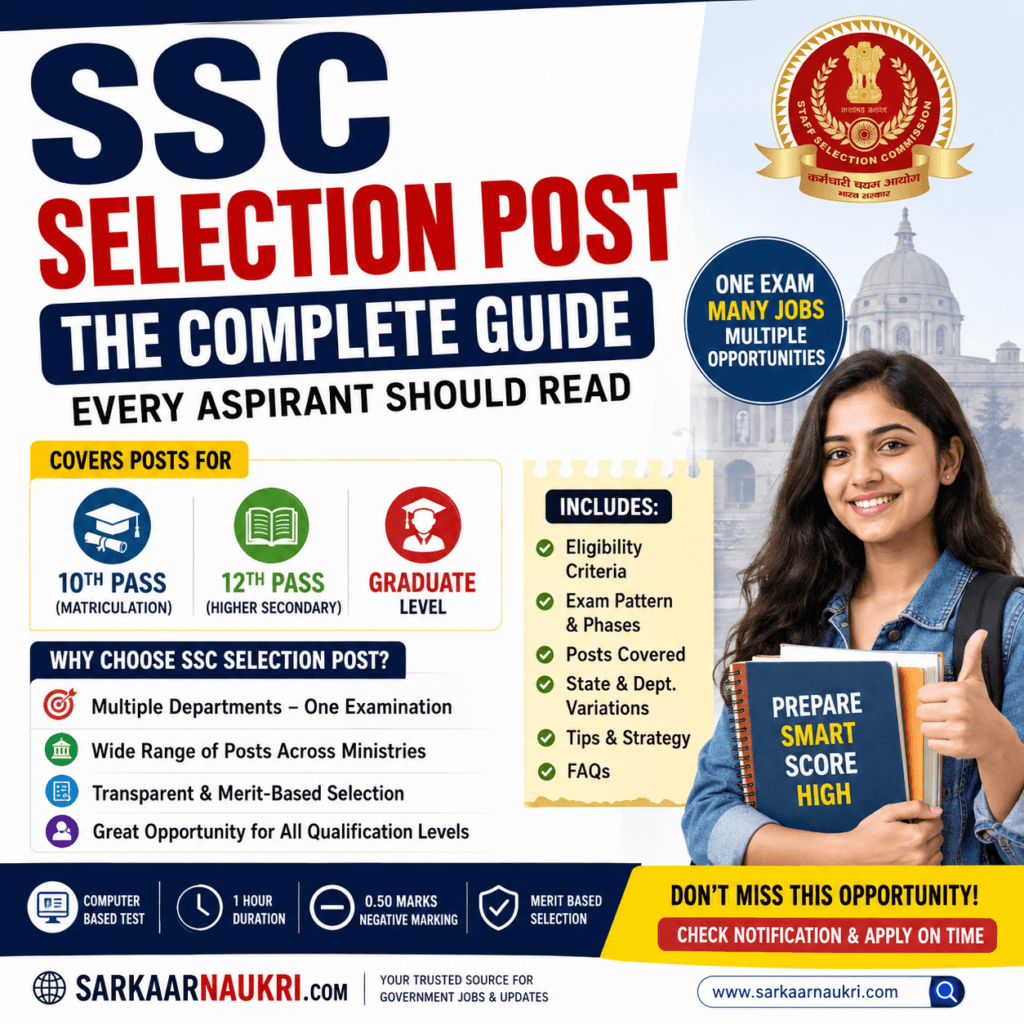
The exam is conducted in “phases,” and each phase is further divided based on educational qualification level:
- Phase for matriculation-level posts—Objective-type questions covering general intelligence, general awareness, quantitative aptitude, and English comprehension.
- Phase for higher secondary-level posts—Similar structure, calibrated to a 12th-standard difficulty level.
- Phase for graduate-level posts—The same four sections, but with more analytical and reasoning-heavy questions suited to graduate candidates.
The computer-based test for the SSC Selection Post typically runs for one hour, with negative marking of 0.50 marks for every wrong answer—a detail many first-time applicants overlook until it costs them marks. Unlike SSC CGL, there is generally no separate Tier-2 exam for most posts under this scheme; a single CBT score, combined with document verification and any post-specific skill test, usually decides selection.
Posts Covered
One of the most attractive features of the SSC Selection Post is the sheer range of posts it covers in a single notification cycle. Depending on the year, vacancies have included the following:
- Junior Assistant / Lower Division Clerk roles in various ministries
- Laboratory Assistant and Technical Assistant posts
- Field Investigator and Statistical Assistant roles
- Junior Translator and Hindi Translator posts
- Various technician and supervisory posts in central government departments
Because the vacancy list changes every cycle based on which departments report shortages, it’s worth checking each new SSC Selection Post notification in full rather than assuming the same posts will repeat.
State-Specific and Department-Specific Variations
While this is a central recruitment scheme, individual posts can carry state-specific or department-specific conditions:
- Some vacancies are region-restricted, meaning only candidates domiciled in a particular state or union territory can apply for that specific post.
- Certain technical posts require a valid driving license, computer proficiency certificate, or subject-specific diploma in addition to the base qualification.
- Physical standards (height, chest measurement) apply to a small subset of posts, mainly field or enforcement-adjacent roles.
Always read the postcode description carefully—two posts under the same notification can have entirely different eligibility despite similar-sounding titles. This is where a lot of SSC Selection Post applicants lose time re-reading the annex after they’ve already submitted a mismatched form.
Common Mistakes and Misconceptions
- Assuming one qualification fits all posts: The biggest mistake candidates make with SSC Selection Post is applying broadly without checking that their specific qualification matches the post code selected.
- Ignoring post preference order: The scheme allows candidates to rank preferences among eligible posts—get this wrong, and you could be allotted a post you didn’t actually want.
- Skipping the fine print on region restriction: Many posts are state-specific, and candidates outside that domicile get rejected at verification despite clearing the exam.
- Treating it like a lesser exam: Because it doesn’t carry the brand recognition of SSC CGL, some candidates underprepare for SSC Selection Post—but competition for popular posts can be just as intense.
- Not tracking multiple departments separately: Since one exam feeds several departments, candidates sometimes miss a verification call from one department while following up on another.
Practical Tips for Candidates
- Shortlist 3–5 posts under the notification that genuinely match your qualification before you even start preparing.
- Practice previous years’ question papers for SSC Selection Post—the difficulty pattern is fairly consistent across cycles.
- Keep scanned documents (caste certificate, PwD certificate, and educational marksheets) ready in advance since verification timelines can be tight.
- Track the phase-wise result and document verification dates separately for each post you’ve applied to, since departments sometimes conduct these independently.
- Don’t ignore the post-specific skill test if one is mentioned — some technical posts require it even after clearing the CBT.
- Set calendar reminders around the SSC Selection Post notification cycle each year, since application windows tend to be short relative to the number of posts on offer.
- Cross-verify the SSC Selection Post preference form before final submission, since the preference order generally cannot be edited once locked.
- Follow the official SSC Selection Post results page directly rather than relying on secondhand updates, since phase-wise results are often released on different dates for different qualification levels.
Frequently Asked Questions
1. What is SSC Selection Post and how is it different from SSC CGL? It’s a phase-wise recruitment scheme covering non-gazetted posts across multiple government departments, while SSC CGL is a dedicated exam for a fixed set of graduate-level posts.
2. Who is eligible to apply? Eligibility depends on the specific post; posts under this scheme range from Matriculation to Graduate level, each with its own qualification and age criteria.
3. Is there negative marking in the exam? Yes, it typically carries a penalty of 0.50 marks for each incorrect answer in the computer-based test.
4. How many posts can I apply for in one cycle? Candidates can generally apply for multiple posts within a phase, provided they meet each individual post’s eligibility.
5. Does SSC Selection Post have a separate Tier-2 exam? Most posts are selected through a single CBT stage, though some technical posts may include an additional skill or document-based assessment.
6. Are the vacancies the same every year? No — they vary by cycle based on which departments report openings, so it’s important to review each new notification rather than assuming repeat posts.
7. Is domicile a requirement for these posts? Some posts are region-restricted to specific states, while others are open nationally; this is specified individually in the post description.
8. How is the final merit list prepared for SSC Selection Post? Merit is generally based on the CBT score alone for most posts, though a handful of technical roles factor in an additional skill test result.
Conclusion
The SSC Selection Post remains one of the most underrated entry points into central government service precisely because it isn’t tied to a single job family. Its phase-wise structure means candidates across qualification levels—from Matriculation to Graduate—get a shot at government employment through one streamlined process. The key to succeeding isn’t just clearing the CBT; it’s carefully matching your qualification to the right post codes and staying on top of department-specific requirements. For more on related recruitment cycles, see our guides on [SSC CHSL Eligibility and Exam Pattern] and [Age Relaxation Rules for Government Jobs].
