UPSC Prelims Syllabus
The UPSC Prelims Syllabus 2026 is the foundation of the Civil Services Examination conducted every year by the Union Public Service Commission (UPSC). Every candidate aspiring to become an IAS, IPS, IFS, IRS, or other Group A or Group B officer must first qualify for the preliminary examination.
The UPSC Civil Services Examination (CSE) consists of three stages:
- Preliminary Examination (Prelims)
- Main Examination (Mains)
- Personality Test (Interview)
Among these, the preliminary examination serves as the screening stage. Although the marks obtained in the prelims are not included in the final merit list, qualifying for this stage is mandatory to appear for the mains examination.
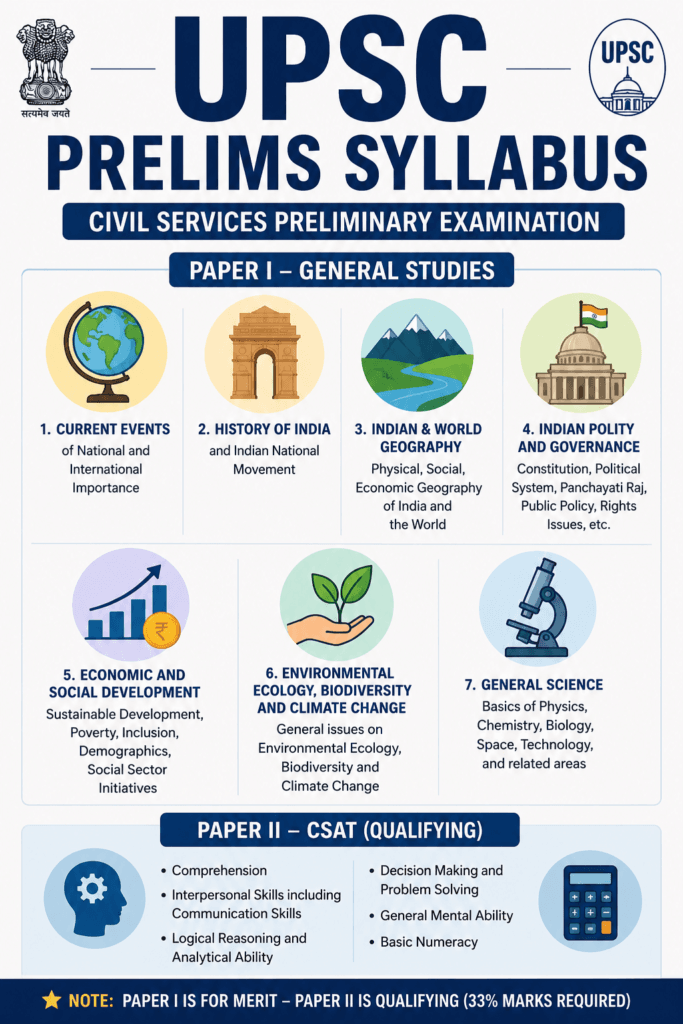
The UPSC Prelims Syllabus 2026 consists of two objective-type papers:
- General Studies Paper I (GS Paper I) – Used for merit ranking to qualify for Mains.
- General Studies Paper II (CSAT) – Qualifying in nature, requiring a minimum of 33% marks.
Understanding the latest UPSC syllabus is essential because questions are designed to test analytical ability, conceptual clarity, decision-making skills, and awareness of current national and international events rather than simple memorisation.
This comprehensive guide explains the complete UPSC Prelims Syllabus 2026, including the official syllabus, exam pattern, marking scheme, preparation strategy, and important tips for success.
UPSC Prelims 2026 Highlights
| Particular | Details |
|---|---|
| Exam Name | UPSC Civil Services Preliminary Examination 2026 |
| Conducting Authority | Union Public Service Commission (UPSC) |
| Exam Level | National |
| Mode of Examination | Offline (Pen & Paper) |
| Question Type | Multiple Choice Questions (MCQs) |
| Number of Papers | 2 |
| Total Questions | 180 |
| Total Marks | 400 |
| Duration | 2 Hours for each Paper |
| Negative Marking | Yes |
| Qualifying Paper | CSAT (Paper II) |
| Selection Stage | Preliminary Examination |
UPSC Prelims Exam Pattern 2026
Before understanding the syllabus, candidates should know the examination pattern.
The preliminary examination consists of two objective-type papers conducted on the same day.
Paper I – General Studies
| Particular | Details |
| Number of Questions | 100 |
| Maximum Marks | 200 |
| Duration | 2 Hours |
| Negative Marking | Yes |
| Marks per Question | 2 |
Paper I determines whether a candidate qualifies for the Main Examination.
Paper II – CSAT
| Particular | Details |
| Number of Questions | 80 |
| Maximum Marks | 200 |
| Duration | 2 Hours |
| Qualifying Marks | 33% |
| Nature | Qualifying Only |
Although CSAT is qualifying in nature, candidates must secure at least 66 marks out of 200.
UPSC Prelims Marking Scheme
Understanding the marking scheme is important for effective exam strategy.
General Studies Paper I
- Total Questions: 100
- Marks per Question: 2
- Total Marks: 200
CSAT Paper
- Total Questions: 80
- Marks per Question: 2.5
- Total Marks: 200
Negative Marking
UPSC follows a negative marking system.
For every incorrect answer:
- One-third (1/3) of the allotted marks are deducted.
For example:
- Wrong answer in GS Paper I = –0.66 marks
- Wrong answer in CSAT = –0.83 marks
No marks are deducted for unanswered questions.
Official UPSC Prelims Syllabus 2026
According to the official UPSC notification, the syllabus for the Civil Services Preliminary Examination is as follows.
General Studies Paper I Syllabus
General Studies Paper I is the most important paper because its marks determine whether a candidate qualifies for the main examination.
The official syllabus includes:
- Current events of national and international importance
- History of India and the Indian National Movement
- Indian and World Geography – Physical, Social, Economic Geography of India and the World
- Indian Polity and Governance – Constitution, Political System, Panchayati Raj, Public Policy, Rights Issues, etc.
- Economic and Social Development – Sustainable Development, Poverty, Inclusion, Demographics, Social Sector Initiatives
- General issues on Environmental Ecology, Biodiversity and Climate Change
- General Science
These topics form the core of the UPSC Prelims Syllabus 2026 and should be studied thoroughly.
Subject-wise UPSC Prelims Syllabus
1. Current Affairs
Current affairs play a significant role in the UPSC preliminary examination.
Candidates should regularly study:
- Government Schemes
- International Relations
- Economic Developments
- Reports and Indices
- Awards and Honours
- Sports
- Science & Technology
- Defence
- Environment
- Important Days
- Budget
- Economic Survey
- National Events
- International Organizations
Reading newspapers daily and revising monthly current affairs magazines is highly recommended.
2. History of India
History is one of the highest-scoring sections.
Important topics include:
- Indus Valley Civilization
- Vedic Period
- Mahajanapadas
- Mauryan Empire
- Gupta Empire
- Delhi Sultanate
- Mughal Empire
- Bhakti and Sufi Movements
- Maratha Empire
- Advent of Europeans
- Revolt of 1857
- Indian National Movement
- Governor Generals
- Constitutional Development
- Freedom Struggle
- Important Congress Sessions
- Post-Independence Consolidation
Modern history generally carries greater weightage than ancient and mediaeval history.
3. Indian Geography
Important topics include:
- Physical Geography
- Indian Physiography
- Climate
- Monsoon
- Drainage System
- Rivers
- Mountains
- Soils
- Agriculture
- Minerals
- Natural Resources
- Population
- Industries
- Transport
- Mapping
- World Geography
- Ocean Currents
- Earthquakes
- Volcanoes
- Cyclones
Maps and atlas practice significantly improve geography preparation.
UPSC Prelims Syllabus 2026 (Part 2): Subject-wise Topics, CSAT Syllabus & Preparation Strategy
4. Indian Polity and Governance
Indian polity is one of the highest-scoring and most important sections in the UPSC Prelims syllabus 2026. Every year, a significant number of questions are asked about the Constitution, governance, and political system.
Important Topics
- Historical Background of the Constitution
- Making of the Indian Constitution
- Preamble
- Union and its Territory
- Citizenship
- Fundamental Rights
- Directive Principles of State Policy (DPSPs)
- Fundamental Duties
- Union Executive
- President of India
- Vice President
- Prime Minister and Council of Ministers
- Parliament
- Parliamentary Committees
- State Executive
- Governor
- Chief Minister
- State Legislature
- Judiciary
- Supreme Court
- High Courts
- Judicial Review
- Constitutional Bodies
- Election Commission
- Comptroller and Auditor General (CAG)
- Finance Commission
- Union Public Service Commission (UPSC)
- Emergency Provisions
- Constitutional Amendments
- Local Government
- Panchayati Raj Institutions
- Municipalities
- Important Constitutional Articles
- Schedules of the Constitution
- Important Supreme Court Judgments
- Governance
- Transparency
- Citizen Charters
- E-Governance
- Rights Issues
- Public Policy
Preparation Tips
- Read the Constitution along with standard polity books.
- Focus on Articles, Amendments, and Constitutional Bodies.
- Revise landmark Supreme Court judgements.
- Follow important governance-related current affairs.
5. Indian Economy
The Economy section in the UPSC Prelims Syllabus 2026 tests conceptual understanding rather than complex calculations. Questions are often linked to current economic developments.
Important Topics
- Basic Concepts of Economics
- National Income
- GDP, GNP, NNP
- Inflation
- Deflation
- Monetary Policy
- Fiscal Policy
- Banking System
- RBI Functions
- Financial Institutions
- Budget
- Economic Survey
- Taxation
- GST
- Public Finance
- Agriculture
- Inclusive Growth
- Poverty
- Unemployment
- Sustainable Development
- Foreign Trade
- Balance of Payments
- International Financial Institutions
- Capital Market
- Stock Market Basics
- Digital Economy
Preparation Tips
- Build strong conceptual clarity.
- Read the Union Budget and Economic Survey every year.
- Stay updated on RBI policies and major economic news.
- Practice economy-based MCQs regularly.
6. Environment and Ecology
Environment has become one of the most important sections in recent UPSC examinations.
Important Topics
- Ecosystem
- Biodiversity
- Food Chain
- Food Web
- Ecological Pyramid
- National Parks
- Wildlife Sanctuaries
- Biosphere Reserves
- Ramsar Sites
- Tiger Reserves
- Climate Change
- Global Warming
- Greenhouse Gases
- Ozone Layer
- Environmental Pollution
- Environmental Impact Assessment
- Sustainable Development
- Conservation Projects
- Renewable Energy
- International Environmental Conventions
- COP Meetings
- Important Species
Preparation Tips
- Learn about protected areas and species found in the news.
- Cover international environmental conventions.
- Follow current affairs related to climate change and biodiversity.
7. General Science
Science questions in the UPSC Prelims Syllabus 2026 generally focus on concepts and current developments rather than numerical problems.
Important Topics
Physics
- Motion
- Electricity
- Magnetism
- Light
- Heat
- Sound
- Nuclear Physics
- Space Science
Chemistry
- Atomic Structure
- Chemical Reactions
- Acids and Bases
- Everyday Chemistry
- Polymers
- Fertilizers
- Environmental Chemistry
Biology
- Human Body
- Nutrition
- Diseases
- Vaccines
- Genetics
- Biotechnology
- Plant Physiology
- Animal Physiology
- Ecology
Preparation Tips
- Focus on NCERT concepts.
- Link science concepts with current affairs.
- Revise biotechnology and health-related developments.
8. Science and Technology
Questions from science & technology have increased steadily in recent years.
Important Topics
- Artificial Intelligence
- Machine Learning
- Robotics
- Quantum Technology
- Semiconductor Technology
- Nanotechnology
- Space Missions
- ISRO Programmes
- DRDO Projects
- Biotechnology
- Genome Editing
- CRISPR Technology
- Cyber Security
- Blockchain
- Digital India
- 5G & 6G Technology
- Renewable Energy Technologies
UPSC CSAT Syllabus 2026 (Paper II)
The Civil Services Aptitude Test (CSAT) is qualifying in nature. Candidates must secure at least 33% marks to qualify.
Official CSAT Syllabus
- Comprehension
- Interpersonal Skills
- Communication Skills
- Logical Reasoning
- Analytical Ability
- Decision Making
- Problem Solving
- General Mental Ability
- Basic Numeracy
- Data Interpretation
Topic-wise CSAT Preparation – UPSC Prelims Syllabus
Reading Comprehension
Practice:
- Long Passages
- Short Passages
- Inference-Based Questions
- Vocabulary in Context
Logical Reasoning
Important Topics
- Coding-Decoding
- Blood Relations
- Direction Sense
- Seating Arrangement
- Statement and Conclusion
- Syllogism
- Assumptions
- Cause and Effect
Analytical Ability
Focus on:
- Pattern Recognition
- Critical Thinking
- Analytical Questions
- Logical Puzzles
Decision Making
Practice questions involving:
- Ethics
- Administrative Decisions
- Situational Judgment
- Public Interest
Basic Numeracy
Key Topics
- Number System
- Percentage
- Profit and Loss
- Ratio and Proportion
- Average
- Time and Work
- Time, Speed and Distance
- Simple Interest
- Compound Interest
- Data Sufficiency
Data Interpretation
Practice:
- Bar Graphs
- Pie Charts
- Line Graphs
- Tables
- Caselets
High-Weightage Areas in UPSC Prelims syllabus
Based on previous examination trends, candidates should pay special attention to:
- Current Affairs
- Indian Polity
- Environment & Ecology
- Economy
- Modern History
- Geography Mapping
- Science & Technology
These subjects consistently contribute a significant share of questions and should form the core of your preparation strategy.
Preparation Strategy for UPSC Prelims syllabus 2026
A well-planned strategy is essential for covering the vast UPSC Prelims syllabus 2026.
Step 1: Build Fundamentals
Start with NCERT textbooks for History, Geography, Polity, Economy, Environment, and Science to strengthen your basics.
Step 2: Follow Current Affairs Daily
Read a national newspaper regularly and maintain concise notes on important events, government schemes, international relations, reports, and environmental developments.
Step 3: Revise Consistently
Allocate dedicated revision time every week. Repeated revision helps retain factual information and improves recall during the examination.
Step 4: Practise Previous Year Papers
Solve UPSC Prelims previous year question papers to understand the nature of questions, difficulty level, and recurring themes.
Step 5: Attempt Mock Tests
Regular mock tests improve time management, accuracy, and decision-making. Analyse every test to identify weak areas and avoid repeating mistakes.
UPSC Prelims Syllabus 2026 (Part 3): Best Books, Study Plan, FAQs & Conclusion
Best Books for UPSC Prelims 2026
Choosing the right study material is as important as understanding the UPSC Prelims Syllabus 2026. Instead of collecting too many books, candidates should focus on a limited number of standard resources and revise them multiple times.
Recommended Books
| Subject | Recommended Book |
|---|---|
| Indian Polity | Indian Polity by M. Laxmikanth |
| Modern History | A Brief History of Modern India by Spectrum |
| Ancient & Medieval History | NCERT History Books |
| Geography | NCERT Geography + Certificate Physical & Human Geography by G.C. Leong |
| Economy | Indian Economy by Ramesh Singh |
| Environment | Environment by Shankar IAS |
| Science | NCERT Science Books (Class 6–10) |
| Current Affairs | Daily Newspaper + Monthly Current Affairs Magazine |
| CSAT | Previous Year Papers & CSAT Practice Book |
Tip: Read fewer books but revise them thoroughly. Multiple revisions are more effective than covering many sources only once.
6-Month Study Plan for UPSC Prelims syllabus 2026
Month 1
- Understand the complete UPSC Prelims syllabus 2026.
- Begin reading NCERT textbooks.
- Start daily newspaper reading.
- Cover Indian polity basics.
Month 2
- Complete History and Geography.
- Begin the Indian economy.
- Practice 50–100 MCQs daily.
Month 3
- Cover environment & ecology.
- Complete General Science.
- Start solving previous years’ question papers.
Month 4
- Revise all static subjects.
- Take one full-length mock test every week.
- Improve weak areas identified through mock tests.
Month 5
- Increase mock tests to 2–3 per week.
- Revise current affairs from the past 12 months.
- Strengthen CSAT preparation.
Month 6
- Focus only on revision.
- Solve previous year papers again.
- Attempt full-length mock tests under exam conditions.
- Avoid starting any new books or topics.
Subject-wise Weightage (Based on Previous Trends)
The exact number of questions changes every year, but the following table shows the approximate distribution seen in recent UPSC Prelims examinations.
| Subject | Approximate Weightage |
| Current Affairs | 15–25 Questions |
| Indian Polity | 12–18 Questions |
| History | 12–18 Questions |
| Geography | 10–15 Questions |
| Economy | 10–15 Questions |
| Environment & Ecology | 12–18 Questions |
| Science & Technology | 8–12 Questions |
Note: UPSC does not prescribe a fixed subject-wise distribution. Candidates should prepare every topic mentioned in the official syllabus.
Common Mistakes to Avoid
Many aspirants spend months studying but lose marks because of avoidable mistakes. Keep the following points in mind:
- Ignoring the official UPSC syllabus.
- Reading too many books without revision.
- Neglecting current affairs.
- Avoiding CSAT because it is qualitative in nature.
- Not solving previous years papers.
- Taking very few mock tests.
- Guessing too many answers in the exam despite negative marking.
- Skipping revision during the final weeks.
Quick Preparation Tips
- Read the official syllabus several times.
- Build strong fundamentals using NCERT textbooks.
- Revise regularly instead of constantly switching resources.
- Practice previous year papers.
- Attempt mock tests consistently.
- Improve accuracy to minimise the impact of negative marking.
- Follow current affairs every day.
- Make concise revision notes for the last month before the exam.
Frequently Asked Questions (FAQs)
What is the UPSC Prelims Syllabus 2026?
The UPSC Prelims Syllabus 2026 includes current affairs, history, geography, Indian polity, economy, environment & ecology, general science, and the CSAT paper, covering comprehension, reasoning, aptitude, and numeracy.
How many papers are there in UPSC Prelims?
The preliminary examination consists of two papers:
- General Studies Paper I
- CSAT (General Studies Paper II)
Is CSAT a qualification in UPSC prelims?
Yes. CSAT is qualifying in nature. Candidates must score at least 33% to qualify.
Are UPSC Prelims marks counted in the final merit list?
No. The marks obtained in the Preliminary Examination are used only for screening candidates for the Main Examination.
Does UPSC change the syllabus every year?
The core syllabus generally remains the same. However, candidates should always refer to the latest UPSC notification to confirm the official syllabus for the examination year.
How important are NCERT books for UPSC Prelims?
NCERT textbooks provide a strong conceptual foundation in history, geography, science, and other subjects. They are highly recommended, especially for beginners.
How many months are required to complete the UPSC Prelims syllabus?
The preparation time varies depending on the candidate’s background. Many aspirants dedicate six to twelve months to cover the syllabus thoroughly, revise multiple times, and practise mock tests.
Conclusion
The UPSC Prelims Syllabus 2026 is broad, but a structured preparation strategy makes it manageable. Candidates should begin by understanding the official syllabus, strengthening conceptual knowledge through standard books, and regularly revising important topics. Consistent practice with previous-year question papers and mock tests helps improve accuracy and time management.
Success in the preliminary examination depends on disciplined preparation rather than the number of study resources. A balanced approach that combines static subjects with current affairs, frequent revision, and continuous self-assessment can significantly improve the chances of qualifying for the Mains Examination.
Keep this guide bookmarked and revisit it throughout your preparation to ensure that every topic in the UPSC Prelims Syllabus 2026 is covered systematically.
