Introduction
Every year, thousands of candidates clear the written exam for a defense job only to get rejected at the medical or physical stage, simply because they never checked the Defence Physical Standards beforehand. This is one of the most avoidable mistakes in the entire recruitment process. Defense physical standards cover far more than just height and weight. They include chest expansion, vision, dental health, and specific fitness benchmarks that vary by service and by trade. This guide walks you through every major physical standards requirement across the Army, Navy, and Air Force so you know exactly where you stand before you apply.
Why Defence Physical Standards Matter
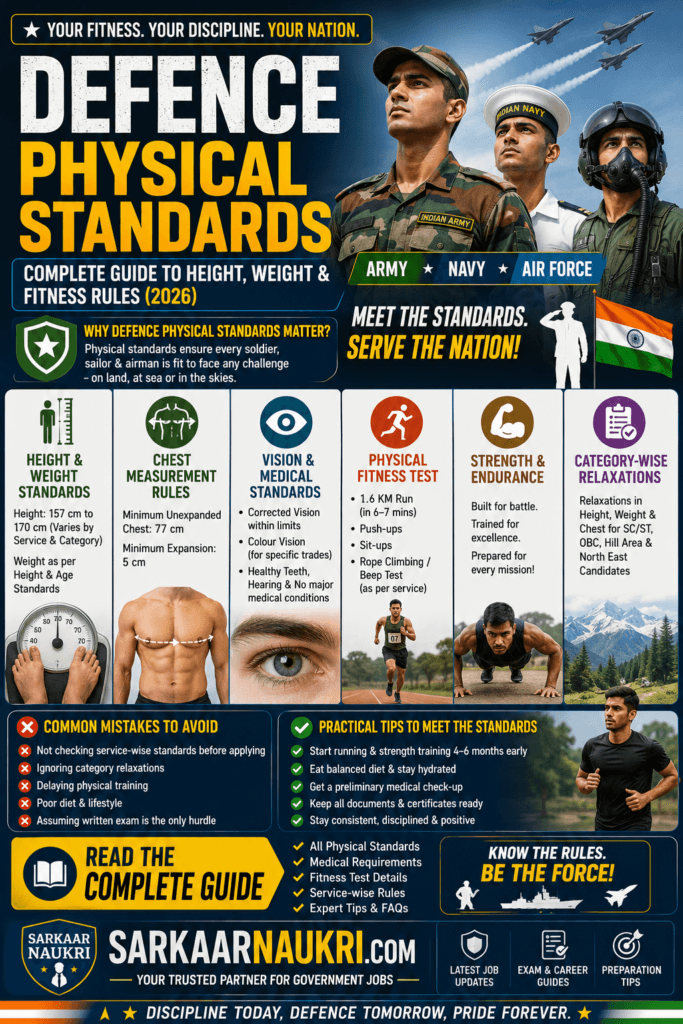
Defense physical standards exist because military service places genuine physical demands on personnel, from carrying equipment on long marches to withstanding the physiological stress of high altitude or flying. Recruiting boards treat physical standards as a non-negotiable filter, and unlike the written exam, there is very limited room for appeal once you are found short of the prescribed limits. Understanding physical standards early lets you prepare your body the same way you prepare your syllabus.
Height and Weight Under Defence Physical Standards
Height requirements under defense physical standards typically range from 157 cm to 170 cm depending on the service, region, and category, with relaxation available for candidates from hill areas and certain northeastern states. Weight is assessed proportionate to height and age rather than as a fixed number, and boards use standard height-weight charts to check compliance with defense physical standards during the medical exam. Candidates who fall short on height should check region-specific relaxations before assuming they are ineligible, since several states have separate defense physical standards for hill and tribal candidates.
Chest Measurement Under Defence Physical Standards
Chest expansion is a distinctive part of defense physical standards that many first time applicants overlook. Minimum unexpanded chest is usually around 77 cm, with a minimum expansion of 5 cm required to pass this stage of defense physical standards. Candidates are advised to practice basic breathing and expansion exercises for a few months before their medical exam, since chest expansion is one of the more trainable parameters within defense physical standards.
Vision and Medical Standards Under Defence Physical Standards
Vision requirements are among the strictest parts of defense physical standards, particularly for flying and technical branches. General duty candidates need correctable vision within prescribed limits, while flying branch aspirants face additional testing for depth perception and colour vision as part of defense physical standards. Dental health, hearing thresholds, and absence of disqualifying conditions like flat feet or knock knees are also assessed under the same defense physical standards framework, so a routine check up before applying can save months of wasted preparation.
Physical Fitness Test Under Defence Physical Standards
Beyond the medical exam, defense physical standards also include a physical efficiency test involving running, push ups, sit ups, and sometimes rope climbing or a beep test, depending on the service. The running standard is usually the biggest filter, with most defense physical standards requiring 1.6 km in under 6 to 7 minutes for general categories. Candidates who neglect physical training in favour of pure academic preparation frequently fail this stage of defense physical standards despite topping the written exam.
Common Mistakes Regarding Defence Physical Standards
A frequent mistake is assuming Defence Physical Standards are identical across all three services, when in reality Army, Navy, and Air Force each maintain their own variations, especially for technical and flying trades. Another common error is ignoring category specific relaxations under Defence Physical Standards, leading eligible candidates to wrongly disqualify themselves before even applying. Many candidates also delay their fitness preparation until after clearing the written exam, leaving too little time to meet Defence Physical Standards for running and chest expansion.
Practical Tips to Meet Defence Physical Standards
Start a structured running and strength routine at least four to six months before your exam to comfortably clear the fitness component of Defence Physical Standards. Get a preliminary medical check done early, since correctable issues like minor vision problems or dental cavities can be fixed well ahead of the official Physical Standards assessment. Keep your category certificate ready if you qualify for any height or weight relaxation under Defence Physical Standards, as boards require documentary proof on the spot.
Frequently Asked Questions on Defence Physical Standards
What is the minimum height under Defence Physical Standards for general category?
Minimum height generally ranges from 157 cm to 170 cm depending on the service and post, with relaxations for hill areas and specific states.
Are Defence Physical Standards the same for Army, Navy and Air Force?
No, each service sets its own variations within the broader Defence Physical Standards framework, particularly for technical and flying branches.
Can I clear physical standards if I wear spectacles?
It depends on the branch. General duty roles often allow correctable vision, while flying branch Defense physical standards are far stricter on uncorrected and corrected vision limits.
Is chest expansion mandatory?
Yes, a minimum expansion of around 5 cm is required, in addition to a minimum unexpanded chest measurement.
What happens if I fail the running test in defense physical standards?
Candidates who fail the physical efficiency test are usually disqualified for that recruitment cycle, though most services allow reapplication in the next cycle if age permits.
Are there height and weight relaxations for women?
Yes, women candidates have separate height, weight, and fitness benchmarks under defense physical standards compared to male candidates.
Conclusion on Defence Physical Standards
Clearing physical defense standards is just as important as clearing the written exam, and candidates who prepare their bodies alongside their books consistently perform better at this stage. Whether it is height, chest expansion, vision, or the running test, every element of Defence Physical Standards can be prepared for with enough lead time. For related eligibility details, check our 10th Pass Jobs, defence jobs, and 12th pass jobs categories below.
