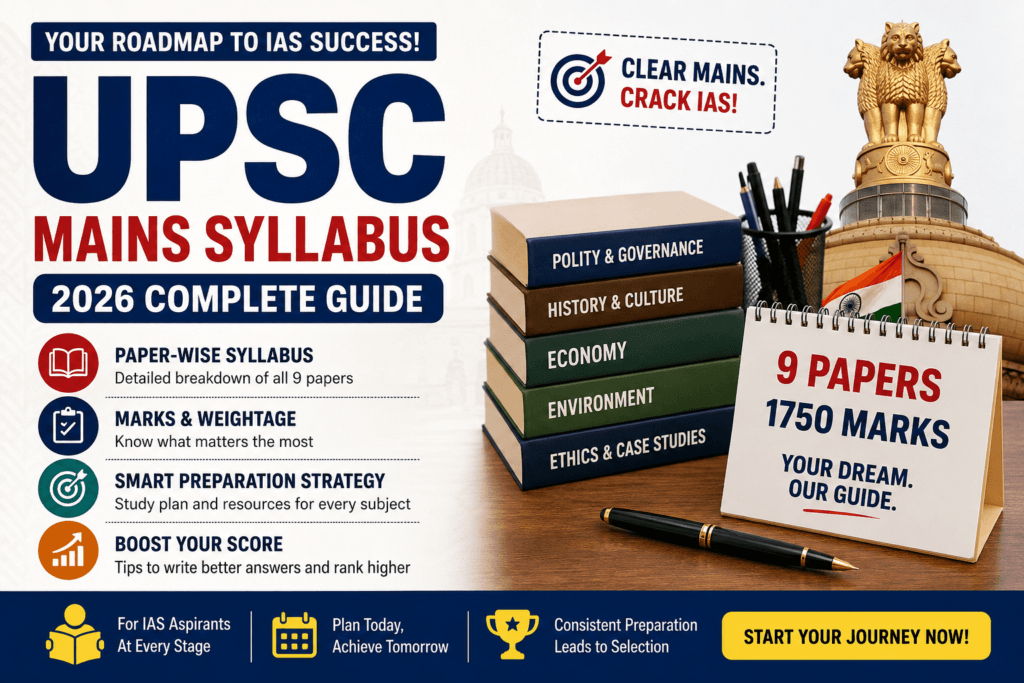
Every year, lakhs of aspirants clear the UPSC Prelims only to feel completely lost when they open the UPSC Mains syllabus for the first time. The sheer spread of subjects, the unfamiliar paper structure, and the pressure of descriptive writing can turn even a confident candidate into a nervous wreck. This guide breaks down the complete UPSC Mains Syllabus paper by paper, explains how marks are distributed, and shows you exactly what to focus on so you’re not wasting precious months on the wrong material.
The UPSC Civil Services Mains examination is not just a bigger version of the Prelims—it tests depth, articulation, and the ability to connect ideas across subjects. Unlike the objective-type prelims, mains demands that you write structured, analytical answers within strict word and time limits. Understanding the UPSC Mains syllabus properly is therefore not optional; it is the single biggest factor separating candidates who make it to the interview stage from those who don’t.
Why the UPSC Mains Syllabus Matters
Most candidates underestimate how directly the UPSC Mains syllabus shapes the entire preparation strategy. Since Mains carries far greater weightage than Prelims in the final merit list, every paper in the syllabus needs a dedicated study plan, regular answer-writing practice, and periodic revision. Aspirants who prepare without mapping their notes against the official syllabus often end up with either irrelevant knowledge or major gaps that surface only in the exam hall. A clear grasp of the syllabus structure also helps in selecting current affairs topics wisely, since not every news item is Mains-relevant.
It also helps to remember that the Mains stage is where the actual ranking happens. Prelims is only a screening test—its marks are not added to the final tally—so the hundreds of hours spent on the nine Mains papers are what ultimately decide selection and service allocation. Treating the syllabus document as a working blueprint, rather than a one-time read, is what separates aspirants who improve steadily from those who plateau after their first attempt.
UPSC Mains Syllabus: Paper-Wise Structure and Marks
The UPSC Mains Syllabus is divided into nine papers, though only seven are counted for merit ranking:
- Paper A: Compulsory Indian Language — Qualifying (300 marks)
- Paper B: English — Qualifying (300 marks)
- Paper I: Essay — 250 marks
- Paper II: General Studies I (History, Geography, Society) — 250 marks
- Paper III: General Studies II (Governance, Polity, IR) — 250 marks
- Paper IV: General Studies III (Economy, Environment, Security) — 250 marks
- Paper V: General Studies IV (Ethics, Integrity, Aptitude) — 250 marks
- Paper VI & VII: Optional Subject Papers I & II — 250 marks each
This brings the total merit-counted marks to 1750, followed by 275 marks for the personality test (interview), making the final tally 2025 marks.
General Studies Papers: A Closer Look
The four General Studies papers form the backbone of the syllabus and require the widest reading. Together they carry 1000 marks—nearly 57% of the total merit-counted score—which is why most serious preparation timelines are built around these four papers first, with the optional subject and essay layered in alongside.
GS Paper I covers Indian heritage and culture, world and Indian history, and topics like urbanization, globalization, and geographical phenomena. This paper rewards candidates who can connect historical events to their long-term social consequences rather than just memorizing dates.
GS Paper II focuses on governance, the Constitution, polity, social justice, and international relations. It is often considered the most current-affairs-heavy paper, since bills, judgments, and diplomatic developments from the past year regularly appear as direct questions.
GS Paper III deals with the Indian economy, agriculture, science and technology, the environment, and internal security. This paper demands familiarity with government schemes, economic surveys, and recent security-related developments.
GS Paper IV is unique because it tests ethics, integrity, and aptitude through case studies rather than direct factual questions. Many aspirants struggle here simply because they treat it like a theory paper instead of practicing structured, example-driven answers.
Optional Subject in the UPSC Mains Syllabus
Two papers worth 250 marks each are dedicated to an optional subject chosen by the candidate from a list that includes subjects like Public Administration, Sociology, Geography, History, and various literature options. The optional subject often becomes the real differentiator in final rank, since scores here tend to have wider variation than in General Studies. Choosing an optional based on genuine interest, availability of quality material, and personal academic background usually works better than chasing a subject purely because it appears “scoring” in a given year.
Essay and Language Papers
The Essay paper requires two essays of about 1000–1200 words each, chosen from different sections, and tests both writing ability and the depth of argument. Candidates who read widely across economy, society, ethics, and governance tend to do better here because they can draw connections between seemingly unrelated themes.
The qualifying language papers — the compulsory Indian language and English — do not count toward merit but must be cleared with minimum marks. Ignoring these papers has cost several well-prepared candidates their entire attempt, so they deserve at least basic, consistent practice.
Common Mistakes and Misconceptions in UPSC Mains Syllabus
- Treating the syllabus as a checklist instead of a framework. Simply “covering” topics without practicing how to write answers under time pressure rarely translates into good scores.
- Ignoring GS Paper IV until the last month. Ethics is scoring precisely because most candidates neglect it; last-minute preparation usually backfires.
- Choosing an optional subject based on rank-holder success stories alone. What worked for one candidate’s background and interest may not work for another.
- Underestimating the language papers. Some aspirants assume these are formalities and fail to clear the qualifying threshold, which disqualifies the entire attempt regardless of GS or optional scores.
- Not practicing answer writing regularly. Reading static and current affairs material is not the same as being able to produce a well-structured 150–250 word answer in 7–8 minutes.
Practical Tips to Cover the UPSC Mains Syllabus Efficiently
- Map every current affairs topic you read against the specific GS paper and sub-topic it belongs to, rather than reading news in isolation.
- Start answer writing practice early, even before your first reading of a topic is complete — it reveals gaps faster than passive revision.
- Revise static portions of GS I to III on a fixed weekly cycle instead of leaving them for the final months.
- Solve previous years’ Mains question papers topic-wise to understand how the same syllabus heading has been interpreted differently across years.
- Keep a separate, running note for Paper IV case studies and real-life examples, since these are hard to recall spontaneously in the exam.
Building a Realistic Study Timeline
Most successful candidates work backward from the exam date rather than forward from day one. A common approach is to divide preparation into three broad phases: a foundation phase for building static knowledge across GS I to III, a consolidation phase focused on current affairs integration and the optional subject, and a final revision-and-answer-writing phase in the last two to three months before Mains. Within each phase, weekly targets tend to work better than monthly ones, since weekly cycles make it easier to spot when a topic is falling behind schedule and adjust before too much time is lost.
Answer writing deserves its own dedicated time block rather than being squeezed in “whenever there’s time left.” Aspirants who write at least a few full-length answers every week, and get them evaluated by a mentor or peer group, consistently show faster improvement in structuring and time management than those who only read model answers. The goal by the final months should be to comfortably attempt a full GS paper — twenty questions in three hours — without running out of time on the later questions.
Frequently Asked Questions
How many papers are there in the UPSC Mains exam?
There are nine papers in total — two qualifying language papers, the Essay paper, four General Studies papers, and two optional subject papers.
Is the UPSC Mains Syllabus the same every year?
The core structure has remained largely stable for several years, though current affairs-linked sub-topics naturally shift with recent developments, so aspirants should always cross-check the latest official notification.
How is the optional subject different from the General Studies papers?
The optional subject allows candidates to choose one subject from a fixed list and study it in much greater depth, unlike General Studies, which covers a broad range of compulsory topics for every candidate.
Do the language papers count towards the final UPSC Mains ranking?
No, Paper A and Paper B are qualifying in nature; candidates must clear the minimum marks, but the scores are not added to the merit list.
What is the best way to start preparing for GS Paper IV?
Focus on understanding core concepts like integrity, probity, and emotional intelligence through case studies, and practice writing structured answers rather than memorizing definitions alone.
Can a candidate change their optional subject after Prelims?
Yes, candidates typically finalize the optional subject at the time of filling the Mains application, so there is some flexibility, though switching very late is generally not advisable given limited preparation time.
Conclusion
The UPSC Mains Syllabus can feel overwhelming at first glance, but breaking it into its nine papers and understanding how each one is weighted makes preparation far more manageable. Focus on consistent answer writing, don’t neglect the qualifying papers, and choose your optional subject with a long-term view rather than short-term trends. For candidates still preparing for the objective stage, our detailed guide on the UPSC Prelims Syllabus is a useful companion resource, and those exploring broader opportunities can check our regularly updated Government Exam Notifications section for upcoming applications.
