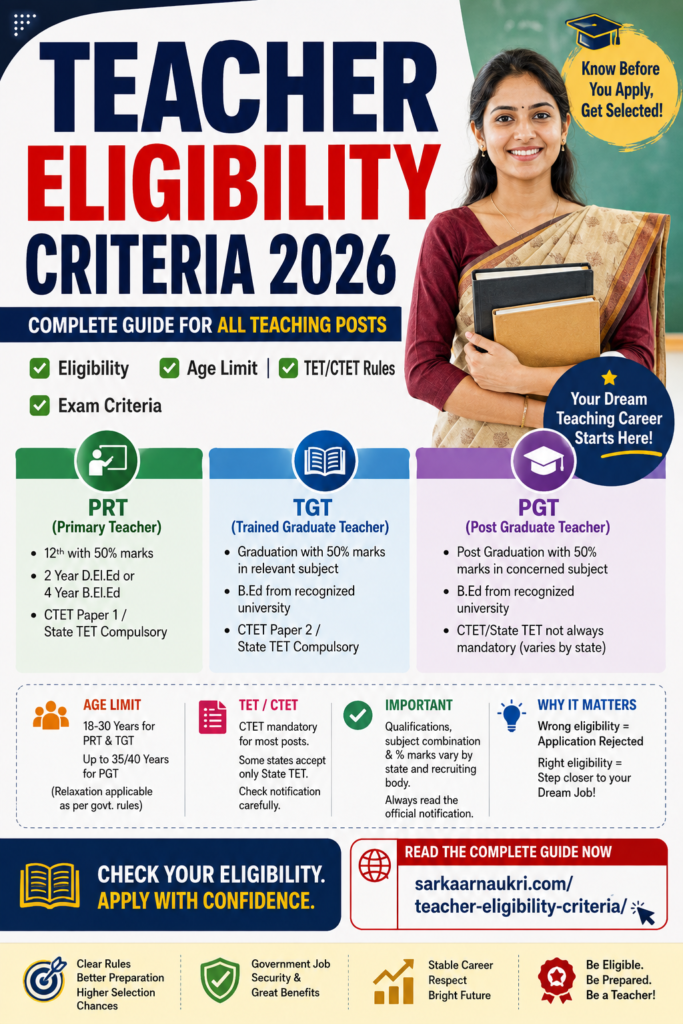
Every year, thousands of graduates dream of becoming government school teachers, yet a surprising number get rejected at the very first stage simply because they misread the Teacher Eligibility Criteria for the post they applied to. Teaching recruitment in India is not governed by one single rule. Qualifications, required tests, and age limits change depending on whether you are applying for a primary, upper primary, or senior secondary level post. This guide breaks down the Teacher Eligibility Criteria for every major teaching level so you can check your own qualification against the actual requirement before you spend time and money on an application.
Whether you are a fresh B.Ed graduate or someone who already holds a Diploma in Elementary Education, understanding the exact Teacher Eligibility Criteria that applies to your qualification saves you from the most common and most painful mistake candidates make: applying for a post you were never eligible for in the first place.
Why Understanding Teacher Eligibility Criteria Matters
Government teaching recruitment bodies scrutinize applications strictly, and a mismatch between your qualification and the post’s requirement leads to rejection at the document verification stage, often after you have already cleared the written exam. Getting the Teacher Eligibility Criteria right before you apply is not optional homework. It is the single biggest factor that decides whether your effort in exam preparation actually converts into a job offer.
Teacher Eligibility Criteria for Primary Teacher (PRT) Posts
For Primary Teacher posts, most states and central recruiting bodies require a Senior Secondary certificate with at least 50 percent marks, along with either a two year Diploma in Elementary Education or a four year Bachelor of Elementary Education degree. Passing the relevant Teacher Eligibility Test, commonly CTET Paper 1 or the state level TET, is compulsory in almost every case. Some states also accept a two year Diploma in Nursery Teacher Education for pre primary and lower primary posts specifically.
Teacher Eligibility Criteria for Trained Graduate Teacher (TGT) Posts
TGT posts generally require a bachelor’s degree in the relevant subject combination with at least 50 percent marks, along with a B.Ed degree from a recognized institution. Passing CTET Paper 2 or the equivalent state TET is usually mandatory. One point that trips up many candidates is subject combination. A B.A. in History and Political Science does not automatically qualify you for a Social Science TGT post in every state, since some recruiting bodies specify exact subject pairings.
Teacher Eligibility Criteria for Post Graduate Teacher (PGT) Posts
PGT posts sit at the top of the school teaching ladder and require a master’s degree in the concerned subject with a minimum of 50 percent marks, along with a B.Ed qualification. Unlike PRT and TGT posts, CTET or state TET is not always mandatory for PGT recruitment, though this varies by state and by the specific recruiting body, so checking the individual notification is essential rather than assuming a blanket rule.
Age Limit and Relaxation Rules
Age limits for teaching posts typically fall between 18 and 30 years for PRT and TGT posts, and up to 35 or sometimes 40 years for PGT posts depending on the state. Reserved category candidates receive standard government relaxation, commonly 5 years for SC/ST, 3 years for OBC, and up to 10 years for PwD candidates, though exact figures vary by recruiting body and should always be confirmed against the specific notification rather than assumed from a previous year’s rules.
State Specific Variations You Should Not Ignore
Teacher Eligibility Criteria is not identical across India. Some states run their own TET exam alongside CTET and only accept their own state TET for state government posts. Others accept both interchangeably. A few states also apply different minimum marks requirements for reserved category candidates at the qualification stage itself, not just at the exam stage. Before applying to any state level teaching post, checking that specific state’s latest eligibility notification is far safer than relying on a general understanding built from a different state’s rules.
Common Mistakes and Misconceptions
- Assuming CTET alone is enough: Passing CTET makes you eligible to apply. It does not guarantee selection, and it does not replace the additional educational qualification requirement.
- Ignoring subject combination rules: Many candidates assume any degree in a broad subject area qualifies them for a specific TGT or PGT post, when recruiting bodies often specify exact subject pairings.
- Confusing CTET with state TET: Some state recruitments accept only their own state TET score, not CTET, a distinction that catches out candidates who assume the two are interchangeable everywhere.
- Overlooking validity periods: Older CTET certificates had a fixed validity window before rules changed to lifetime validity. Candidates relying on very old score cards should confirm current validity rules rather than assuming automatic acceptance.
- Applying without checking B.Ed recognition: A B.Ed degree from an institution not recognized by the National Council for Teacher Education can lead to rejection even if every other qualification matches.
Practical Tips for Meeting Teacher Eligibility Criteria
- Read the eligibility section of every notification in full before applying, rather than assuming it matches a previous year’s requirement.
- Keep both CTET and any relevant state TET scorecards updated, since some posts accept only one or the other.
- Verify that your B.Ed or D.El.Ed institution is recognized by the appropriate regulatory body before relying on that qualification.
- If your subject combination is unusual, contact the recruiting body’s helpdesk or check the detailed notification annexure rather than guessing.
- Maintain organized digital copies of all mark sheets and certificates, since document verification often has a short window and incomplete submission at that stage can cost you the post.
How to Verify Your Teacher Eligibility Criteria Before Applying
Before submitting any application, run your own qualification through a quick checklist against the notification’s stated Teacher Eligibility Criteria. Start with your basic degree and percentage, then confirm your professional qualification (D.El.Ed, B.El.Ed, or B.Ed), and finally check whether a CTET or state TET score is mandatory for that specific post. Many candidates skip this last step and assume general Teacher Eligibility Criteria they read online applies uniformly, when the actual notification may carry additional conditions specific to that recruiting body or that year’s cycle.
It also helps to compare the current notification against the previous year’s Teacher Eligibility Criteria for the same post. Recruiting bodies occasionally revise minimum percentage requirements, subject combination rules, or age limits between cycles, and relying on outdated information is one of the most preventable reasons candidates get rejected at scrutiny despite being genuinely qualified.
Frequently Asked Questions
What is the minimum qualification needed to become a primary school teacher? A Senior Secondary certificate with at least 50 percent marks along with a Diploma in Elementary Education or B.El.Ed degree, plus a passing CTET or state TET score, is the standard Teacher Eligibility Criteria across most states.
Is CTET compulsory for all teaching posts? CTET is generally compulsory for PRT and TGT posts. For PGT posts, the Teacher Eligibility Criteria depends on the specific state or recruiting body, so it should not be assumed as a blanket rule.
Can a B.Ed degree replace a D.El.Ed for primary teacher posts? In most states, no. Primary teacher posts specifically require D.El.Ed or B.El.Ed, and a standard B.Ed alone does not satisfy this requirement, though a few states have made limited exceptions in specific notifications.
Does CTET have lifetime validity now? Yes, CTET certificates issued after the rule change now carry lifetime validity, though candidates with older certificates should confirm their specific certificate’s status before applying.
What subject combination is required for TGT Social Science posts? This varies by state and recruiting body, but most require a graduation degree covering History, Geography, and either Political Science or Economics, so checking the exact notification annexure is important.
Is there an age relaxation for candidates with teaching experience? Some states offer limited age relaxation for candidates with prior contractual or guest teaching experience, though this is not universal and should be verified against the specific state’s rules.
Do private school teaching qualifications count the same as government eligibility norms? Broadly yes for degree and B.Ed requirements, but government recruitment additionally requires a passing CTET or state TET score as part of the Teacher Eligibility Criteria, which private schools do not always mandate.
Conclusion
Meeting the correct Teacher Eligibility Criteria is the foundation every teaching career is built on, and getting it wrong wastes both time and application fees. Always cross check your qualification, subject combination, and test scores against the specific notification rather than a general assumption. For live vacancies matching your qualification, check our Latest Government Jobs section & Teacher Jobs Section, and for a deeper look at reservation based relaxations, see our Age Relaxation Rules guide.
