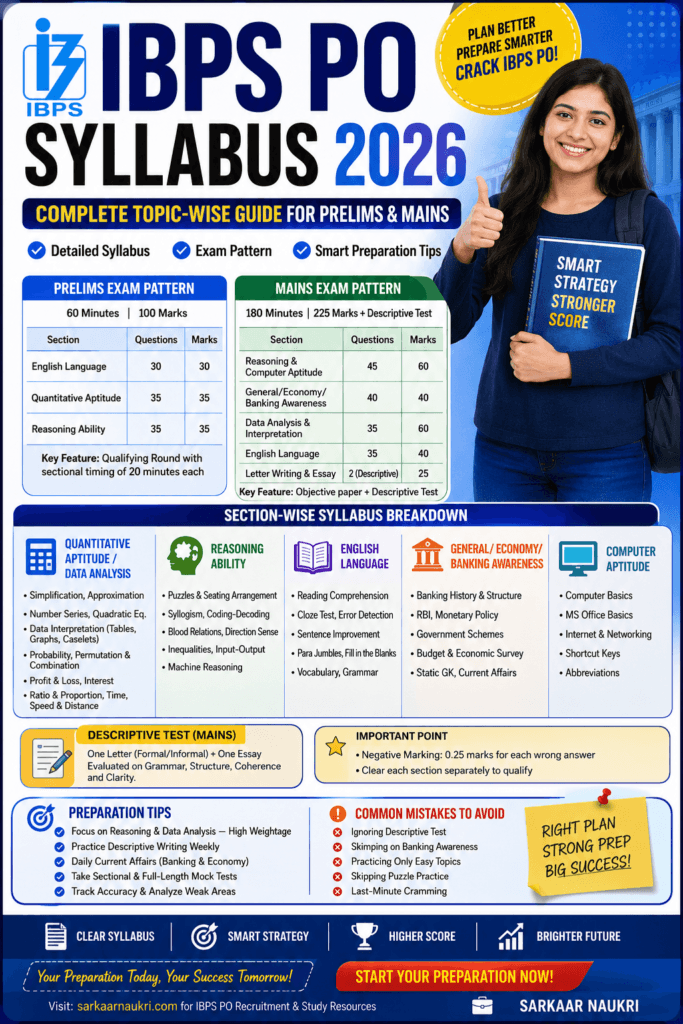
Every year, thousands of candidates prepare for IBPS PO without a clear picture of what the exam actually tests — leading to wasted hours on low-priority topics while high-weightage areas get ignored. The IBPS PO syllabus is structured across two stages, Prelims and Mains, each testing distinct skills. This guide breaks down the syllabus topic by topic, along with the exam pattern and a preparation strategy that reflects how the exam is actually weighted.
Unlike some banking exams, this syllabus places heavy emphasis on reasoning and data interpretation at the Mains level, along with a descriptive test many candidates underprepare for.
Why Understanding the Syllabus Matters
Jumping into mock tests without first mapping the IBPS PO syllabus is one of the most common mistakes candidates make. A clear, topic-wise understanding helps you:
- Prioritize sections that carry consistent year-on-year weightage
- Avoid over-investing time in topics that appear rarely
- Plan a realistic timeline across Prelims, Mains, and interview stages
- Prepare for the descriptive writing component, which is unique among most clerical-level exams
Because IBPS follows a fairly consistent pattern year to year, previous papers are a reliable guide to what actually matters.
Prelims Exam Pattern
The Prelims stage of the IBPS PO syllabus is a qualifying round with three sections in a single 60-minute test:
| Section | Topics Covered | Questions | Marks |
|---|---|---|---|
| English Language | Reading comprehension, cloze tests, error detection, para jumbles | 30 | 30 |
| Quantitative Aptitude | Simplification, data interpretation, quadratic equations, arithmetic | 35 | 35 |
| Reasoning Ability | Puzzles, seating arrangement, syllogism, coding-decoding, inequalities | 35 | 35 |
With sectional timing of 20 minutes each, this stage rewards speed as much as accuracy.
Mains Exam Pattern
Mains is significantly more demanding. The IBPS PO syllabus at this stage includes the following:
| Section | Topics Covered | Questions | Marks |
|---|---|---|---|
| Reasoning & Computer Aptitude | Puzzles, blood relations, input-output, computer basics | 45 | 60 |
| General/Economy/Banking Awareness | Banking history, current affairs, RBI functions, economic terms | 40 | 40 |
| Data Analysis & Interpretation | Tables, graphs, caselets, data sufficiency, probability | 35 | 60 |
| English Language | Vocabulary, grammar, comprehension, sentence correction | 35 | 40 |
| Letter Writing & Essay | One letter and one essay, tested online | 2 | 25 |
A part many first-time candidates overlook is the descriptive test, conducted immediately after the objective Mains paper.
Section-Wise Breakdown
Quantitative Aptitude / Data Analysis
This is one of the most scoring but time-intensive parts of the IBPS PO syllabus. Core topics include simplification and approximation, number series, quadratic equations, data interpretation across multiple formats, probability, permutation and combination, profit and loss, simple and compound interest, ratio and proportion, and time-speed-distance.
Reasoning Ability
Reasoning consistently carries the highest weightage in this syllabus. Key areas are puzzles and seating arrangement (circular, linear, floor-based, box-based), syllogism, coding-decoding, blood relations, direction sense, inequality, and input-output-based machine reasoning.
English Language
The English component tests applied language ability: reading comprehension (including inference-based questions), a cloze test, error spotting, sentence improvement, para jumbles, and fill-in-the-blanks.
General, Economy and Banking Awareness
This section is exclusive to Mains and forms a distinct pillar of the IBPS PO syllabus. It covers banking structure and history, RBI monetary policy, government financial schemes, budget highlights, static GK, and current affairs from roughly the preceding six months.
Computer Aptitude
A smaller but reliably scoring section, covering computer fundamentals, MS Office basics, networking and internet basics, and common abbreviations.
Descriptive Test (Letter Writing and Essay)
This is the section most candidates neglect while preparing for the IBPS PO syllabus. It tests one formal or informal letter and one essay, both typed directly on-screen, and evaluates structure, grammar, and clarity of expression rather than just content knowledge.
Common Mistakes in Preparation
Ignoring the descriptive test until the last week. Because it’s the final hurdle in Mains, many candidates treat this part of the IBPS PO syllabus as an afterthought and lose easy marks on structure and presentation.
Underestimating sectional cutoffs. Every stage requires clearing each section individually, not just an overall score.
Treating Data Analysis and Quant as identical. Mains-level data analysis is noticeably harder and more calculation-intensive than Prelims Quant.
Skipping daily puzzle practice. Reasoning puzzles are consistently the highest-weightage topic within the IBPS PO syllabus, yet many candidates practice them inconsistently.
Neglecting banking awareness until close to Mains. Since this section rewards long-term retention, cramming it late works against how the exam is structured.
Practical Tips to Cover the Syllabus Efficiently
- Prioritise reasoning and Data Analysis early, since these carry the heaviest marks across the IBPS PO syllabus.
- Practice descriptive writing weekly from the start rather than only before Mains
- Dedicate 15–20 minutes daily to banking and economy current affairs
- Use sectional mock tests before attempting full-length papers
- Track section-wise accuracy separately, since the IBPS PO Syllabus is scored and cleared section by section, not just overall
Frequently Asked Questions
Is the IBPS PO syllabus the same for Prelims and Mains?
No, Prelims covers three objective sections, while Mains adds banking awareness, data analysis, computer aptitude, and a separate descriptive test, making the Mains stage considerably broader.
Does the IBPS PO syllabus include an interview after Mains?
Yes, candidates who clear Mains proceed to a personal interview, which is separate from the written syllabus but factors into the final merit list.
How is the descriptive test evaluated?
It’s evaluated on grammar, structure, coherence, and clarity of the letter and essay, typed within a fixed word limit and time.
Is negative marking applicable across the IBPS PO syllabus sections?
Yes, 0.25 marks are deducted per wrong answer in both the prelims and the objective mains paper; the descriptive test has no negative marking.
How much weightage does computer aptitude carry?
It’s clubbed with Reasoning in Mains and typically contributes a smaller share of questions, but it’s considered high-scoring if prepared early.
Is the IBPS PO syllabus different from the IBPS Clerk syllabus?
The core sections overlap significantly, but IBPS PO adds data analysis, a descriptive test, and an interview stage not present in the clerk process.
Related Bank Exam Syllabus Guide
Conclusion
Mastering the IBPS PO syllabus comes down to recognising where the exam places the heaviest weight – Reasoning and Data Analysis – while not neglecting the often-overlooked Descriptive Test. A structured, topic-wise approach to preparation, paired with consistent mock practice and current affairs revision, puts you well ahead of candidates who study without a clear roadmap.
For more exam-specific preparation guidance, check our [IBPS PO Recruitment Notification] page and browse other [Bank Job Guides] for related exams.
