Introduction
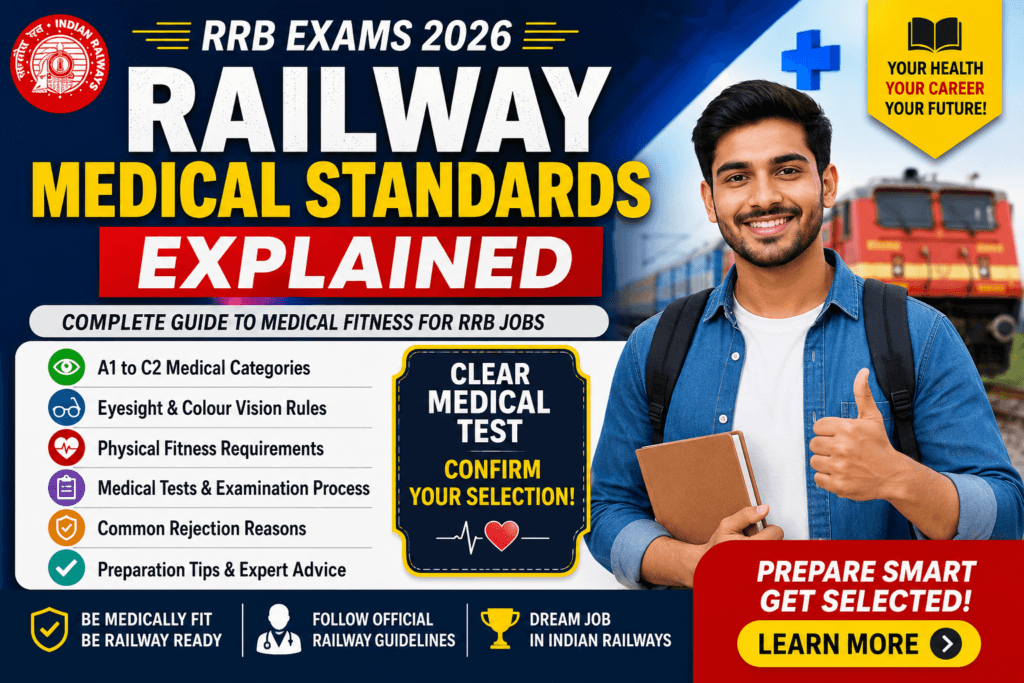
Every year, lakhs of candidates prepare for Railway Recruitment Board (RRB) examinations hoping to secure a stable government job. Many focus entirely on the written examination, CBT, PET, or document verification but overlook one equally important stage—the Railway Medical Examination. Unfortunately, numerous candidates who perform well in the written examination fail to secure their appointment because they do not satisfy the prescribed medical standards for their chosen post.
This guide on Railway Medical Standards Explained is designed to remove every confusion regarding railway medical fitness. Whether you are applying for RRB NTPC, Group D, Assistant Loco Pilot (ALP), Technician, Junior Engineer (JE), Paramedical Staff, or Ministerial posts, understanding Railway Medical Standards Explained before submitting your application can save you from disappointment later.
In this comprehensive guide, you will learn how Indian Railways classifies medical standards, what doctors examine during the medical test, eyesight and colour vision requirements, common reasons candidates are declared medically unfit, and practical preparation tips that can improve your confidence before appearing for the examination.
Why Railway Medical Standards Explained Is Important for Every Candidate
Many candidates assume that clearing the CBT guarantees selection. However, railway recruitment follows multiple stages, and the medical examination is one of the final eligibility checks before appointment.
Understanding Railway Medical Standards Explained helps candidates:
- Apply only for posts they are medically eligible for.
- Understand eyesight and colour vision requirements.
- Avoid unnecessary application fees for unsuitable posts.
- Prepare mentally for the medical examination.
- Reduce the chances of rejection during the final stage.
Indian Railways operates one of the largest rail networks in the world. Employees working in train operations, signalling, maintenance, electrical systems, and passenger services perform duties where even a minor medical issue may affect operational safety. Therefore, every post is assigned a specific medical category.
What Is the Railway Medical Examination?
The Railway Medical Examination is an official health assessment conducted after candidates qualify the recruitment stages prescribed for their post.
Its purpose is to determine whether a candidate is physically and medically capable of performing the responsibilities associated with the selected railway position.
The examination generally evaluates:
- Vision
- Colour perception
- Hearing ability
- General physical health
- Cardiovascular fitness
- Respiratory health
- Neurological condition
- Musculoskeletal fitness
- Medical history
Understanding Railway Medical Standards Explained before reaching this stage ensures candidates know exactly what the Railway Medical Board expects.
Railway Medical Categories Explained
One of the most important aspects of Railway Medical Standards Explained is understanding the six medical classifications used by Indian Railways.
These categories range from A1 (most stringent) to C2 (least restrictive).
A1 Medical Category
The A1 category has the highest medical requirements in Indian Railways.
Typical posts include:
- Assistant Loco Pilot
- Loco Pilot
- Train Driver
- Certain operational safety posts
Candidates must possess:
- Excellent distant vision
- Excellent near vision
- Perfect colour perception
- Normal binocular vision
- Healthy night vision
- No eye diseases affecting safety
The standards remain extremely strict because these employees directly control train movement.
For anyone applying to these posts, Railway Medical Standards Explained should be studied thoroughly before application.
A2 Medical Category
The A2 category also requires excellent medical fitness but is slightly less restrictive than A1.
Generally applicable for:
- Signal staff
- Certain electrical departments
- Safety-related supervisory positions
Medical examination includes:
- Distance vision
- Near vision
- Colour vision
- Hearing ability
- Physical health assessment
Candidates should not assume A2 standards are easy; they remain among the toughest medical categories in railway recruitment.
A3 Medical Category
The A3 category applies to many field-based operational posts.
Examples include:
- Guards
- Yard operational staff
- Technical field employees
Doctors assess:
- Visual acuity
- Eye coordination
- General physical health
- Hearing capability
- Musculoskeletal fitness
Understanding Railway Medical Standards Explained helps candidates determine whether these operational posts match their medical profile.
B1 Medical Category
The B1 medical category is common for technical railway positions.
Typical examples include:
- Junior Engineer
- Signal Maintainer
- Track Machine Staff
- Technical Supervisors
Medical requirements include:
- Good eyesight
- Functional colour vision
- Healthy hearing
- Overall physical fitness
Although less restrictive than A-category standards, B1 posts still involve safety responsibilities.
B2 Medical Category
The B2 category generally applies to workshop and maintenance positions.
Candidates undergo examinations for:
- Vision
- General health
- Physical mobility
- Hearing
- Coordination
Many candidates mistakenly believe B2 has no medical standards. In reality, Railway Medical Standards Explained clearly shows that every railway employee must satisfy prescribed fitness norms.
C1 Medical Category
C1 standards are generally applicable for administrative and commercial posts.
Examples include:
- Commercial Clerk
- Goods Clerk
- Reservation Clerk
- Ticket-related positions
The medical examination focuses primarily on:
- Functional vision
- Hearing
- General physical health
- Medical history
Candidates still need to satisfy the prescribed standards even though these jobs are less physically demanding.
C2 Medical Category
C2 is the least restrictive railway medical category.
Usually applicable for:
- Office assistants
- Accounts staff
- Ministerial positions
- Clerical departments
Although comparatively relaxed, candidates are still expected to be medically fit for regular government service.
Understanding Railway Medical Standards Explained allows candidates to identify which posts are realistically suitable based on their health condition.
Eyesight Standards Under Railway Medical Standards Explained
Eyesight is one of the most important components of Railway Medical Standards Explained.
Every candidate undergoes a detailed ophthalmic examination conducted by authorized railway medical officers.
The examination normally includes:
Distance Vision Test
Doctors evaluate how clearly a candidate can identify distant objects using standardized vision charts.
Different posts require different minimum vision standards.
Near Vision Test
Near vision is checked to ensure candidates can comfortably read documents, instruments, control panels, technical manuals, and digital displays.
Colour Vision Test
Colour perception is especially important for safety-category posts.
Candidates may undergo:
- Ishihara Colour Test
- Lantern Test
- Other approved colour perception examinations
Failure to distinguish railway signal colours may lead to disqualification for specific posts.
Binocular Vision
Railway doctors assess whether both eyes work together effectively.
Good binocular vision helps employees judge speed, distance, and movement accurately.
Night Vision
For certain operational categories, doctors also verify normal night vision.
Candidates working in train operations often perform duties during nighttime, making this assessment important.
Understanding Railway Medical Standards Explained helps candidates appreciate why eye health receives so much attention during recruitment.
Hearing Standards
Good hearing is equally essential in railway operations.
Doctors evaluate whether candidates can hear:
- Normal conversation
- Warning signals
- Safety alarms
- Operational communication
Hearing impairment may affect eligibility for several safety-sensitive posts.
Physical Examination
The Railway Medical Board also performs a comprehensive physical examination that includes:
- Height
- Weight
- Body Mass Index
- Blood Pressure
- Heart examination
- Lung examination
- Spine assessment
- Joint movement
- Limb function
- Neurological evaluation
- General health screening
The objective is to ensure candidates can safely perform the responsibilities of their selected railway post.
Common Reasons Candidates Fail the Railway Medical Examination
Despite clearing the Computer-Based Test (CBT), Physical Efficiency Test (PET), or document verification, some candidates are declared medically unfit. Understanding these issues in advance is an important part of Railway Medical Standards Explained and helps aspirants avoid unpleasant surprises.
1. Colour Vision Deficiency
Colour blindness is one of the leading reasons for rejection in safety-related railway posts. Employees responsible for train operations must accurately identify red, green, and yellow railway signals. Even mild colour vision defects may make a candidate ineligible for A1, A2, or certain B1 category posts.
2. Poor Eyesight
Candidates whose eyesight does not meet the prescribed standards for their selected post may be declared medically unfit. The required visual acuity varies according to the medical category assigned to the post.
3. Hearing Impairment
Railway employees often rely on audible warnings, communication devices, and operational signals. Significant hearing loss may affect eligibility for several technical and operational posts.
4. Uncontrolled Lifestyle Diseases
Conditions such as uncontrolled diabetes, hypertension, severe cardiac disease, or chronic respiratory illnesses may require additional medical evaluation. Candidates are encouraged to keep such conditions well managed before appearing for the examination.
5. Orthopaedic or Neurological Problems
Serious spine disorders, joint deformities, restricted limb movement, or neurological conditions affecting coordination may impact medical fitness depending on the duties of the post.
6. Providing Incorrect Medical Information
Concealing previous surgeries or significant medical conditions can create complications during verification. Always provide accurate information if asked by the Railway Medical Board.
Understanding Railway Medical Standards Explained helps candidates identify these potential issues well before the recruitment reaches the medical stage.
Common Myths About Railway Medical Standards Explained
Many aspirants rely on rumours instead of official guidelines. Here are some of the most common misconceptions.
Myth 1: Every Railway Job Requires Perfect Eyesight
Incorrect. Office-based and clerical posts generally have comparatively relaxed medical standards. However, operational posts require stricter vision requirements.
Myth 2: Wearing Spectacles Means Automatic Rejection
False. Several railway posts permit candidates to wear spectacles if the corrected vision satisfies the prescribed medical category.
Myth 3: Colour Blindness Does Not Matter
Incorrect. Colour perception is one of the most important aspects of Railway Medical Standards Explained for safety-category posts.
Myth 4: Medical Examination Is Just a Formality
The Railway Medical Examination is a mandatory stage of recruitment. A candidate who fails to meet the required medical standards may not be appointed, even after clearing every previous stage.
Practical Tips to Clear the Railway Medical Examination
Although some medical conditions cannot be changed, proper preparation can reduce avoidable problems.
Get an Eye Examination Early
If you plan to apply for operational posts, visit an ophthalmologist before submitting your application. Knowing your visual acuity and colour vision status beforehand helps you select suitable posts.
Maintain a Healthy Lifestyle
Regular exercise, balanced nutrition, and sufficient sleep contribute to better overall health and can help maintain normal blood pressure and weight.
Control Existing Medical Conditions
Candidates with diabetes or hypertension should follow medical advice and ensure their condition remains under control before the examination.
Carry Required Documents
If you have undergone surgery or received treatment that does not affect your fitness, keep relevant medical records available in case clarification is required.
Avoid Last-Minute Stress
Reach the medical examination centre on time, stay hydrated, and follow all instructions provided by the Railway Medical Board.
Preparing well in advance is one of the best ways to benefit from Railway Medical Standards Explained and approach the examination with confidence.
Who Should Read Railway Medical Standards Explained?
This guide is useful for candidates applying to:
- RRB NTPC
- RRB Group D
- RRB ALP
- RRB Technician
- RRB Junior Engineer
- RRB Paramedical Recruitment
- Railway Ministerial & Isolated Categories
- Railway Apprentices (where applicable)
Regardless of the recruitment, understanding Railway Medical Standards Explained enables candidates to make informed career decisions.
Frequently Asked Questions
1. What are Railway Medical Standards Explained?
Railway Medical Standards Explained refers to the official medical fitness requirements prescribed by Indian Railways for different categories of railway posts. These standards determine whether a candidate is medically fit to perform the duties associated with a particular position.
2. Are medical standards the same for every railway post?
No. Different posts fall under different medical categories such as A1, A2, A3, B1, B2, C1, and C2. The required medical fitness depends on the nature of the job.
3. Can I join Indian Railways if I wear spectacles?
Yes. Several railway posts allow candidates to wear spectacles if their corrected vision meets the prescribed standards. However, certain safety-related posts have stricter vision requirements.
4. Is colour blindness allowed in railway jobs?
It depends on the medical category. Safety-related operational posts generally require normal colour perception because employees must correctly identify railway signals.
5. Can I appeal if I fail the Railway Medical Examination?
Indian Railways has provisions for review medical examinations in specific situations, subject to the applicable recruitment rules and procedures.
6. Which railway posts have the strictest medical standards?
Assistant Loco Pilot, Loco Pilot, and other safety-category operational posts generally require A1 or A2 medical standards.
7. Does Railway Group D have a medical examination?
Yes. Candidates selected for Railway Group D posts must undergo a medical examination according to the medical category prescribed for the respective post.
8. Why is Railway Medical Standards Explained important before applying?
Studying Railway Medical Standards Explained before applying helps candidates understand the eligibility requirements, choose suitable posts, and reduce the risk of rejection during the final stage of recruitment.
Conclusion
Understanding Railway Medical Standards Explained is just as important as preparing for the written examination. Every railway post has its own medical category, and candidates must satisfy the prescribed standards related to eyesight, hearing, physical fitness, and overall health. Before submitting any railway application, carefully check the medical category mentioned in the official notification and assess whether you meet the required standards. A little preparation today can prevent disappointment later and significantly improve your chances of beginning a successful career with Indian Railways. By following the guidance provided in Railway Medical Standards Explained, aspirants can approach the recruitment process with greater clarity and confidence.
Related Guides
- Government Job Medical Test Guide: https://sarkaarnaukri.com/category/guides/
- Latest Railway Recruitment Notifications: https://sarkaarnaukri.com/category/railway-jobs/
External Links
- Indian Railways Medical Manual (Medical Examination Rules): Indian Railways Medical Manual – Chapter V
- RRB Medical Standards (Official PDF): Railway Medical Standards PDF
- Railway Recruitment Board Portal: Railway Recruitment Board (RRB) Official Website
