Every year, lakhs of candidates apply for sub-Inspector posts, yet only a small fraction manage to clear both the written test and the physical standards. If you are wondering where to begin your SI Exam preparation, you are not alone. Most aspirants struggle not because the syllabus is impossible, but because their preparation lacks structure. This guide breaks down exactly how to plan your SI Exam preparation so that you cover every stage of the selection process with confidence, from the written exam to the physical efficiency test and the final interview.
Why SI Exam Preparation Needs a Different Approach
Sub-Inspector recruitment is unlike most other government job exams because it tests candidates on three very different fronts at once: academic knowledge, physical fitness, and psychological readiness. A candidate who is excellent at general knowledge but neglects running practice can still fail. Similarly, someone who is physically fit but weak in reasoning and numerical ability will struggle to clear the written round. This is exactly why SI Exam Preparation cannot be treated the same way as preparation for a purely desk-based government job. It demands a balanced routine that gives equal weight to books and boots.
Understanding the SI Exam Pattern Before You Start
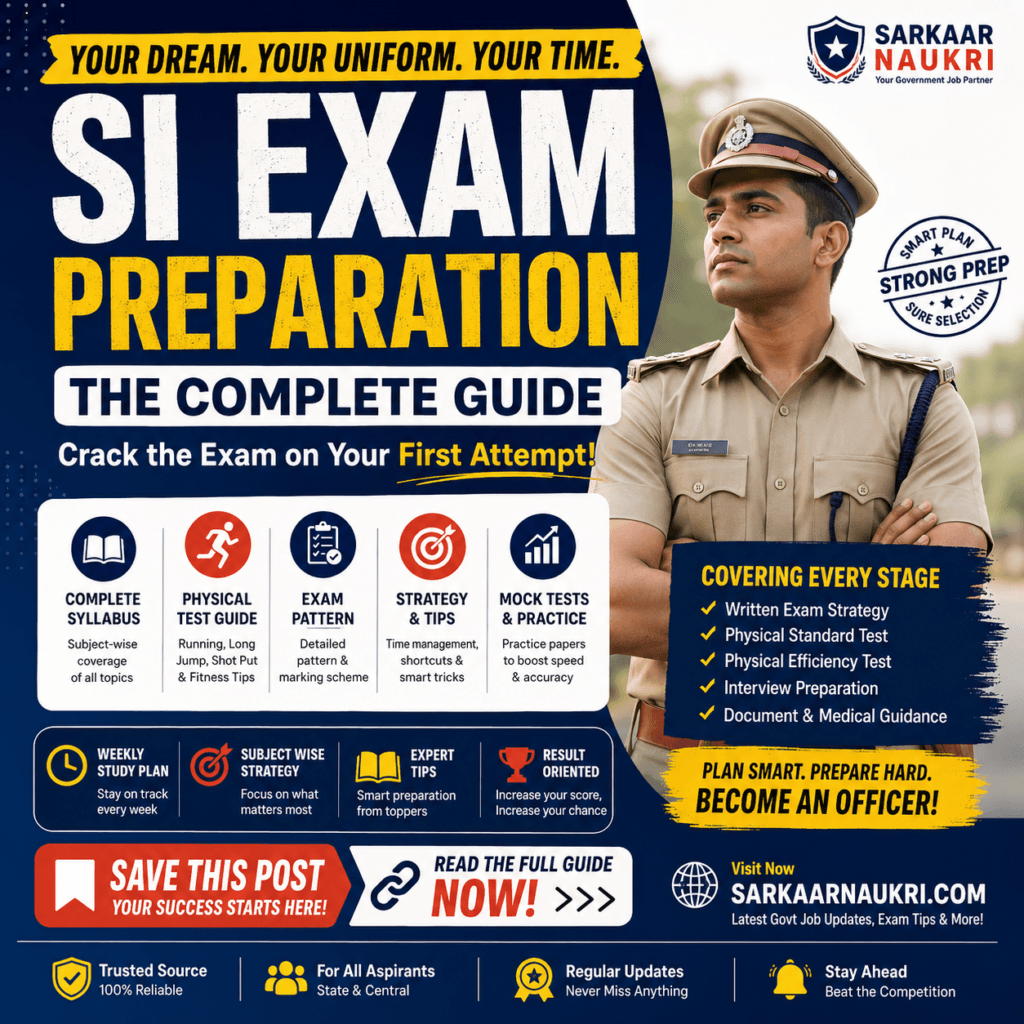
Before diving into any SI Exam Preparation plan, it is essential to understand how the selection process is usually structured. Most State Police and Central Armed Police Force SI recruitments follow a similar pattern:
- Written Examination (objective type, covering general knowledge, reasoning, numerical ability, and English or the regional language)
- Physical Standard Test (height, chest, and sometimes vision standards)
- Physical Efficiency Test (running, long jump, shot put, or similar events depending on the state)
- Interview or Personality Test
- Document Verification and Medical Examination
Each recruiting body tweaks this pattern slightly, so always check the official notification of the specific SI post you are targeting before finalizing your study schedule.
Subject-Wise SI Exam Preparation Strategy
General Knowledge and Current Affairs
General Knowledge typically carries significant weightage in SI written exams. Focus on your SI exam. Preparation on Indian history, polity, geography, and static general knowledge topics, along with the last six to twelve months of current affairs. Reading a daily newspaper and maintaining short handwritten notes works far better than passively scrolling through news apps, because writing things down improves recall during the actual exam.
Reasoning and Mental Ability
Reasoning questions in SI exams usually include coding and decoding, blood relations, series completion, syllogisms, and analytical puzzles. This section rewards practice more than memorization, so daily timed quizzes should form a core part of your SI Exam preparation. Aim to solve at least thirty reasoning questions every day, gradually increasing difficulty as your accuracy improves.
Numerical or Quantitative Ability
Basic arithmetic, percentages, ratio and proportion, time and work, and data interpretation are the recurring themes here. Many candidates ignore this section during early SI exam preparation and regret it later, since a weak numerical score can drag down an otherwise strong overall result. Revise formulas weekly and practice speed calculation techniques to save time in the exam hall.
English or Regional Language
Grammar, vocabulary, comprehension passages, and error detection are common question types. Read short editorials daily and note down unfamiliar words, since building vocabulary gradually is far more effective than last-minute cramming.
Building a Physical Test Plan Alongside Academics
Physical fitness is often the most neglected part of SI exam preparation, yet it disqualifies more candidates than the written test itself. Start training for running, long jump, and shot put at least four to six months before the exam. Build a weekly routine that mixes endurance running with strength training, and track your timing regularly against the official qualifying standard for your category. Treating physical training with the same seriousness as academic study is one of the biggest differentiators between candidates who clear the SI Exam Preparation cycle successfully and those who fall short at the final stage.
State-Wise Variations You Should Check
Every recruiting body sets its own syllabus weightage, physical standards, and exam pattern, so a generic plan needs local adjustment. Some states include a separate paper for the regional language, while central forces usually stick to general knowledge, reasoning, numerical ability, and English. Physical standards also differ widely: qualifying timings for the 100-meter and 800-meter runs, the height and chest requirements, and even relaxation rules for reserved categories can vary from one recruiting body to another. Before locking in your final SI Exam Preparation timetable, download the official notification for the specific post you are targeting and note down every deadline, cutoff, and standard mentioned in it, since relying on outdated information from previous years can cost you valuable time.
A Sample Weekly Timetable
A realistic weekly routine keeps preparation sustainable over many months instead of burning candidates out in a few weeks. One workable structure looks like this:
- Monday to Friday mornings: physical training, alternating between running days and strength or flexibility days
- Monday to Friday evenings: two subjects covered in rotation, with one hour dedicated to solving practice questions
- Saturday: one full length mock test taken under strict timed conditions, followed by detailed error analysis
- Sunday: revision of the week’s notes, current affairs catch-up, and light physical recovery activity
This kind of rhythm works well because it prevents any single subject or skill from being neglected for too long, and it builds the stamina needed for both the written exam and the physical test on the same footing.
Common Mistakes Candidates Make During SI Exam Preparation
- Ignoring the physical test until the last month, leading to injuries and poor performance
- Studying every subject in isolation instead of practicing full-length mock tests under timed conditions
- Relying only on video lectures without solving previous year’s question papers
- Skipping revision and moving straight to new topics every day
- Underestimating negative marking and guessing randomly in the written exam
- Not tracking sectional accuracy, which makes it hard to identify weak areas early
- Comparing personal progress with other candidates instead of tracking individual improvement
- Switching study sources too often, which breaks continuity and wastes revision time
Practical Tips to Strengthen Your SI Exam Preparation
- Create a weekly timetable that allocates fixed hours to each subject and to physical training
- Attempt at least one full-length mock test every week and analyze mistakes the same day
- Maintain a single revision notebook for formulas, current affairs, and tricky reasoning tricks
- Sleep and nutrition matter as much as study hours, since physical fitness tests demand real stamina
- Join a study group or online forum to stay accountable and motivated through a long preparation cycle
- Revisit previous year cutoffs regularly so your SI Exam preparation stays aligned with a realistic target score
Frequently Asked Questions
How many months are ideal for SI Exam Preparation? Most successful candidates spend eight to twelve months preparing in a focused, structured way, combining academic study with steady physical training rather than cramming everything in the final weeks.
Can a working professional manage SI Exam Preparation alongside a job? Yes, many working candidates clear SI exams by dedicating two to three focused hours daily and using weekends for mock tests and physical practice, though consistency matters more than total hours.
Which subject should be prioritized first when preparing for the SI exam? There is no universal answer, but most mentors suggest starting with your weakest subject early so there is enough time left for revision before the exam date.
Is coaching necessary for the SI exam or can self study work? Self-study works well if you follow a structured plan and solve enough mock tests, though coaching can help with discipline and doubt clearing for candidates who struggle with self-motivation.
How important is the physical test compared to the written exam? Both stages are equally important because failing either one eliminates a candidate, so physical training should never be postponed in favor of academics alone.
What is a good daily study routine for candidates preparing for the SI exam? A balanced routine typically includes two to three hours of academic study, one hour of physical training, and thirty minutes of current affairs revision, adjusted based on how close the exam date is.
How do I improve speed for the numerical ability section? Regular timed practice, memorizing key formulas, and learning shortcut calculation methods are the most effective ways to build speed for the numerical section over a few months.
Are previous year’s question papers useful for candidates preparing for the SI exam? Yes, solving previous year papers helps candidates understand the actual difficulty level and question pattern, which is often more valuable than solving generic practice questions alone.
Conclusion
A well-structured SI exam preparation plan balances academic study, physical training, and regular self-assessment through mock tests. Candidates who treat every stage of the selection process with equal seriousness, rather than focusing only on the written exam, tend to perform far better across the full recruitment cycle. For more detailed guidance, check our articles on Government Job Exam Preparation Tips and Physical Test Standards for Police Recruitment to round out your study plan.
