Most candidates preparing for a police job know the exam pattern inside out but have only a rough idea of what they will actually earn once selected, which is exactly the gap this Police Salary Guide is meant to close. Pay in the police department is not a single number. It is built from a basic pay level fixed under the 7th Pay Commission, layered with allowances that vary by force, posting, and city, and it changes again with every promotion. This Police Salary Guide breaks down what constables, sub inspectors, and other ranks actually take home, how state police pay compares with central forces, and the mistakes candidates commonly make when estimating their future salary.
Why Understanding Pay Structure Matters
A police salary is rarely just the number printed in a recruitment notification. That figure is usually the basic pay at the entry point of a pay level, and the actual monthly credit includes dearness allowance, house rent allowance, and a set of force-specific allowances on top of it. Understanding this structure matters because two candidates joining different forces at what looks like the same rank can end up with meaningfully different in-hand pay once allowances are factored in. This Police Salary Guide focuses on the components that make up the total package, not just the headline basic pay figure, since that headline number alone tells an incomplete story. Candidates who skip this step often base their financial planning on an inflated or deflated expectation, which can be avoided simply by reading a proper Police Salary Guide before joining rather than after the first payslip arrives.
Constable Level Pay Structure
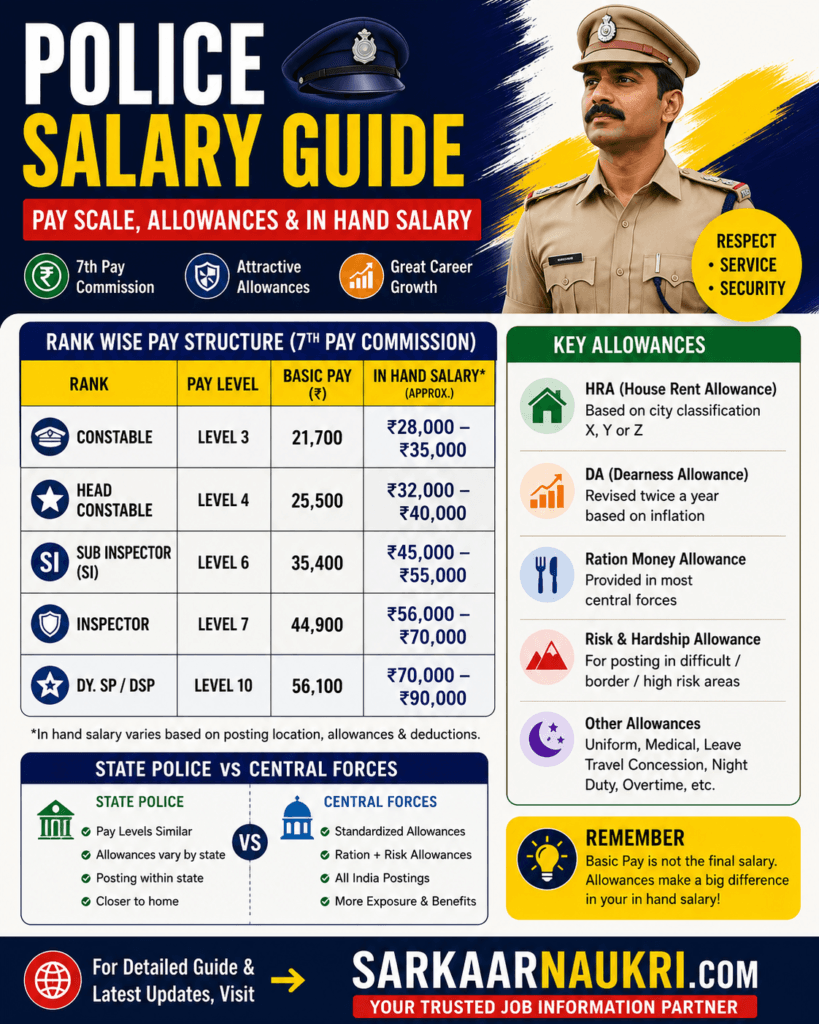
Constables across most state police forces and central armed police forces are placed in Pay Level 3 of the 7th Pay Commission matrix, which starts with a basic pay in the range of roughly 21,700 rupees. On top of this basic pay, dearness allowance is added twice a year based on inflation, house rent allowance depends on the city classification of the posting, and forces such as CRPF, BSF, ITBP, SSB, and CISF also add a risk and hardship allowance for personnel posted in difficult terrain or border areas. This is one of the most useful sections of any Police Salary Guide for fresh applicants, since constable is the entry rank for the overwhelming majority of police recruitment. Candidates should note that the figures above are basic pay only, and a complete Police Salary Guide always separates basic pay from the gross and net figures that actually reflect what lands in the bank account each month.
Sub Inspector and Higher Rank Pay Structure
Sub Inspectors are generally placed in Pay Level 6, with a basic pay starting significantly higher than the constable level, typically in the range of 35,400 rupees before allowances. Assistant Sub Inspectors and Head Constables sit between the constable and Sub Inspector levels, in Pay Level 4 or 5 depending on the force. Inspectors move up further still. As rank increases, the gap between basic pay and total in-hand salary tends to widen, since allowance rates and eligibility also improve with seniority. Any Police Salary Guide aimed at long-term career planning should account for this widening gap rather than comparing only the entry-level basic pay across ranks. Inspectors, Deputy Superintendents, and higher ranks follow the same pattern, with each step up the pay matrix bringing both a higher basic pay and better allowance eligibility, which is why a rank-by-rank Police Salary Guide is more useful than a single average figure for the whole force.
State Police vs Central Forces: Comparing the Police Salary Guide Numbers
State police salaries and central armed police force salaries often look similar on paper because both frequently start at the same pay level, but the actual take-home differs because of allowance structure. Central forces typically offer a more standardized allowance package nationwide, including ration money allowance and transfer-related benefits, since personnel are posted across the country rather than within one state. State police allowances vary more by state government policy, and some states offer additional local allowances that central forces do not. Neither option is straightforwardly better, since state police postings usually mean staying closer to home, while central forces trade that convenience for broader allowance coverage and faster all-India postings. A side-by-side Police Salary Guide comparison is most useful when it accounts for posting preference alongside the raw pay numbers, since the better financial choice on paper is not always the better lifestyle choice in practice.
Allowances That Affect Take Home Pay
Dearness allowance is revised periodically and applies as a percentage of basic pay, so it grows over time even without a promotion. House rent allowance depends on whether the posting city falls into the X, Y, or Z classification, with metro postings generally attracting the highest rate. Uniform allowance, ration money allowance, and, for personnel in high-risk zones, hardship or counter-insurgency allowance can meaningfully raise the monthly figure above the basic pay alone. Overtime and night duty allowances also apply in many forces, though the calculation method differs, and a thorough Police Salary Guide should list these separately since they are often the most overlooked component of the total package. Reading only the basic pay column of a notification and ignoring this allowance layer is the single biggest reason new recruits are surprised by their first payslip, which is exactly the gap a proper Police Salary Guide is meant to close before joining rather than after.
Common Mistakes and Misconceptions
The most common mistake candidates make is treating the basic pay figure quoted in a recruitment notification as the full salary, when in most cases it represents less than the actual monthly credit once allowances are added. Another frequent misconception is assuming that central force salaries are always higher than state police salaries, when in reality the comparison depends heavily on posting location and allowance eligibility, not just the pay level. Some candidates also assume promotions happen on a fixed timeline everywhere, when promotion cycles actually vary significantly between states and forces based on vacancy availability. A further misconception is ignoring deductions such as provident fund contributions and professional tax, which reduce the figure from gross to net pay and can create a noticeable gap between the number quoted online and the amount that actually reaches the bank account. Candidates relying on outdated online figures instead of an updated Police Salary Guide often carry these misconceptions into their financial planning well after joining the force.
Practical Tips for Estimating Your Salary
Always check the specific pay level mentioned in the recruitment notification rather than assuming it matches a similar-sounding post elsewhere, since two forces can use different pay levels for what looks like the same rank. Use official pay calculators published by the respective force or department where available, since these account for the correct dearness allowance rate and city classification automatically. When comparing offers from two different forces, look at total in-hand pay after allowances and deductions rather than comparing basic pay figures side by side, since basic pay alone can be misleading and a rushed comparison without a proper Police Salary Guide often overstates the difference between two roughly equal offers. Finally, keep in mind that dearness allowance rates change periodically, so any figure calculated today will shift slightly within a year even without a change in rank or posting. Bookmarking an updated Police Salary Guide or the force’s own official pay circular is a more reliable habit than relying on a single figure remembered from the recruitment notification.
Frequently Asked Questions
What is the starting salary of a police constable in India?
Most state and central force constables start at Pay Level 3, with a basic pay around 21,700 rupees, before dearness allowance, house rent allowance, and other applicable allowances are added.
How much does a Sub Inspector earn compared to a constable?
Sub Inspectors are placed at Pay Level 6, with a basic pay starting significantly higher than the constable level, and the gap widens further once allowances are included.
Is central force salary higher than state police salary?
Not necessarily. Both often start at similar pay levels, and the actual difference depends more on posting location, allowance eligibility, and city classification than on the force itself.
Do police allowances change every year?
Dearness allowance is typically revised twice a year based on inflation, so the total in-hand figure gradually increases even without a promotion or transfer.
What does a complete Police Salary Guide need to cover besides basic pay?
A complete Police Salary Guide should cover basic pay by rank, applicable allowances such as dearness and house rent allowance, standard deductions, and how the total changes with promotion and posting location.
Why is my in-hand salary lower than the basic pay I saw in the notification?
The notification usually lists basic pay only, while your actual credit includes allowances added and deductions such as provident fund and tax subtracted, which can move the final number in either direction.
Does promotion significantly increase police salary?
Yes, since each promotion moves you to a higher pay level with a higher basic pay, and allowance eligibility often improves as well, so the increase is usually more than a simple annual increment.
How often should I recheck a Police Salary Guide for accurate figures?
Since dearness allowance is revised roughly twice a year, it is worth rechecking an updated Police Salary Guide or the official pay circular at least once a year to keep your estimate current.
Conclusion
A recruitment notification’s basic pay figure is only the starting point, and this Police Salary Guide is meant to help you read the full picture, including allowances, deductions, and how pay evolves with promotion, before you commit to a specific force or posting. Keeping a rank-wise Police Salary Guide handy makes it easier to compare offers realistically rather than by headline numbers alone. For the latest openings, see our Latest Jobs, Police Jobs, Central Jobs & Defence Jobs for current vacancy details alongside pay information.
