Every year, thousands of physically fit candidates get rejected from police recruitment not because they failed the exam, but because they never checked the Police Height Requirements before applying. It sounds avoidable, and it is, yet it remains one of the most common reasons for disqualification at the document verification stage. Height is a fixed, non-negotiable eligibility criterion in almost every police recruitment process in India, set separately by each state government and each central armed police force. Unlike written exam marks, there is no way to compensate for falling short on this measurement, which makes it worth understanding in detail before you invest months preparing for a police job. This guide walks through the standard for men and women, how the numbers differ between states and central forces, what relaxations exist for reserved categories, and the mistakes candidates repeatedly make around this single eligibility rule.
Why This Standard Matters
Height and chest measurement standards exist because police work is physically demanding, involving crowd control, foot patrol, and situations that call for a certain physical presence and stamina. Recruitment boards treat this as a baseline fitness filter rather than an arbitrary rule, and it is applied before a candidate’s exam performance is even considered. Because policing in India is organized at both the state and central level, there is no single national standard for the Police Height Requirements. Each state police department, along with central forces such as CRPF, BSF, CISF, ITBP, and SSB, publishes its own criteria, and even Delhi Police maintains a separate standard from the states around it. This is precisely why candidates need to check the exact figure for the specific force and state they are applying to, rather than assuming a number they read somewhere else applies universally.
Police Height Requirements for Male Candidates
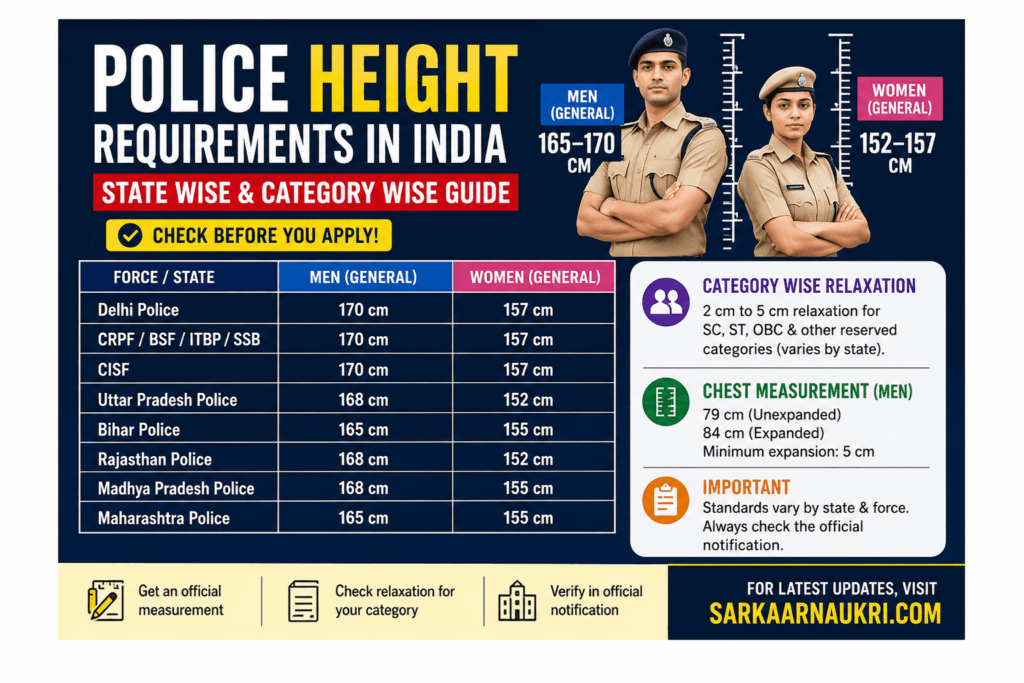
For most state police forces, the general category Police Height Requirements for male candidates sit between 165 cm and 168 cm. Central forces tend to set a slightly higher bar, with CRPF, BSF, ITBP, and SSB commonly requiring 170 cm for general category men. CISF follows the same 170 cm benchmark, and Delhi Police also applies 170 cm to general category male applicants. These figures represent the general, unreserved category. Reserved category candidates should refer to the relaxation section further down, since the effective cutoff for them is usually lower.
Police Height Requirements for Female Candidates
Female candidates are held to a separate, lower standard across nearly every force. Most state police departments set the general category minimum for women under the Police Height Requirements between 152 cm and 155 cm. Central armed police forces generally set the bar slightly higher, at around 157 cm. As with the male standard, individual states vary within this range, so the exact figure should always be confirmed against the specific recruitment notification rather than assumed from a neighboring state’s rules. Women applying to central forces should also note that this figure does not change based on the specific post, only the force and category.
State Wise Police Height Requirements Table
| Force or State | Men (General) | Women (General) |
|---|---|---|
| Delhi Police | 170 cm | 157 cm |
| CRPF / BSF / ITBP / SSB | 170 cm | 157 cm |
| CISF | 170 cm | 157 cm |
| Uttar Pradesh Police | 168 cm | 152 cm |
| Bihar Police | 165 cm | 155 cm |
| Rajasthan Police | 168 cm | 152 cm |
| Madhya Pradesh Police | 168 cm | 155 cm |
| Maharashtra Police | 165 cm | 155 cm |
This comparison makes clear that a candidate who comfortably clears one state’s Police Height Requirements might fall just short of another’s, or of a central force’s. Always verify against the current notification, since these figures are occasionally revised.
Category-Wise Relaxation in Police Height Requirements
Reserved category candidates typically receive a relaxation of 2 cm to 5 cm below the general category Police Height Requirements. SC, ST, and OBC candidates are the categories most commonly granted this concession, though the exact margin differs by state. Scheduled Tribe candidates from hill areas and the North Eastern states often receive the largest relaxation of all, sometimes as much as 5 cm below the general standard, in recognition of regional physical variation. Ex-servicemen and certain sports quota candidates may also qualify for separate relaxation in some states. None of this is standardized nationally, so the category wise relaxation table published alongside the Police Height Requirements in each individual recruitment notification is the only source that should be trusted.
Chest Measurement Alongside Height
Male candidates are almost always assessed on chest measurement in addition to height, typically 79 cm unexpanded and 84 cm expanded, with a minimum expansion of around 5 cm required. This standard also varies slightly by force. Women candidates are generally exempted from the chest measurement test altogether, but they must still clear the applicable Police Height Requirements and weight criteria for their category. Both measurements are usually taken at the same physical standards test, so candidates should prepare for both rather than treating height as the only physical hurdle.
Common Mistakes and Misconceptions
A surprising number of eligible candidates disqualify themselves through avoidable errors around this single criterion. The most frequent mistake is relying on a height measured casually at home rather than an official reading, since posture, footwear, and even the time of day can shift a home measurement by a centimeter or more. Another common misconception is assuming that a reserved category relaxation applies automatically across every state, when in reality each state notification specifies its own relaxation table, and some categories that get relaxation in one state get none in another. Candidates also frequently confuse the central force standard with their state’s Police Height Requirements, assuming CRPF or BSF’s 170 cm cutoff applies to a state police recruitment that actually asks for 165 cm or 168 cm. Finally, many candidates ignore the height rule entirely while preparing, focusing only on the written exam, and only discover the mismatch at document verification, by which point it is too late to do anything about it. A related mistake is assuming that a relaxation earned in one recruitment cycle automatically carries over to the next, when boards periodically revise the Police Height Requirements and relaxation tables between cycles.
Practical Tips If You Are Near the Cutoff
If your height is close to the minimum for your target force and category, get an official measurement done at a government hospital or by a certified medical practitioner before you apply, rather than relying on a tape measure at home. Keep that certificate on hand, since some recruitment boards accept it as supporting documentation. If you fall just short of the general category cutoff, check carefully whether your category, region, or background qualifies for any relaxation before ruling yourself out, since many candidates give up prematurely without checking. It is also worth tracking multiple recruitment notifications rather than one, since the same candidate might fall short of one state’s cutoff while comfortably clearing another’s. Building a simple personal reference sheet of the Police Height Requirements for two or three forces you are targeting can save time during a busy application season.
Frequently Asked Questions
What are the Police Height Requirements for male police constables in India?
It varies by force, but most state police departments require between 165 cm and 168 cm, while CRPF, BSF, ITBP, SSB, CISF, and Delhi Police require 170 cm for general category men.
What are the Police Height Requirements for women in India?
Most states require between 152 cm and 155 cm for women in the general category, while central forces typically require around 157 cm.
How much relaxation is given in Police Height Requirements for SC, ST, and OBC candidates?
Relaxation is usually between 2 cm and 5 cm below the general category figure, though the exact amount depends on the state and category, so the specific notification should always be checked.
Is chest measurement required for female candidates along with the Police Height Requirements?
No, women are generally exempt from the chest measurement test, though they still need to meet the applicable height and weight standards.
Can I get a relaxation if I am from a hill area or the North East?
Many states offer additional relaxation, sometimes up to 5 cm, for Scheduled Tribe candidates from hill areas and North Eastern states, though this varies by state.
Where should I check the exact height cutoff before applying?
Always refer to the official recruitment notification for that specific force and cycle, since figures are set independently by each state and central force and are occasionally revised.
Conclusion
The Police Height Requirements are one of the few eligibility criteria in police recruitment that cannot be improved through preparation, which is exactly why they deserve attention before you commit months to exam prep. Confirm the exact Police Height Requirements for your target force and category, get an official measurement if you are anywhere near the cutoff, and check the relaxation table for your category before assuming you are ineligible. For the central jobs, latest jobs, state police & Defence listings
