Government Job Reservations in India: Understanding the System
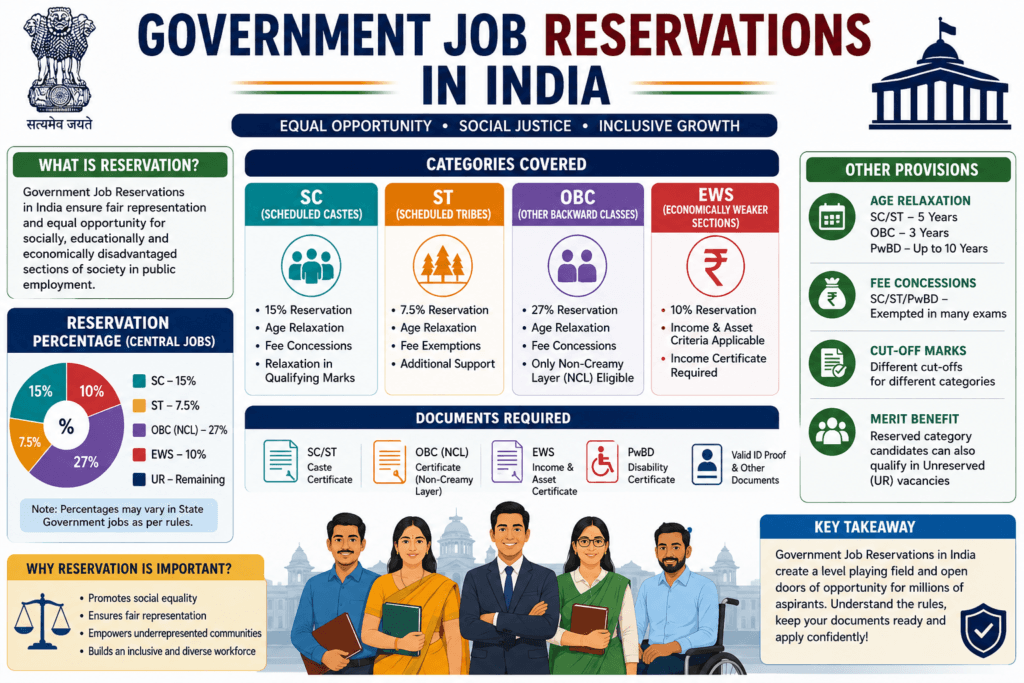
Government Job Reservations in India play a vital role in ensuring equal employment opportunities for various sections of society. Every year, lakhs of candidates apply for government jobs through SSC, UPSC, Railways, Banking, Defence, State Public Service Commissions, and Public Sector Undertakings. During the application process, candidates frequently encounter categories such as SC, ST, OBC, and EWS. However, many job seekers remain confused about how reservation benefits are applied and who is eligible to claim them.
Government Job Reservations in India were introduced to promote social justice and ensure fair representation of historically disadvantaged communities in public employment. The reservation system affects vacancy allocation, age relaxation, application fees, qualifying marks, and final selection. Understanding these provisions is essential because even a small mistake in category selection or certificate submission can lead to rejection during document verification.
This guide explains Government Job Reservations in India in simple language, helping candidates understand reservation percentages, eligibility requirements, age relaxation benefits, and important rules that apply during government recruitment.
What Are Government Job Reservations?
Government Job Reservations in India refer to the allocation of a fixed percentage of vacancies to specific categories of candidates. These categories are identified based on social, educational, and economic factors recognized by the Government of India.
The primary objective is to provide equal opportunities to communities that have historically faced barriers in education and employment. Reservation helps create a balanced workforce while promoting inclusion across government departments and public institutions.
Reservation benefits may include:
- Reserved vacancies
- Age relaxation
- Fee concessions
- Relaxation in qualifying standards
- Additional opportunities during selection
These benefits vary depending on the recruitment organization and applicable rules.
Categories Covered Under Government Job Reservations in India
The reservation system mainly covers four major categories:
Scheduled Castes (SC)
Scheduled Castes include communities recognized by the Constitution of India as historically disadvantaged groups.
In most central government recruitments, SC candidates receive:
- 15% reservation in vacancies
- Age relaxation benefits
- Application fee exemptions in many examinations
- Relaxation in qualifying standards where applicable
Candidates claiming SC reservation must possess a valid caste certificate issued by the competent authority.
Scheduled Tribes (ST)
Scheduled Tribes consist of indigenous tribal communities recognized by the Government of India.
ST candidates generally receive:
- 7.5% reservation in Central Government jobs
- Age relaxation
- Fee exemptions
- Additional support during recruitment processes
Valid tribal certificates are mandatory for claiming reservation benefits.
Other Backward Classes (OBC)
OBC candidates form one of the largest reserved categories under Government Job Reservations in India.
The OBC category receives:
- 27% reservation in Central Government vacancies
- Age relaxation benefits
- Fee concessions in many recruitments
However, only candidates belonging to the Non-Creamy Layer category can claim OBC reservation benefits.
Understanding the OBC Non-Creamy Layer
One of the most misunderstood aspects of Government Job Reservations in India is the concept of the Creamy Layer.
The Creamy Layer consists of financially advanced members of OBC communities who exceed the prescribed income limits set by the government.
Candidates falling under the Creamy Layer:
- Cannot claim OBC reservation
- Compete under the Unreserved category
- Do not receive OBC age relaxation benefits
Therefore, candidates must obtain a valid OBC Non-Creamy Layer certificate before applying for reserved vacancies.
Economically Weaker Sections (EWS)
The EWS category was introduced to support economically disadvantaged candidates who do not belong to SC, ST, or OBC categories.
Under Government Job Reservations in India, EWS candidates receive:
- 10% reservation in Central Government jobs
To qualify for EWS benefits, candidates must satisfy income and asset criteria prescribed by the Government of India.
Applicants must produce a valid Income and Asset Certificate issued by the designated authority.
Persons with Benchmark Disabilities (PwBD)
Apart from caste and economic reservations, special provisions exist for persons with disabilities.
PwBD candidates may receive:
- Reservation in identified posts
- Additional age relaxation
- Scribe facilities
- Extra examination time
- Relaxation in certain eligibility conditions
Disability certificates issued by authorized medical authorities are mandatory.
Reservation Percentages in Central Government Jobs
The standard reservation pattern followed in most Central Government recruitments is:
| Category | Reservation Percentage |
|---|---|
| SC | 15% |
| ST | 7.5% |
| OBC (NCL) | 27% |
| EWS | 10% |
The remaining vacancies are generally categorized as Unreserved (UR).
Although Government Job Reservations in India follow a standard framework, certain organizations may have additional provisions depending on recruitment rules and judicial decisions.
Age Relaxation Benefits
Age relaxation is one of the most valuable benefits available under Government Job Reservations in India.
Typical age relaxations include:
| Category | Relaxation |
|---|---|
| SC/ST | 5 Years |
| OBC | 3 Years |
| PwBD | Up to 10 Years |
| Ex-Servicemen | As Per Rules |
Age relaxation allows candidates additional opportunities to participate in competitive examinations and recruitment processes.
Application Fee Concessions
Many government recruitment agencies provide fee concessions to reserved category candidates.
Examples include:
- SSC Examinations
- Railway Recruitment
- State Government Jobs
- Public Sector Undertakings
In many cases:
- SC candidates receive fee exemptions
- ST candidates are exempted from fees
- PwBD candidates pay no application fee
- Women candidates may also receive fee concessions
Candidates should always check the official notification before applying.
How Reservation Affects Cut-Off Marks
One important aspect of government job reservations in India is the effect on cut-off scores.
Because vacancies are allocated separately for different categories, cut-off marks may vary between:
- General Category
- OBC Category
- SC Category
- ST Category
- EWS Category
However, reserved category candidates who score high enough can secure selection against Unreserved vacancies through merit.
This principle ensures that deserving candidates are not restricted solely to reserved vacancies.
Documents Required to Claim Reservation Benefits
Candidates must possess valid documents to claim reservation benefits.
For SC Candidates
- Scheduled Caste Certificate
For ST Candidates
- Scheduled Tribe Certificate
For OBC Candidates
- OBC Certificate
- Non-Creamy Layer Certificate
For EWS Candidates
- Income and Asset Certificate
For PwBD Candidates
- Disability Certificate
Government Job Reservations in India require strict document verification, and incorrect certificates can result in cancellation of candidature.
Common Mistakes Candidates Should Avoid
Many candidates lose reservation benefits because of avoidable errors.
Common mistakes include:
- Submitting expired OBC certificates
- Using outdated EWS certificates
- Uploading unclear documents
- Entering the wrong category in the application form
- Failing to produce original certificates during verification
Candidates should carefully review all eligibility conditions before submitting applications.
Why Reservation Continues to Matter
Government job reservations in India continue to play an important role in creating a diverse and inclusive workforce. The system aims to provide opportunities to candidates from different social and economic backgrounds while ensuring fair representation in public institutions.
At the same time, reservation policies are periodically reviewed through constitutional amendments, government notifications, and judicial decisions to maintain balance and fairness.
Conclusion
Government Job Reservations in India provide important benefits to SC, ST, OBC, EWS, and PwBD candidates through reserved vacancies, age relaxation, fee concessions, and selection advantages. Understanding government job reservations in India is essential for every government job aspirant because category-based benefits often influence eligibility and final selection. Candidates should ensure they possess valid certificates, carefully verify their category status, and follow official recruitment guidelines to maximize their chances of securing a government job successfully.
