Every year, lakhs of students finish Class 10 and immediately hit the same wall: college feels far off, family finances are tight, and the internet is full of vague advice about “trying for a government job.” What most of them never find is a clear, honest map of which Government Jobs After 10th actually exist, which ones pay well, and which ones are worth the wait. This guide fixes that. Government Jobs After 10th are not a fallback option departments like Railways, SSC, Police, Postal, and several State PSCs actively recruit 10th-pass candidates every year into roles with real career growth, pension benefits, and job security that most private-sector entry jobs simply cannot match.
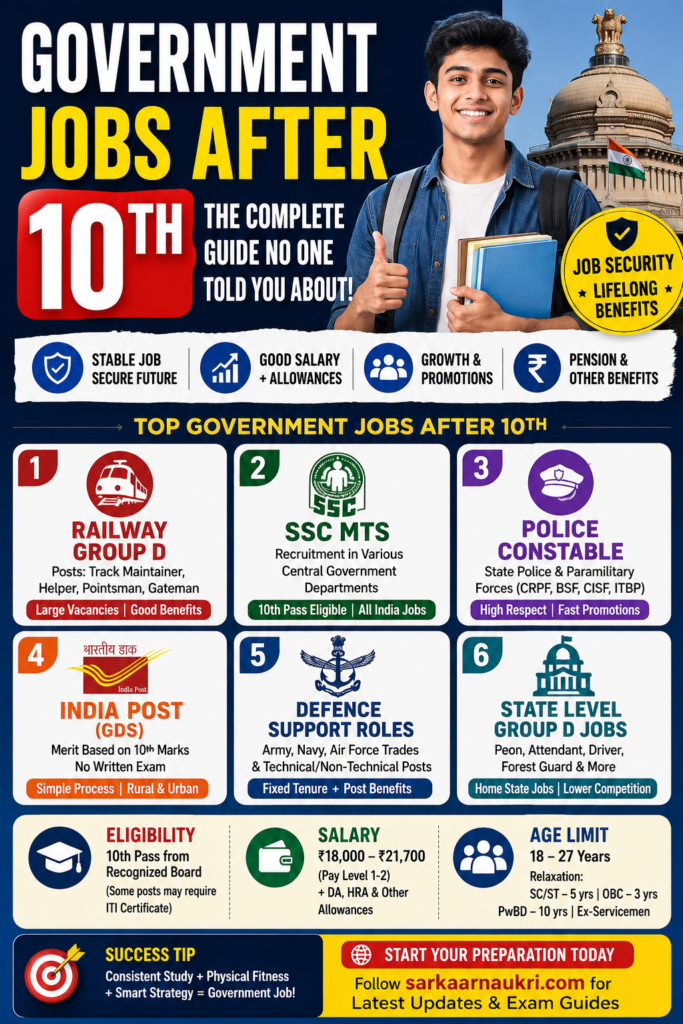
Why Government Jobs After 10th Matter
For a large share of Indian households, a diploma or degree isn’t always financially or logistically possible right after school. Government Jobs After 10th solve a real problem: they offer a legitimate entry point into stable, pensionable employment without demanding years of additional study upfront. Many of these roles also come with in-service promotion tracks, meaning a candidate who starts as a Group D employee or Constable can, over a decade or more, move into supervisory and even gazetted positions through departmental exams. This is one of the most underrated advantages of choosing Government Jobs After 10th over an unplanned gap year or an unstable private job.
Top Categories of Government Jobs After 10th
1. Railway Group D and RRB Jobs
The Railway Recruitment Boards (RRB) regularly notify large-scale Group D recruitment for posts like Track Maintainer, Helper, Pointsman, and Gateman. These are among the most sought-after Government Jobs After 10th because Indian Railways is one of the largest employers in the country, vacancies run into the tens of thousands per cycle, and the selection process — a single Computer Based Test followed by a Physical Efficiency Test — is straightforward compared to many other exams.
2. SSC MTS (Multi-Tasking Staff)
The Staff Selection Commission’s MTS exam is open to 10th-pass candidates and recruits for various central government ministries and departments, including CBDT, CBIC, and Passport offices. SSC MTS remains a favorite among aspirants exploring Government Jobs After 10th because the syllabus is basic (general intelligence, numerical aptitude, and general awareness up to Class 10 level), and postings are spread across almost every state.
3. Police Constable Recruitment
State Police departments and paramilitary forces such as CRPF, BSF, ITBP, and CISF recruit Constables with a minimum qualification of Class 10 or 12 depending on the state. Police constable roles are consistently one of the highest-volume Government Jobs After 10th, combining physical fitness tests with a written exam, and offering fast-track promotions for those who later clear departmental or Sub-Inspector exams.
4. Indian Postal Circle (GDS)
The Gramin Dak Sevak (GDS) recruitment conducted by India Post is a merit-based process (no written exam, purely on 10th marks) and is one of the simplest Government Jobs After 10th to apply for. It suits candidates who prefer a merit-list system over competitive exams, particularly in semi-urban and rural postings.
5. Defence Support Roles (Indian Army, Navy, Air Force)
Beyond the well-known Agniveer scheme, the Indian Armed Forces recruit 10th-pass candidates into technical and non-technical support trades. These defence-linked Government Jobs After 10th combine a fixed tenure with strong post-service benefits, including reservation quotas in several civilian government jobs for those who complete their term.
6. State-Level Group D and Class IV Posts
Almost every state government through its Public Service Commission or a dedicated recruitment board periodically hires for Class IV/Group D roles such as Peon, Attendant, Driver, and Forest Guard. These state-specific openings often have lower competition than central-level exams since applications are restricted to domicile candidates, making them a smart regional strategy for anyone scanning the wider landscape of Government Jobs After 10th. Because notifications are usually published only in local newspapers and regional-language portals, candidates who track their home state’s recruitment board closely tend to face far less competition than those chasing only high-profile central exams.
Eligibility and Age Limits
Most Government Jobs After 10th require only a Class 10 pass certificate from a recognized board, though some technical trades (like Railway ITI-based posts) may need an additional ITI certificate. Age limits typically range from 18 to 27 years for entry-level posts, with standard relaxations of 5 years for SC/ST, 3 years for OBC-NCL, and 10 years for PwBD candidates, along with additional relaxation for Ex-Servicemen. Since exact cut-offs vary by department, always cross-check the specific notification rather than assuming a blanket rule applies across all Government Jobs After 10th.
Salary and Career Growth
Entry-level Government Jobs After 10th typically start at Pay Level 1 or Level 2 of the 7th CPC, translating to a starting basic pay of roughly ₹18,000 to ₹21,700 per month, before allowances. While this may look modest compared to Level 6 or 7 diploma-based posts, the real value lies in long-term growth: Dearness Allowance revisions, annual increments, and departmental promotion exams can meaningfully increase both pay and designation over 10-15 years. Many candidates who start with Government Jobs After 10th eventually clear internal promotional exams to reach supervisory grades without needing to quit and study full-time.
Common Mistakes and Misconceptions
A frequent misconception is that Government Jobs After 10th are “easy” simply because the educational bar is low in reality, the sheer volume of applicants (often lakhs per few thousand vacancies) makes the competition intense, especially for Railway and SSC exams. Another common mistake is ignoring physical standards: many Police, Railway, and Defence roles have height, chest, and endurance requirements that candidates discover only after clearing the written stage, wasting months of preparation. Aspirants also frequently apply to every notification without checking domicile or category-specific eligibility, leading to rejected applications at the document verification stage. Finally, many candidates underestimate how much General Awareness and current affairs matter even in “basic” exams, assuming Class 10-level knowledge alone is sufficient.
Practical Tips to Crack Government Jobs After 10th
Start by choosing two or three target exams instead of applying everywhere , Railway Group D, SSC MTS, and one state-level exam is a realistic combination for most first-time aspirants. Build a fixed daily routine around Mathematics and Reasoning, since these sections carry the most scoring potential relative to preparation time. Physical fitness should be trained alongside written preparation, not after clearing the exam, especially for Police and Defence posts. Keep a folder of all required documents like caste certificate, income certificate, domicile proof ready well before any notification closes, since document issues are one of the biggest causes of application rejection.
Frequently Asked Questions
1. Which government job is best after 10th for a stable career? Railway Group D and SSC MTS are widely considered the most stable entry points because of their large vacancy numbers, central postings, and pension-linked benefits.
2. Do Government Jobs After 10th offer promotion opportunities? Yes, most departments allow departmental exams and seniority-based promotions that let 10th-pass employees rise to supervisory or even gazetted roles over time.
3. Is there an age limit for applying to jobs after Class 10? Most posts have an age window of 18 to 27 years, with relaxations for reserved categories, though the exact limit depends on the specific recruiting department.
4. Can girls apply for Railway or Police jobs after 10th? Yes, all major recruiters, including Railways, SSC, Police, and India Post, have dedicated vacancies and, in several states, additional reservation for female candidates.
5. What is the salary range for entry-level government posts after 10th? Starting basic pay typically falls between ₹18,000 and ₹21,700 per month under Pay Level 1-2, excluding allowances like DA and HRA.
6. How can I prepare without coaching for Government Jobs After 10th? NCERT textbooks up to Class 10, previous years’ question papers, and free online mock tests are usually sufficient, since most syllabi stay within school-level Mathematics, Reasoning, and General Awareness.
7. Are there government jobs after 10th that don’t require a written exam? Yes, India Post’s GDS recruitment is merit-based on Class 10 marks alone, making it one of the few entry-level options without a competitive written test.
Conclusion
Government jobs after 10th open a genuine, well-paved path into long-term financial stability without requiring years of additional education upfront. From Railways and SSC MTS to Police, Postal, and state-level Group D posts, the opportunities are wider than most students realize the key is picking the right combination of exams and preparing consistently rather than chasing every notification. For deeper eligibility details on specific recruiters, check our guides on 10th Pass Jobs and Railway Jobs to plan your next application.
