Ask ten CDS aspirants what the exam actually tests, and most will say Maths, English, and GK without being able to name a single sub-topic under any of them. That vague understanding is exactly why so many candidates plateau midway through preparation. CDS Syllabus 2026 is a clearly defined framework released by UPSC twice a year, covering English, General Knowledge, and Elementary Mathematics, and once you know exactly what falls under each paper, your study plan stops being guesswork. This guide walks through CDS Syllabus 2026 subject by subject, explains how the Officers Training Academy pattern differs from IMA, INA, and AFA, and covers the SSB stage that follows the written exam.
Why CDS Syllabus 2026 Matters More Than Most Aspirants Realise
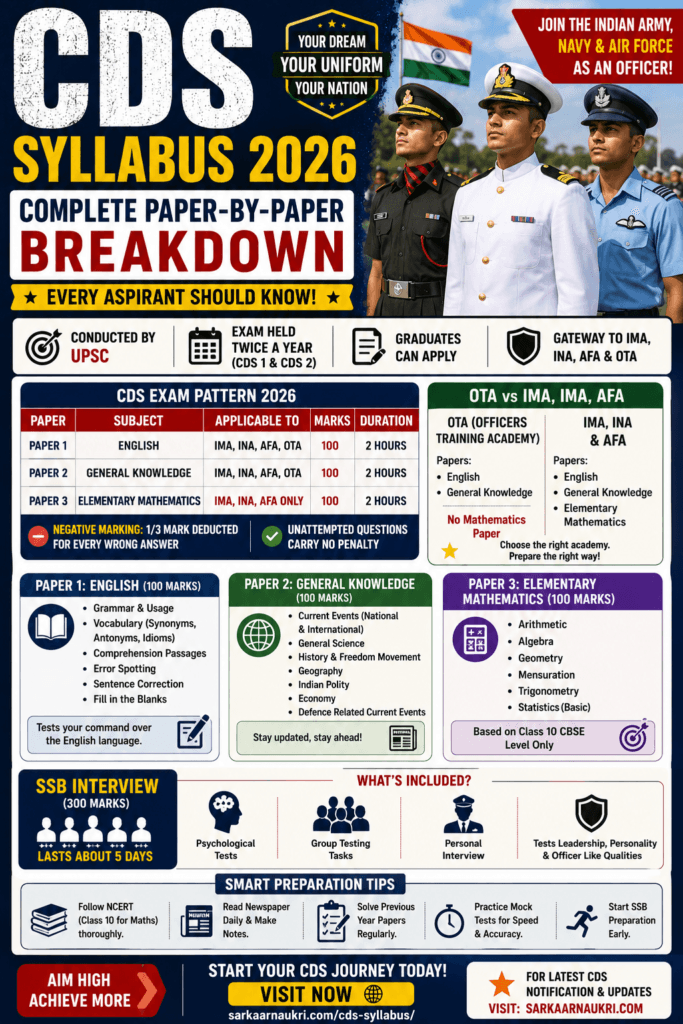
The Combined Defence Services Examination is the main route through which graduates enter the officer cadres of the Indian Army, Navy, and Air Force, and it is conducted twice a year by the UPSC. Under CDS Syllabus 2026, candidates applying for the Indian Military Academy, Indian Naval Academy, and Air Force Academy write three papers, English, General Knowledge, and Elementary Mathematics, while candidates applying only for the Officers Training Academy write two papers, skipping Mathematics entirely. Each paper is worth 100 marks and runs for two hours, which means the written stage totals 300 marks for OTA candidates and 300 marks across the two mandatory papers plus Mathematics for the other three academies. Clearing this written stage is the first real filter, and everything after it, the SSB interview, medical examination, and final merit, depends on getting past it first.
CDS Syllabus 2026 Exam Pattern at a Glance
| Paper | Applicable To | Marks | Duration |
|---|---|---|---|
| English | IMA, INA, AFA, OTA | 100 | 2 hours |
| General Knowledge | IMA, INA, AFA, OTA | 100 | 2 hours |
| Elementary Mathematics | IMA, INA, AFA only | 100 | 2 hours |
All papers are objective type with four options per question, and negative marking applies, roughly one third of a mark is deducted for every wrong answer, while unattempted questions carry no penalty. Every question paper for General Knowledge and Elementary Mathematics is set bilingually in Hindi and English.
English Paper Under CDS Syllabus 2026
The English paper in CDS Syllabus 2026 is designed to test grammar, vocabulary, comprehension, and correct workman-like use of the language rather than literary knowledge. Expect questions on error spotting, sentence correction, synonyms and antonyms, fill in the blanks, comprehension passages, and idiomatic usage. This paper is common to all four academies, including OTA, so it deserves consistent attention regardless of which academy a candidate is targeting. Strong English scores also carry forward practically, since fluent communication matters heavily at the SSB interview stage later.
General Knowledge Paper Under CDS Syllabus 2026
General Knowledge is the broadest and often the most unpredictable section of CDS Syllabus 2026, covering current events, everyday scientific observation, Indian history, and geography at a level an educated graduate should reasonably know without specialised study. In practice, this paper draws from General Science, History and the Freedom Movement, Geography, Indian Polity, Economy, and Current Affairs, with a noticeable tilt toward defence related current events given the nature of the exam. Current Affairs typically forms a meaningful share of the paper, so candidates need to follow national and defence news consistently in the months leading up to the exam rather than relying on static facts alone.
Elementary Mathematics Paper Under CDS Syllabus 2026
Elementary Mathematics is required only for candidates applying to IMA, INA, and AFA, not for OTA aspirants, and this is one of the most important distinctions in CDS Syllabus 2026 that candidates frequently miss when filling their application. The paper follows a Class 10 CBSE standard and covers arithmetic, algebra, geometry, mensuration, trigonometry, and basic statistics, without extending into Class 11 or 12 level concepts. Because the difficulty ceiling is capped at Class 10, this paper rewards speed and accuracy over advanced problem solving, making it one of the more scoring sections for candidates who revise the fundamentals thoroughly.
SSB Interview Stage After the Written Exam
Clearing the written papers under CDS Syllabus 2026 is only the first step. Candidates who qualify move to the Services Selection Board interview, worth 300 marks and conducted over roughly five days. It includes psychological tests, group testing tasks, and a personal interview designed to assess leadership potential, personality, and officer-like qualities rather than academic knowledge. This stage sits outside the traditional syllabus but is equally decisive, and candidates who treat it as an afterthought after clearing the written exam often struggle to prepare adequately in the limited time between results and the interview call.
OTA Versus IMA, INA, and AFA: Key Differences
A common point of confusion in CDS Syllabus 2026 is the difference in papers between academies. OTA candidates, who are training for a short service commission and do not receive a permanent commission through this specific entry, write only English and General Knowledge, skipping Mathematics entirely. Candidates applying for IMA, INA, or AFA must clear all three papers, including Mathematics. This distinction affects not just preparation time but also application choices, since a candidate weak in Mathematics but strong in English and GK may find OTA a more realistic near term target while continuing to build Maths skills for future attempts at the other academies.
Common Mistakes and Misconceptions
Many aspirants underestimate the General Knowledge paper because it feels less structured than Mathematics, and end up under preparing for a section that carries equal weight to both other papers. Another frequent mistake is ignoring negative marking, candidates guess aggressively on GK questions they are genuinely unsure about and lose more marks than they gain, when a more disciplined approach of attempting only reasonably confident questions usually produces a better net score. Some candidates preparing for IMA, INA, or AFA also neglect Elementary Mathematics because it feels like a “school level” formality, not realising that consistent practice at speed is what actually separates strong scorers here. Finally, many aspirants treat the written exam as the finish line and only start SSB preparation after results are declared, leaving very little time to build the communication and group task skills that stage genuinely demands.
Practical Tips for CDS Aspirants
Solve previous years’ question papers early in your preparation rather than only in the final weeks, since they show exactly how CDS Syllabus 2026 topics get converted into actual exam questions. Maintain a dedicated Current Affairs notebook through the months before the exam instead of relying on last minute revision, since defence related current events form a genuine chunk of the General Knowledge paper. For Elementary Mathematics, revise NCERT Class 10 concepts thoroughly and then move into timed practice sets, since accuracy and speed matter more than depth here. For English, read newspapers and practice comprehension passages regularly rather than memorising grammar rules in isolation.
Frequently Asked Questions
Q1. Is Elementary Mathematics compulsory for every CDS candidate? No. Under CDS Syllabus 2026, Mathematics is required only for IMA, INA, and AFA candidates, not for those applying exclusively to OTA.
Q2. How many marks does each paper carry under CDS Syllabus 2026? Each paper, English, General Knowledge, and Elementary Mathematics, carries 100 marks with a duration of 2 hours.
Q3. What level of Mathematics is tested in the CDS exam? The Elementary Mathematics paper follows a Class 10 CBSE standard and does not include Class 11 or 12 level topics.
Q4. Is there negative marking in CDS Syllabus 2026? Yes, roughly one third of the marks allotted to a question is deducted for every incorrect answer, while unattempted questions carry no penalty.
Q5. Does the General Knowledge paper focus only on current affairs? No, it also covers General Science, History, Geography, Polity, and Economy, alongside a meaningful share of current events, particularly defence related news.
Q6. What comes after the written exam in the CDS selection process? Candidates who clear the written cutoff move to the SSB interview, a separate 300 mark evaluation over about five days covering psychological tests, group tasks, and a personal interview.
Q7. Does the syllabus differ between CDS 1 and CDS 2 exams? No, the syllabus remains consistent across both CDS 1 and CDS 2 cycles conducted in the same year, with only minor variations if any.
Conclusion
Understanding CDS Syllabus 2026 in full detail, rather than preparing around vague subject names, is what separates focused aspirants from those who lose momentum midway. Once English, General Knowledge, and Elementary Mathematics are broken down into their actual weightage and topics, preparation becomes a plan you can execute rather than an overwhelming list of everything. Candidates preparing for this cycle can also check our Defense Jobs section for the latest CDS notification updates or browse Graduate Jobs for other entry routes into government service.
