Introduction
Completing an MBBS is only the first milestone — the bigger decision most doctors face next is whether to go private or pursue MBBS Government Jobs. For many graduates, government medical postings offer something private practice often can’t match in the early years: job security, structured pay scales, pension benefits, and a clear path toward postgraduate seats through in-service quotas. From Central Government Health Service (CGHS) postings to State Health Department vacancies, Railways, Defence Medical Services, and PSU hospitals, MBBS Government Jobs span a wide range of departments and specialisations. This guide walks through every major category of these opportunities, the eligibility rules that apply, how selection actually works, and the mistakes candidates commonly make while applying.
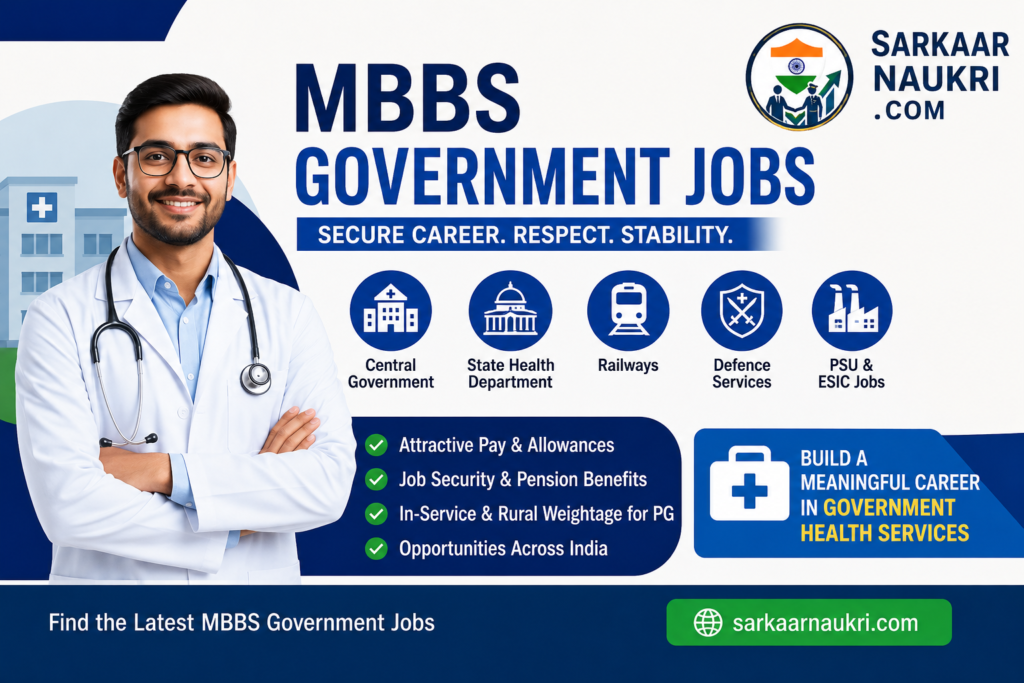
Why MBBS Government Jobs Matter
Government departments recruit MBBS-qualified doctors as Medical Officers, General Duty Medical Officers (GDMOs), and Assistant Surgeons across hospitals, primary health centres, and specialised institutions. Unlike private hospital roles, MBBS Government Jobs come with defined pay matrices under the 7th Pay Commission, typically starting around Pay Level 10, along with Non-Practicing Allowance (NPA), dearness allowance, and pension coverage under NPS. Beyond the financial stability, many of these roles also carry weightage for postgraduate admission through in-service and rural service quotas, which is a major reason MBBS graduates actively pursue government postings early in their careers.
Major Categories of MBBS Government Jobs
Central Government Health Service (CGHS)
CGHS recruits MBBS doctors as General Duty Medical Officers to serve in dispensaries and hospitals across major cities. These MBBS Government Jobs are recruited through UPSC and offer central government pay scales along with transferable postings across CGHS-covered cities.
State Health Department Postings
Every state runs its own Directorate of Medical & Health Services, which recruits MBBS graduates as Medical Officers for Community Health Centres (CHCs), Primary Health Centres (PHCs), and District Hospitals. These state-level roles are often the fastest entry point into government service, since vacancies are frequent and domicile-based reservation reduces competition for local candidates.
Railway Medical Services
Indian Railways operates its own hospital network and recruits MBBS doctors as Assistant Divisional Medical Officers through RRB CEN medical notifications. These postings combine central government benefits with relatively lower competition compared to UPSC-route MBBS Government Jobs.
Defence Medical Services
The Armed Forces Medical Services (AFMS) recruits MBBS graduates as Short Service Commissioned Officers and Permanent Commissioned Medical Officers in the Army, Navy, and Air Force. This route is unique among MBBS Government Jobs because it combines a medical career with a defence commission, including rank, uniform allowance, and accelerated promotion tracks.
PSU & ESIC Hospital Postings
Public sector organisations such as ESIC (Employees’ State Insurance Corporation), ONGC, Coal India, and SAIL operate their own hospitals and regularly hire MBBS doctors for in-house medical staff positions. These roles are less publicised than UPSC or state postings but offer comparable pay and often faster recruitment cycles.
Eligibility Criteria
- Educational Qualification: A recognised MBBS degree from an NMC (National Medical Commission) approved institution, along with completion of a mandatory rotating internship, is required for nearly all MBBS Government Jobs.
- Registration: A valid registration with the State Medical Council or National Medical Commission is mandatory at the time of application or joining.
- Age Limit: Generally between 21 and 32 years for most central and state postings, with the standard relaxation of 5 years for SC/ST, 3 years for OBC, and 10 years for PwD candidates.
- PG Diploma/Degree (for specialist posts): Certain specialist MBBS Government Jobs, such as those in radiology or anaesthesia departments, require an additional postgraduate qualification beyond the base MBBS degree.
Selection Process
Most recruitment for MBBS Government Jobs follows a broadly similar structure:
- Application & Screening: Verification of MBBS degree, internship completion certificate, and medical council registration.
- Written Examination (where applicable): Objective-type test on general medicine and subject knowledge, used mainly for UPSC and select state recruitments.
- Interview / Walk-in Selection: Many state and PSU postings use direct interview-based or walk-in selection rather than a written exam, especially for urgent vacancies.
- Document Verification: Verification of educational certificates, registration proof, category certificates, and identity documents.
- Final Merit List / Appointment Order: Based on either written exam performance, interview scores, or a combination of both, depending on the recruiting body.
Common Mistakes & Misconceptions
- Assuming all MBBS Government Jobs require UPSC: Many state, Railway, and PSU postings recruit directly through interviews or walk-ins without any UPSC involvement.
- Ignoring registration renewal: Candidates sometimes apply with an expired State Medical Council registration, which leads to rejection at document verification.
- Overlooking bond/service obligation clauses: Several state MBBS Government Jobs carry a mandatory rural service bond — not reading this clause carefully leads to unexpected commitments after joining.
- Missing walk-in-only vacancies: Because many PSU and state hospital postings are filled via walk-in interviews rather than formal notifications, candidates who only track UPSC-style ads miss a large share of available openings.
Practical Tips
- Keep your MBBS degree certificate, internship completion letter, and State Medical Council/NMC registration updated and scanned in advance.
- Track both UPSC-route and state Directorate of Health notifications simultaneously, since MBBS Government Jobs open through very different channels depending on the department.
- If pursuing Defence Medical Services, start preparing early for the SSB interview process alongside your medical qualifications, since selection isn’t based on academics alone.
- Read bond/service obligation terms carefully before accepting any state-level posting, since breaking a rural service bond can carry a financial penalty.
Frequently Asked Questions
1. Do all MBBS Government Jobs require clearing UPSC?
No, only central postings like CGHS typically go through UPSC — most state, Railway, and PSU MBBS Government Jobs use direct interviews or walk-in selection.
2. What is the starting pay scale for MBBS Government Jobs?
Most Medical Officer posts start around Pay Level 10 of the 7th Pay Commission, with Non-Practicing Allowance added on top of the basic pay.
3. Can a fresh MBBS graduate apply for Defence Medical Services?
Yes, fresh graduates who have completed their internship can apply for Short Service Commission or Permanent Commission roles in AFMS.
4. Is a postgraduate degree required for MBBS Government Jobs?
No, a basic MBBS with internship is sufficient for most Medical Officer posts, though certain specialist positions do require a PG qualification.
5. Do MBBS Government Jobs help with postgraduate admission later?
Yes, many in-service and rural service postings carry additional weightage for NEET-PG counselling under in-service quotas.
6. What is the age limit for MBBS Government Jobs?
Typically between 21 and 32 years, with standard reservation-category relaxations applicable as per government norms.
7. Are walk-in interviews common for MBBS Government Jobs?
Yes, especially for state hospitals, ESIC, and PSU medical postings, which often fill vacancies faster through walk-ins than formal written exams.
Conclusion
MBBS Government Jobs offer a stable, well-structured career path for doctors across CGHS, State Health Departments, railways, Defence Medical Services, and PSU hospitals. Success depends on knowing which recruitment channel applies to each type of posting, keeping registration and documents current, and carefully reviewing service bond terms before joining. For current openings, check our [Latest Government Jobs] and [Medical & Health Department Jobs] sections regularly.
