Introduction
Walk into any bookstore near a coaching hub and you’ll find dozens of titles claiming to be the best Bank Exam Books on the shelf—and most aspirants end up buying five or six before realizing half cover the same ground. Picking the right Bank Exam Books matters more than picking the most books, because IBPS, SBI, and RBI exams test a narrow, well-defined set of topics repeatedly, year after year. Aspirants who prepare with a scattered mix of Bank Exam Books often end up revising the same concepts across multiple titles while leaving newer question formats untouched. This guide lists genuinely useful books for every section of the syllabus—Reasoning, Quantitative Aptitude, English, General Awareness, and Computer Knowledge—so you can build a focused shelf instead of an overwhelming one and spend your limited preparation time on practice rather than deciding which book to open next.
Why Choosing the Right Bank Exam Books Matters
Not every title pitched as one of the best actually maps to the current exam pattern. Bank exams have shifted over the years toward higher-difficulty reasoning puzzles, data interpretation-heavy quant sections, and reading-comprehension-driven English papers—and older Bank Exam Books written for an easier pattern can leave gaps. The right selection saves preparation time, prevents redundant practice, and ensures every hour spent studying builds toward what’s actually asked in the exam hall. Aspirants preparing for the first time often assume that more bank exam books automatically means better preparation, but candidates who clear these exams consistently point to focused, well-chosen material over volume. A smaller, well-matched set of resources, revised multiple times, tends to outperform a large pile that’s each read only once.
Reasoning Ability: Recommended Bank Exam Books
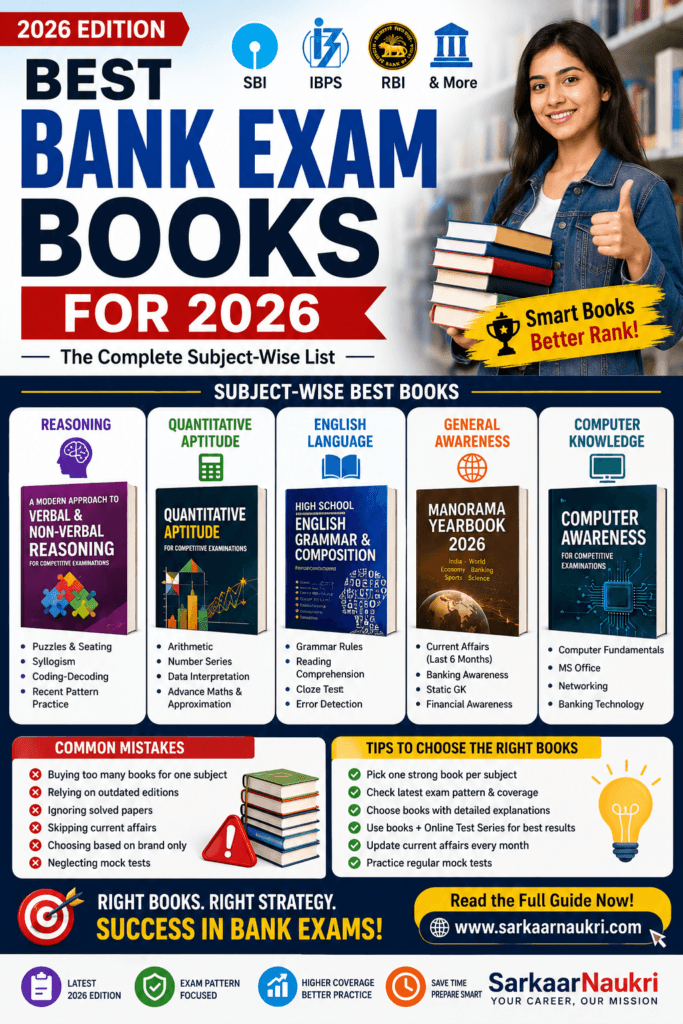
For reasoning, a strong practice book paired with a puzzle-focused book usually beats any single all-in-one guide. Among bank exam books for this section, look for titles with recent-year puzzle sets (seating arrangement, blood relations, syllogism, and input-output), since reasoning difficulty has risen sharply in recent SBI and IBPS PO mains papers. A good reasoning book should also include verbal reasoning and analytical decision-making sections, which are increasingly tested in newer patterns. Beyond puzzles, look for a title that dedicates space to coding-decoding, direction sense, and logical inequalities, since these topics still show up consistently in prelim papers even as the mains-level puzzles get harder. A resource with graded difficulty — starting from basic sets and building toward exam-level complexity — helps aspirants track genuine improvement rather than jumping straight into the hardest questions.
Quantitative Aptitude: Recommended Bank Exam Books
Quant preparation benefits from a book that separates basic-concept building from advanced data interpretation practice. Among the more useful bank exam books here are those with a foundational arithmetic and number-series section for early preparation, followed by a dedicated data interpretation and advanced-math title closer to the exam, since DI sets now carry heavy weightage in mains-level papers. Aspirants should also check that a resource covers approximation, quadratic equations, and simplification with sufficient volume, since these shorter-format questions are often the fastest way to secure marks in the prelims stage. A title with chapter-wise previous-year questions makes it easier to gauge exactly how a topic has been tested in real papers rather than in generic practice sets alone.
English Language: Recommended Bank Exam Books
English sections increasingly reward reading comprehension and error-detection skills over rote grammar memorization. A grammar fundamentals title is useful early on, but closer to the exam, aspirants get more value from Bank Exam Books built around recent-pattern comprehension passages, cloze tests, and sentence rearrangement—the formats that dominate current papers. Vocabulary-building sections matter too, though a resource that ties new words to comprehension passages tends to stick better than a standalone word list, since exam questions rarely test vocabulary in isolation anymore.
General Awareness and Banking Knowledge: Recommended Bank Exam Books
General Awareness is the section most aspirants underprepare for, yet it carries a meaningful share of marks in both prelims and mains. Among bank exam books for this section, a dedicated banking awareness title covering monetary policy, RBI functions, and financial terms should be paired with a current affairs digest updated monthly, since GA questions lean heavily on the six months preceding the exam date.
Computer Knowledge: Recommended Bank Exam Books
Computer Knowledge is a scoring section if approached with the right material, since the syllabus is narrower and more predictable than Reasoning or Quant. The strongest Bank Exam Books for this section cover computer fundamentals, MS Office basics, networking terms, and banking-specific software awareness rather than deep technical detail, since bank exams test conceptual familiarity rather than programming skill. Pairing a concise fundamentals title with a chapter-wise practice set of previous years’ questions is usually enough to cover this section thoroughly without over-investing preparation time better spent on Reasoning or Quant.
Common Mistakes When Choosing Bank Exam Books
- Buying too many titles for one subject: Overlap between books wastes time; one strong book per section, supplemented with mock tests, works better than five books skimmed halfway.
- Relying on outdated editions: Bank exam patterns shift, so older bank exam books may no longer reflect current difficulty or question types.
- Ignoring solved-paper sections: Titles with previous years’ solved papers reveal actual difficulty and question framing far better than generic practice sets.
- Skipping the current affairs component: General Awareness sections in bank exam books go stale fast; pairing a static-knowledge title with a monthly current affairs source is non-negotiable.
- Choosing based on brand alone: Popularity doesn’t guarantee alignment with the latest pattern — check the edition year and recent-exam coverage before buying.
- Neglecting mock tests entirely: Even the best reading material can’t substitute for timed, full-length mock tests, which reveal pacing issues that book-based practice alone won’t surface.
Practical Tips for Building Your Shelf of Bank Exam Books
- Start with one foundational title per subject before adding advanced or topic-specific books.
- Cross-check any shortlist of bank exam books against the previous two years’ papers to confirm topic coverage.
- Prioritize titles with detailed solved explanations over answer-key-only practice sets.
- Combine physical bank exam books for concept-building with an online test series for timed practice.
- Refresh your General Awareness material every month rather than relying on a single static edition.
- Set a fixed weekly rotation across subjects instead of finishing one book cover-to-cover before starting the next, since bank exams test all sections together.
- Track accuracy and speed separately for each subject as you work through practice sets, so you know whether a topic needs more concept revision or simply faster problem-solving.
Frequently Asked Questions
1. Which Bank Exam Books are best for Reasoning? Titles with recent-pattern puzzle sets and verbal reasoning practice tend to serve most aspirants better than an older, generic reasoning guide.
2. Do I need separate Bank Exam Books for prelims and mains? Not always—many candidates use the same foundational titles for both stages and add a mains-specific data interpretation or advanced-English book closer to the exam.
3. How important is a current affairs book among bank exam preparation material? Very important, since general awareness questions in most bank exams draw heavily on events from the preceding six months rather than static knowledge alone.
4. Are older editions of Bank Exam Books still useful? Basic concept sections stay relevant, but question patterns shift, so pairing an older concept book with a recent-year solved-paper resource is safer than relying on the older edition alone.
5. Should I buy a combined all-in-one guide or subject-wise bank exam books? Subject-wise titles generally cover topics in more depth, though an all-in-one guide can work well for a first overview before switching to focused books.
6. How many books should I actually buy for bank exam preparation? Most successful candidates prepare from one strong book per subject plus a current affairs source, rather than accumulating many overlapping titles.
7. Are online bank exams Books and courses better than physical books? Both approaches have a place in preparation—online material is easier to update for current affairs, while physical bank exam books often work better for deep, distraction-free concept building.
Conclusion
Building the right shelf of bank exams Books matter more than the sheer number you collect—one well-chosen, current-pattern title per subject, backed by regular practice tests, consistently outperforms a stack of overlapping guides. Treat your book list as a working toolkit that gets revisited every few months rather than a one-time purchase, and prioritize consistent revision over collecting new titles as the exam date approaches. For eligibility details and exam-wise strategy, check our [Bank Recruitment Notifications] and [Government Job Age Relaxation Rules] guides before you begin preparation.
