Every year, lakhs of engineering graduates apply for B.Tech Government Jobs, hoping to combine technical skill with job security, a respectable salary and long term stability. Yet most students only discover the right path after wasting a year on the wrong exam or the wrong department. This guide breaks down every major avenue for these roles so that you can plan your preparation with a clear head, from the moment you finish your final semester right up to the day you receive your appointment letter. Whether you are in your final year or already working in the private sector and considering a switch, this guide covers everything you need to know about this career path in one place.
Why B.Tech Government Jobs Matter for Engineering Graduates
Engineering graduates in India face a crowded private job market where salaries can vary wildly and layoffs are common during downturns. This is exactly why B.Tech Government Jobs remain so attractive year after year. A government engineering role typically offers a fixed pay scale, allowances such as house rent and dearness allowance, a pension or provident fund benefit, and a level of job security that few private companies can match. Beyond stability, many of these roles also offer genuine technical exposure, whether that means designing public infrastructure, working on defence projects, or maintaining railway systems that serve millions of passengers daily. For many families in smaller towns, a government engineering post also carries social respect that influences career decisions as much as salary does.
Top Government Departments and Organisations Hiring B.Tech Graduates
There is no single door into this career path. Instead, several distinct hiring streams exist, each with its own exam, eligibility rules and selection process.
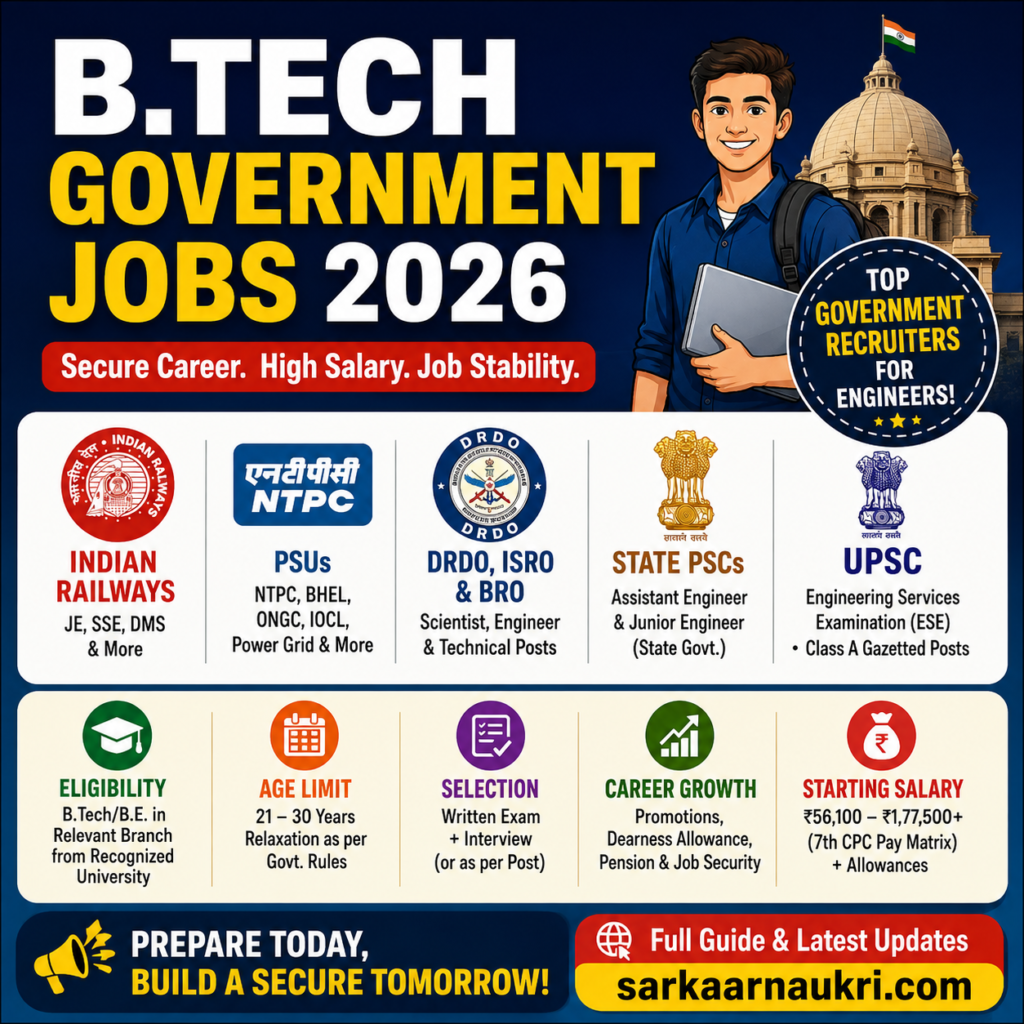
Public Sector Undertakings (PSUs): Companies such as ONGC, NTPC, BHEL, IOCL, and various state electricity boards regularly recruit engineers directly through GATE scores or through their own written exams. These PSU roles are among the most sought after government engineering posts because of the strong pay packages and structured career progression.
Indian Railways: The Railway Recruitment Board and RRB JE exams open thousands of engineering posts every cycle across mechanical, electrical, civil and electronics branches, making Railways one of the largest single sources of engineering recruitment in the country.
Defence and Research Organisations: DRDO, ISRO, and the Border Roads Organisation hire B.Tech graduates for scientist and engineer posts, offering some of the most technically demanding engineering postings available, often through dedicated recruitment drives such as DRDO CEPTAM or ISRO Centre recruitment.
State Public Service Commissions: Almost every state runs its own Assistant Engineer or Junior Engineer recruitment through its Public Service Commission, and these state level postings often have lower competition than central exams because far fewer aspirants apply outside their home state.
Union Public Service Commission (Engineering Services Examination): The ESE, commonly called IES, is the most prestigious route into government engineering service, leading directly to Class A gazetted officer posts in central engineering services.
Eligibility Criteria for B.Tech Government Jobs
Eligibility rules differ slightly by exam, but most B.Tech Government Jobs share a common framework. A candidate generally needs a B.Tech or B.E. degree in a relevant branch from a recognised university, along with a minimum aggregate percentage that is usually set around fifty to sixty percent, though this can be relaxed for reserved categories. Age limits typically range from twenty one to thirty years for entry level posts, with standard relaxation of five years for SC and ST candidates and three years for OBC candidates, plus additional relaxation for persons with disabilities and ex servicemen. Many PSU and central postings also require a valid GATE score, so candidates aiming for these roles should treat GATE preparation as a parallel track alongside their final year coursework rather than an afterthought.
Popular Exams and Entry Routes for B.Tech Government Jobs
If you are serious about B.Tech Government Jobs, it helps to map out the exam calendar early. GATE remains the single most important gateway, since a strong score opens doors to PSU recruitment, IIT admissions, and even some state level posts. SSC JE (Junior Engineer) is another major route, held annually for civil, mechanical and electrical branches across central government departments. RRB JE serves the same purpose for Railways. State PSC Assistant Engineer exams follow a similar pattern at the state level. For candidates targeting the most competitive engineering posts, ESE conducted by UPSC represents the top tier, involving a rigorous written exam followed by a personality test.
Salary and Career Growth in B.Tech Government Jobs
Starting pay for fresh entrants in B.Tech Government Jobs generally falls between Level 6 and Level 10 of the central pay matrix, translating to a gross monthly salary in the range of forty thousand to seventy thousand rupees once allowances are included, though PSU packages can run considerably higher depending on the organisation and posting location. Career progression is usually structured and predictable: a Junior Engineer can expect promotion to Assistant Engineer and then Executive Engineer over a fifteen to twenty year span, with corresponding pay scale increases at each stage. This predictability is part of what makes these postings so appealing compared to private sector roles where promotion timelines are far less certain.
Common Mistakes and Misconceptions
Many aspirants approach this preparation with assumptions that end up costing them valuable time. One common mistake is preparing for only one exam, such as GATE, and ignoring SSC JE or state PSC options that may have less competition and equally good outcomes. Another misconception is that a low percentage in B.Tech automatically disqualifies a candidate; in reality most recruitment notices only ask for a minimum pass percentage rather than a high cutoff. Some students also assume that only mechanical and civil branches have strong government opportunities, when in fact electronics, electrical and computer science graduates now have a growing number of specialised posts as departments modernise their systems. Finally, many candidates underestimate the general studies and reasoning sections of these exams, focusing purely on core technical subjects and losing marks in areas that are actually easier to prepare for.
Practical Tips for Cracking B.Tech Government Jobs
Start your preparation at least twelve months before your target exam, since the syllabus for most B.Tech Government Jobs blends core engineering subjects with general aptitude and reasoning. Keep a shared notes system for formulas and standard values so that revision in the final weeks is quick rather than a fresh read through of textbooks. Apply to every exam you are eligible for rather than betting everything on one attempt, since eligibility windows for these exams often overlap and a wider net improves your odds significantly. Solve at least three years of previous papers for each target exam under timed conditions, and track your accuracy by subject so you know exactly where to focus in the final month. Finally, stay updated on notification dates through official sources rather than relying only on social media, since a missed application deadline is one of the most avoidable ways to lose a shot at these posts.
Frequently Asked Questions
Which branch has the most B.Tech Government Jobs available? Mechanical, civil and electrical branches traditionally have the highest number of openings across Railways, PSUs and state departments, though electronics and computer science branches are catching up quickly as more departments digitise their operations.
Is GATE compulsory for all B.Tech Government Jobs? No. GATE is required for most PSU recruitment and some central posts, but exams like SSC JE, RRB JE and state PSC Assistant Engineer recruitment do not require a GATE score at all.
What is the age limit for B.Tech Government Jobs? Most entry level posts set the general category age limit between twenty one and thirty years, with standard relaxation for SC, ST, OBC, PwD and ex servicemen candidates as per government norms.
Can a B.Tech graduate with backlogs apply for government jobs? Generally yes, as long as all backlogs are cleared before the final document verification stage, since most recruitment notices only check the final degree and percentage at that point rather than the semester wise academic record.
How many attempts are allowed for exams linked to B.Tech Government Jobs? This varies by exam and category. GATE has no attempt limit, while UPSC ESE follows the same attempt restrictions as the Civil Services Examination for general category candidates.
Do private engineering college graduates get equal opportunity in B.Tech Government Jobs? Yes. Eligibility for nearly all these posts depends on university recognition rather than the type of college, so graduates from recognised private colleges compete on equal terms with those from public institutions.
Which B.Tech Government Jobs offer the fastest promotion track? Defence and research postings under DRDO and ISRO, along with UPSC ESE recruits, tend to offer faster structured promotion compared to some state level Junior Engineer posts, though all follow a defined pay scale progression.
Conclusion
B.Tech Government Jobs remain one of the most reliable career paths for engineering graduates who value stability alongside technical growth. The key is to treat this as a structured, multi exam campaign rather than a single high stakes attempt: understand the eligibility rules, pick two or three exams that match your branch and interest, and prepare consistently over a realistic timeline. With the right approach, the mix of PSU, Railways, Defence and state level openings covered in this guide gives every B.Tech graduate a genuine shot at a secure government engineering career. For a deeper dive into related topics, check our guides on age relaxation rules for government jobs and high-paying government jobs in India.
