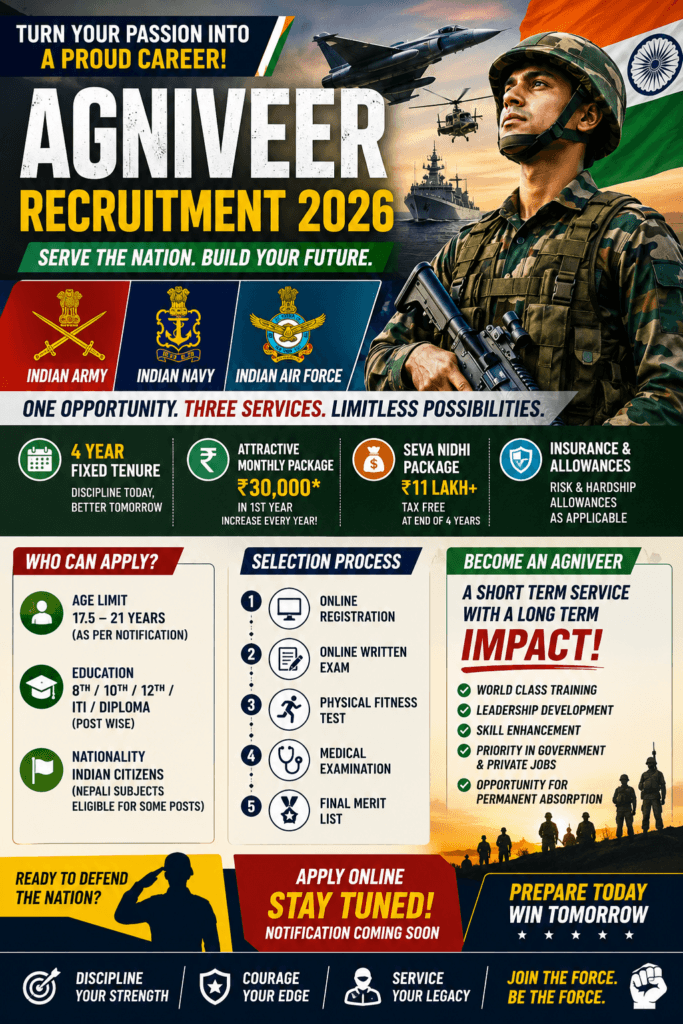
Every year, lakhs of young Indians dream of wearing the uniform, and Agniveer Recruitment has become the single biggest gateway into the Army, Navy, and Air Force for candidates straight out of school or college. Yet a surprising number of aspirants still confuse the Agniveer scheme with the older permanent recruitment process, which leads to wrong assumptions about tenure, salary and career security. This guide clears up every doubt around Agniveer Recruitment, from who is eligible to what happens after the four year term ends, so that you can prepare with a clear head instead of relying on rumours floating around coaching centres.
Whether you are targeting Agniveer General Duty, Agniveer Technical, Agniveer Clerk or a role in the Navy or Air Force, the fundamentals of Agniveer Recruitment remain largely the same across services, with only minor differences in trade specific qualifications and physical standards. Read on for a complete, section wise breakdown.
Why Agniveer Recruitment Matters
Agniveer Recruitment was introduced under the Agnipath scheme by the Ministry of Defence to bring a younger, fitter profile of soldiers into the Indian Armed Forces while also creating a structured pathway for skill development and future employment. Unlike the earlier system where soldiers served for fifteen years or more before pension eligibility, Agniveer Recruitment enrols candidates for a fixed four year tenure, after which a limited percentage are offered permanent positions based on performance and organisational requirements, while the rest exit with a lump sum benefit and priority access to further career opportunities. Understanding this structure early helps candidates plan not just for the exam, but for what comes after service as well.
Eligibility Criteria for Agniveer Recruitment
The general age bracket for Agniveer Recruitment is between 17.5 and 21 years, though this can shift slightly depending on the notification cycle and specific vacancy, so always check the exact cutoff dates in the official notification before applying. Educational qualification depends on the category you are applying for. Agniveer General Duty and Women Military Police posts typically require a minimum of 10th pass with a set aggregate percentage. Agniveer Technical roles need 12th pass in the Science stream with Physics, Chemistry and Mathematics, or an equivalent ITI qualification in a relevant trade. Agniveer Clerk and Store Keeper Technical posts require 12th pass in any stream with a higher aggregate percentage, since these roles involve administrative and accounts work. Agniveer Tradesman posts have a relatively relaxed qualification requirement, often 8th or 10th pass depending on the specific trade. Candidates must also hold Indian citizenship, with certain categories open to eligible candidates from Nepal as well under long standing treaty provisions.
Physical Standards and Medical Requirements
Physical fitness forms a core part of Agniveer Recruitment, and candidates are assessed on height, weight, chest expansion and overall medical fitness before they can be considered for final selection. Minimum height requirements vary by category and region, generally falling between 157 and 170 centimetres for male candidates and slightly lower for female candidates applying to eligible posts. Chest expansion of around five centimetres is commonly expected for male candidates in combat roles. Vision standards are strict, with most technical and combat postings requiring no significant colour blindness or major eye correction. Candidates should also be free from any medical condition that could affect field duty, since the medical examination stage of Agniveer Recruitment is conducted with the same rigour as the earlier permanent recruitment process.
Selection Process for Agniveer Recruitment
The Agniveer Recruitment selection process is entirely online at the registration stage and follows a structured, multi step format. It begins with online registration and document upload, followed by a computer based Common Entrance Exam that tests General Knowledge, General Science, Mathematics and Logical Reasoning, with the exact subject weightage depending on the category applied for. Candidates who clear the written exam are called for physical fitness tests, which include running, push ups and other standard drills specific to each service. This is followed by a detailed medical examination conducted by service doctors. The final merit list for Agniveer Recruitment is prepared based on combined performance across the written exam, physical test and medical fitness, and only candidates who clear all three stages receive an offer letter for training.
Salary, Benefits and the Seva Nidhi Package
One of the most searched aspects of Agniveer Recruitment is the salary structure, since it directly affects a candidate’s decision to apply. Agniveers start with a monthly package of around thirty thousand rupees in the first year, which increases annually and touches roughly forty thousand rupees by the fourth year. A portion of this salary is contributed toward a dedicated Agniveer Corpus Fund, matched by an equal government contribution, which builds into a tax free Seva Nidhi package of approximately eleven lakh rupees paid out at the end of the four-year term. Beyond the monetary package, Agniveer Recruitment also offers risk and hardship allowances depending on posting location, along with insurance cover during the service period.
Career Path After Four Years of Service
A common misconception around Agniveer Recruitment is that it offers no long term career security, but the reality is more nuanced. At the end of the four year term, a defined percentage of Agniveers with the best performance and conduct records are offered enrolment into the permanent cadre of their respective service, continuing their careers under the regular terms applicable to that force. Those who are not retained exit with the Seva Nidhi package, a certificate of skills acquired during service, and priority consideration in recruitment for Central Armed Police Forces, state police forces and certain public sector roles that reserve a quota for Agniveer recruitment candidates. This dual pathway is central to how the scheme is structured, and candidates should factor both outcomes into their career planning rather than assuming automatic permanent service.
Common Mistakes Candidates Make
Many first time applicants approach Agniveer Recruitment with outdated assumptions carried over from the older fifteen year service model, which leads to confusion about pension eligibility and retirement benefits that simply do not apply the same way here. Another frequent mistake is neglecting physical preparation while focusing only on the written exam, even though the physical fitness test eliminates a significant number of otherwise qualified candidates every cycle. Candidates also tend to apply for a trade or category without checking whether their educational qualification genuinely matches the requirement, resulting in rejection at the document verification stage. Some aspirants delay building their fitness routine until after clearing the written exam, leaving very little preparation time before the physical test, which is a risky strategy given how quickly call letters are issued after Agniveer Recruitment results are declared.
Practical Tips to Crack Agniveer Recruitment
Start your physical training at least four to six months before you expect the notification, since running timings and repetition counts for push ups and sit ups improve gradually and cannot be rushed in the final weeks. For the written exam portion of Agniveer Recruitment, focus on General Knowledge and General Science topics that are directly relevant to defence and current affairs, since these tend to repeat in some form across cycles. Keep all your original documents, including educational certificates and domicile proof, ready and verified well before the registration window opens, since last minute document issues are one of the most common reasons candidates miss the Agniveer Recruitment deadline. Practice previous year question papers specifically for your category, whether General Duty, Technical or Clerk, since the difficulty and subject mix does vary slightly between categories. Finally, maintain a realistic body weight and general fitness level year round rather than crash training right before the exam, since sudden weight loss or injury close to the physical test can disqualify an otherwise strong candidate.
Frequently Asked Questions
What is the age limit for Agniveer Recruitment 2026? The general age bracket for Agniveer Recruitment is between 17.5 and 21 years, though the exact cutoff dates depend on the specific notification cycle, so candidates should always verify against the official notification before applying.
Can women apply for Agniveer Recruitment? Yes, female candidates can apply for Agniveer Recruitment in the Army, Navy and Air Force based on available vacancies, with the Military Police stream being a common entry point for women in the Army.
Is there a pension after completing four years as an Agniveer? No, Agniveer Recruitment does not offer a traditional pension after four years. Instead, candidates receive a lump sum tax free Seva Nidhi package built from their own and the government’s matched contributions.
How many Agniveers are retained for permanent service? A limited percentage of Agniveers with the strongest performance and conduct records during their four year term are offered permanent enrolment, while the rest complete their tenure and exit with the Seva Nidhi package and further career support.
What subjects are covered in the Agniveer Recruitment written exam? The Common Entrance Exam for Agniveer Recruitment typically covers General Knowledge, General Science, Mathematics and Logical Reasoning, with the exact weightage varying slightly by category and service.
Do Agniveer candidates get priority in police recruitment after service? Yes, Agniveers who complete their four-year term without being retained get priority consideration in Central Armed Police Forces and several state police recruitment drives, as part of the broader Agniveer recruitment support structure.
Is Agniveer Recruitment the same for Army, Navy and Air Force? The core structure of tenure, salary and the Seva Nidhi package is common across all three services, but educational qualifications, trade options and physical standards differ slightly depending on the specific service and category.
Conclusion
Agniveer Recruitment offers a genuine opportunity to serve the nation while building a strong foundation of discipline, fitness, and technical skill, provided candidates prepare with a realistic understanding of both the written exam and the physical demands involved. Focus on meeting the eligibility criteria precisely, build your physical fitness early, and keep your documents ready well before the application window opens. For more on related opportunities, check our detailed guide on defense jobs‘ eligibility criteria, latest jobs, and the army recruitment notifications section on SarkaarNaukri.com.
