Every year, lakhs of candidates apply for constable and sub-inspector posts in various state police departments, yet most have only a vague idea of how the selection actually works. The State Police Recruitment Process is not a single exam; it is a multi-stage journey that tests your physical fitness, academic knowledge, and character all at once. If you are preparing to join the force, understanding each stage in advance can save you months of confusion and wasted effort. This guide walks through the entire State Police Recruitment Process from notification to final joining, so you know exactly what to expect at every step.
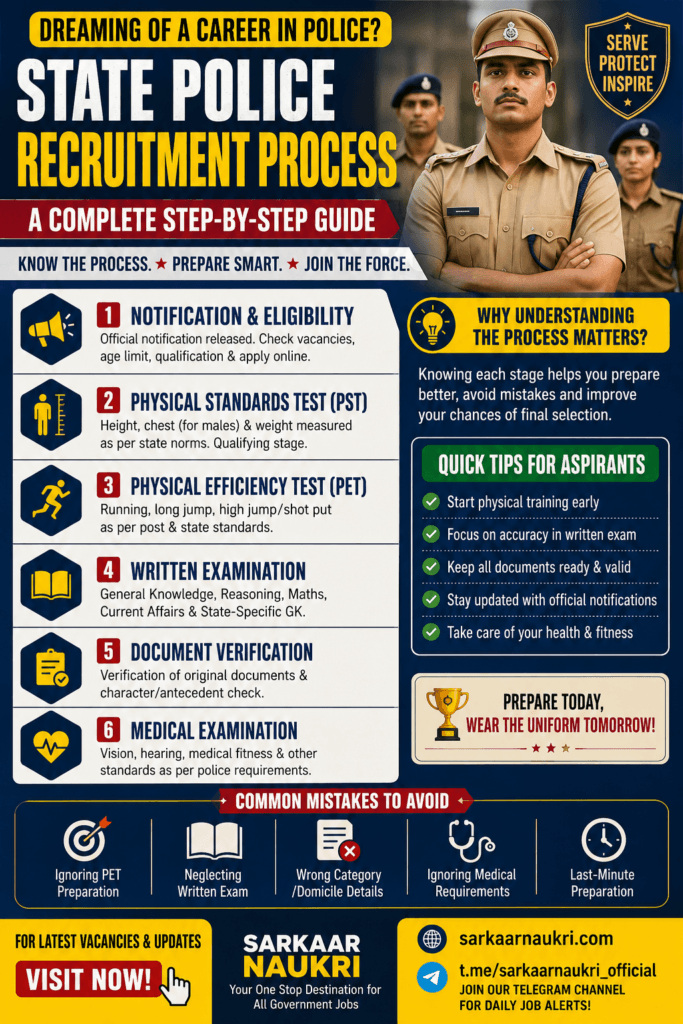
Why Understanding the Process Matters
Most candidates fail not because they lack ability, but because they misjudge one stage of the State Police Recruitment Process and get eliminated before reaching the exam they actually prepared for. A constable aspirant who ignores the Physical Efficiency Test while focusing only on the written exam, for instance, can be knocked out in the very first round. Knowing the full sequence in advance lets you allocate your preparation time correctly across fitness, academics, and documentation, rather than discovering gaps too late.
Stage 1: Notification and Eligibility Screening
The State Police Recruitment Process always begins with an official notification published on the respective state police recruitment board’s website. This notification lists the number of vacancies, the category-wise breakup, age limits, educational qualifications, and the application window. Most states require candidates to have passed at least Class 10 or Intermediate for constable posts, while sub-inspector posts typically require a bachelor’s degree. Age limits generally fall between 18 and 25 years for constables, with relaxation for reserved categories as per state rules. Before applying, candidates should verify their eligibility carefully, since incomplete or incorrect applications are rejected at the scrutiny stage itself, well before the State Police Recruitment Process even reaches its physical or written rounds.
Stage 2: Physical Standards Test (PST)
Once applications are screened, eligible candidates are called for the Physical Standards Test, which measures height, chest (for male candidates), and weight against the minimum criteria fixed by the state. These standards often vary by category and gender, and some states offer relaxed norms for candidates from hill areas, Scheduled Tribes, or paramilitary backgrounds. This stage of the State Police Recruitment Process is purely a qualifying round, meaning candidates either meet the minimum standards or are eliminated, with no scoring involved. It is advisable to carry original certificates and identity proof, as measurements are taken on the spot and disputes are rarely entertained later.
Stage 3: Physical Efficiency Test (PET)
The Physical Efficiency Test is where many candidates struggle the most in the State Police Recruitment Process. It usually involves a timed run, ranging from 1600 metres to 5 kilometres depending on the post and state, along with additional events like long jump, high jump, or shot put in some recruitments. Male and female candidates, as well as different age groups, are given separate time standards. Since PET is physically demanding and often conducted outdoors in summer months, candidates are strongly advised to begin structured fitness training at least four to six months before their expected recruitment cycle, rather than waiting for the notification.
Stage 4: Written Examination
After clearing the physical rounds, candidates sit for the written examination, which forms the academic core of the State Police Recruitment Process. The paper typically covers General Knowledge, Current Affairs, Reasoning, Numerical Ability, and sometimes a state-specific General Studies section covering local history, geography, and government schemes. Sub-inspector level exams may include an additional paper testing English comprehension or law-related basics. Negative marking is common in most state police written exams, so candidates should practice attempting questions strategically rather than guessing blindly, since accuracy weighs heavily in the final merit list produced by the State Police Recruitment Process.
Stage 5: Document Verification and Character Check
Candidates who clear the written exam move to document verification, where original certificates for age, education, category, and domicile are checked against the details submitted during application. Alongside this, police departments conduct a character and antecedent verification through local police stations, checking for any criminal record or pending case. This step in the State Police Recruitment Process is taken seriously, and even a minor discrepancy between submitted documents and originals can lead to disqualification, so candidates should double check every certificate well before the verification date.
Stage 6: Medical Examination
The final major stage is the medical examination, where candidates are checked for vision, hearing, cardiovascular fitness, and any disqualifying medical conditions defined by the recruiting state. Vision standards are particularly strict for police posts, and candidates wearing spectacles beyond a certain power may be rejected. Since this is typically the last hurdle in the State Police Recruitment Process, many candidates who cleared PET and the written exam still get eliminated here due to undiagnosed conditions, making a personal health checkup before applying a wise precaution.
Common Mistakes and Misconceptions
A frequent misconception is that the State Police Recruitment Process is only about physical fitness, causing candidates to neglect the written exam until the last month, when in most states the written paper carries the highest weight in final merit. Another common mistake is applying under the wrong category or without verifying domicile requirements, which leads to rejection at document verification despite clearing every earlier stage. Many candidates also underestimate PET timing standards, assuming general fitness is enough, without practicing the exact distance and time combination required by their specific recruitment. Lastly, candidates often ignore the medical eligibility criteria in advance, only to discover a disqualifying issue after investing months of preparation.
Other websites that can give you more information
Practical Tips for Candidates
Start physical training well before the notification is released, since fitness cannot be built in a few weeks once the State Police Recruitment Process officially begins. Building this habit early also reduces injury risk during the actual PET, which matters more than most candidates expect. Keep all original documents, including caste certificates, domicile proof, and educational marksheets, organized and updated throughout the year rather than scrambling at verification time. Take at least one full-length mock test for the written exam every week during the preparation phase, focusing especially on state-specific General Knowledge sections that generic study material often skips. Get a basic vision and health checkup done early so any correctable issue does not derail your candidacy at the medical stage of the State Police Recruitment Process.
Frequently Asked Questions
1. How long does the entire State Police Recruitment Process usually take? From notification to final joining, the process typically takes six months to a year, depending on the number of vacancies and how quickly each stage is conducted by the state board.
2. Can I skip the PET if I already have a sports certificate? No, sports certificates may earn bonus marks in some states but do not exempt candidates from appearing in the Physical Efficiency Test itself.
3. Is the written exam conducted before or after the physical test? This varies by state. Most states conduct PST and PET first, followed by the written exam, though a few states reverse this order, so always check your specific state’s notification.
4. What happens if I fail the medical test after clearing everything else? Candidates who fail the medical examination are removed from the final merit list, even if they scored well in the written exam and cleared PET, since medical fitness is a mandatory qualifying stage.
5. Are there separate PET standards for reserved categories? Some states provide relaxed time standards or additional attempts for SC/ST, PwD, and ex-servicemen candidates, though the exact relaxation varies significantly by state.
6. Can I reapply if I fail one stage of the State Police Recruitment Process? Yes, candidates can apply again in the next recruitment cycle, provided they still meet the age and eligibility criteria at that time.
7. Do all states follow the same sequence of stages? No, while most states follow PST, PET, written exam, document verification, and medical in that general order, the exact sequence and number of stages differ from state to state.
8. Is prior coaching necessary to clear the State Police Recruitment Process? Coaching is not mandatory. Many candidates clear it through self-study and disciplined physical training, though structured guidance can help with time management for the written exam.
Conclusion
The State Police Recruitment Process is a demanding but predictable journey once you understand its structure. By preparing for physical standards, written exams, documentation, and medical fitness simultaneously rather than sequentially, candidates give themselves the best chance of reaching the final merit list. Treat every stage of the State Police Recruitment Process as equally important rather than focusing on just one. For state-specific vacancy details, check our State Police Recruitment Notifications section, and for exam preparation resources, visit our Government Exam Study Material page.
