A solid BPSC Preparation Guide is the difference between aspirants who wander through the syllabus and those who clear it in one attempt. The Bihar Public Service Commission conducts one of the toughest state-level exams in India, and without a structured plan, even hardworking candidates lose months to trial and error. This BPSC Preparation Guide breaks down the exam stages, subject-wise strategy, timeline planning and common pitfalls so you can prepare with clarity instead of guesswork.
Every year, thousands of graduates start their BPSC journey with scattered notes and no fixed timeline, only to realise midway that they picked the wrong books or ignored high-weightage sections. A good BPSC preparation guide fixes that from day one by mapping out exactly what each stage demands and how much time to allocate. Whether you are a complete beginner or restarting after a previous attempt, the framework below applies to both.
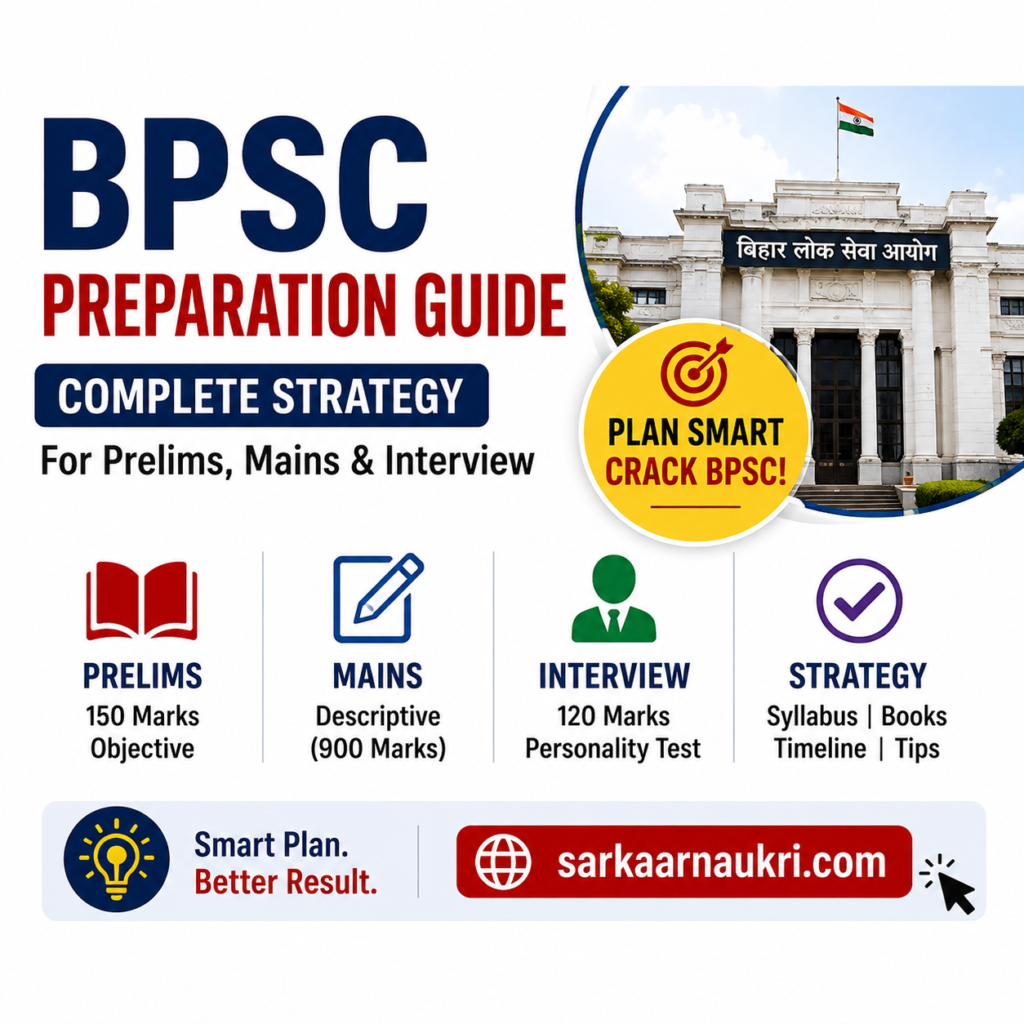
Understanding the BPSC Exam Structure
Before any BPSC Preparation Guide can help you, you need clarity on the three-stage selection process: Preliminary Examination, Main Examination and Interview.
| Stage | Format | Marks |
|---|---|---|
| Prelims | Objective, single GS paper | 150 |
| Mains | Descriptive (GS I, GS II, Essay, Optional, General Hindi) | 900 (merit) |
| Interview | Personality test | 120 |
The Prelims is purely qualifying and does not count toward your final rank. Only Mains and Interview marks decide your merit, with final merit typically calculated as GS Paper I plus GS Paper II plus Essay plus Interview. General Hindi and the Optional Subject are qualifying hurdles that must be cleared but do not add marks to your rank in the current pattern, so any BPSC Preparation Guide that still treats the optional as merit-bearing is working off outdated information.
BPSC Prelims Strategy
The Prelims paper tests breadth and speed under negative marking, so your BPSC Preparation Guide for this stage should focus on:
- NCERT foundation first: History, Geography, Polity and Economy from Class 6 to 12 build the conceptual base every other resource builds on
- Bihar-specific weightage: A significant chunk of questions target Bihar’s history, geography, economy and current government schemes, not just national-level facts
- Negative marking discipline: With penalty applying even to blank answers left unmarked on the OMR sheet, guesswork needs a clear cutoff rule during the exam
- Timed practice: Full-length mocks under exam conditions matter more than passive reading once the basics are covered
BPSC Mains Strategy
This is where any serious BPSC Preparation Guide has to go deeper, since Mains marks decide your actual rank.
General Studies Papers (GS I and GS II)
Structured answer writing wins more marks than raw content knowledge. Practice the intro-points-conclusion format consistently, and keep answers focused on the specific question asked rather than dumping everything you know.
Essay Paper
The Essay paper carries full merit weightage and is frequently under-prepared. Aspirants who skip essay practice until the final weeks typically lose marks that are very hard to recover through GS alone. Write two to three essays weekly from early in your preparation, and get feedback on structure before worrying about depth of content.
Optional Subject and General Hindi
Both are qualifying only under the current pattern. Prepare enough to clear the threshold comfortably, but do not over-invest time that should go toward Essay and GS papers.
Building Your BPSC Preparation Timeline
A realistic BPSC Preparation Guide adjusts the timeline to where you’re starting from:
- Twelve months: Suitable for complete beginners building a base from scratch
- Six months: Works for candidates with prior study or a related academic background
- Three months: Reserved for focused revision when the syllabus is already familiar
Break whichever timeline you choose into three broad phases: building basics, practice with answer writing, and a final revision phase built around mock tests. Assigning months to subjects rather than scattering study across all subjects daily keeps the plan realistic and trackable.
Current Affairs Strategy
Current affairs weave through both Prelims and Mains, so this BPSC Preparation Guide recommends:
- Reading one reliable source daily rather than juggling multiple apps and channels
- Actively linking news events to relevant syllabus topics as you read
- Prioritising Bihar-specific developments, budget announcements and state policy updates over generic national news
- Maintaining monthly compiled notes instead of relying on memory closer to the exam
Interview Preparation
The Interview stage evaluates communication, clarity of thought and awareness of Bihar-specific issues rather than testing pure factual recall. A well-rounded BPSC Preparation Guide treats this as a structured conversation to prepare for, not a cross-examination. Stay updated on both Bihar and national developments, revisit your optional subject and academic background, and practice articulating opinions clearly under mild pressure through mock interview sessions.
Common Mistakes and Misconceptions – BPSC preparation guide
- Treating the Optional Subject as merit-bearing: Under the current pattern it is qualifying only, and over-preparing it wastes time better spent on Essay and GS
- Ignoring Essay writing until the final month: With full merit weightage attached, this single paper can swing your rank significantly
- Relying only on UPSC-level books: Bihar Economic Survey, state budget documents and Bihar government scheme reports matter more than generic national reference material
- Leaving OMR answers blank without marking “not attempted”: Negative marking can apply to unmarked blanks too, so know the exact rule before exam day
- Starting current affairs revision too late: A single monthly compilation habit from month one saves weeks of last-minute cramming
Practical Tips for BPSC Preparation Guide
- Download the latest official syllabus and exam pattern before making any study plan
- Set a fixed daily study routine of four to six hours with clear weekly checklists
- Start Essay writing practice from week one, not after finishing GS syllabus
- Solve previous year question papers to understand recurring question trends
- Take topic-wise tests first, then move to full-length mocks as preparation matures
- Cross-check every detail against the official notification, since the Commission can issue corrigenda after initial release
Frequently Asked Questions on BPSC Preparation
1. How many hours should I study daily for BPSC preparation?
Most successful aspirants follow a four to six hour daily routine, adjusted based on whether you’re working alongside preparation or studying full-time.
2. Is the Optional Subject important for BPSC Mains?
It is qualifying only under the current pattern. You need to clear the threshold, but the marks do not add to your final rank.
3. How much does the Essay paper matter in BPSC Mains?
It carries full merit weightage of 300 marks, making it one of the highest-value papers to prepare for.
4. What is the best starting point for BPSC preparation as a beginner?
NCERT books from Class 6 to 12 across History, Geography, Polity and Economy, followed by Bihar-specific sources.
5. How is negative marking applied in BPSC Prelims?
A penalty applies for each incorrect answer, and in recent cycles this also extends to blanks left unmarked as “not attempted” on the OMR sheet.
6. Can I clear BPSC in six months of preparation?
Yes, if you already have a related academic background or prior exam preparation experience; beginners generally need a longer runway.
7. Does BPSC Prelims marks count toward the final rank?
No. Prelims is purely qualifying; only Mains and Interview marks determine your final merit.
Conclusion
A dependable BPSC Preparation Guide comes down to understanding the current exam structure accurately, prioritising Essay and GS papers over the now-qualifying optional subject, and following a realistic timeline built around consistent daily effort. For more exam-specific resources, check our State PSC section, and browse Latest Government Jobs for current openings across states.
