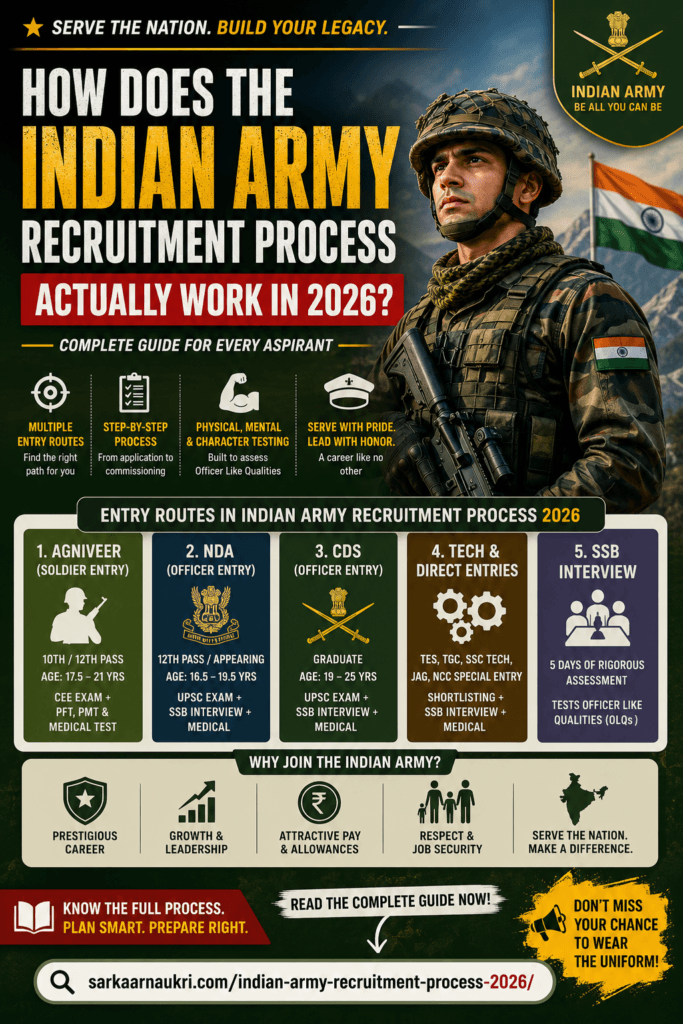
Introduction
If you have ever tried to research how to join the Indian Army, you have probably run into a wall of acronyms within the first five minutes: Agniveer, NDA, CDS, TES, SSB, CEE. Most guides list these terms without explaining how they connect, which leaves aspirants more confused than when they started. The Indian Army Recruitment Process 2026 is not one single exam or one single path. It is a set of parallel routes, soldier-level and officer-level, each with its own eligibility, exam pattern, and training track, but all converging on the same core idea: physical fitness, mental sharpness, and character assessment.
This guide walks through the Indian Army recruitment process 2026 exactly as it is structured today, from the Agnipath scheme for soldiers to the NDA, CDS, and technical officer entries, so you know precisely which door to walk through based on your age, qualification, and career goal.
Why Understanding the Full Process Matters
Most rejections in the Indian Army recruitment process 2026 don’t happen because candidates are unfit or unqualified. They happen because candidates apply to the wrong entry, miss an age-cutoff window by a few months, or misunderstand which stage is qualifying versus which stage actually contributes to merit. Knowing the full shape of the Indian Army Recruitment Process 2026 upfront prevents these avoidable losses and lets you plan your preparation timeline around the correct exam, not a generic one.
Entry Route 1: Agniveer (Soldier-Level Entry Under Agnipath)
The Agnipath scheme is the primary route into the Indian Army recruitment process 2026 for candidates who have completed Class 10 or Class 12 and want to join as a soldier rather than an officer. Under this scheme, selected candidates serve for four years as Agniveers, after which around 25 percent are retained in the regular cadre based on merit and organisational requirement.
- Eligibility: Age typically 17.5 to 21 years (varies slightly by category and notification cycle), with educational qualification depending on the specific Agniveer category (General Duty, Technical, Clerk/Store Keeper Technical, or Tradesman).
- Selection stages: Online registration, a Common Entrance Examination (CEE), followed by a physical fitness test, physical measurement, and medical examination for shortlisted candidates.
- Application fee: A nominal fee, paid entirely online during registration.
This is the highest-volume route within the Indian Army Recruitment Process 2026, with tens of thousands of vacancies filled annually across General Duty, Technical, Clerk, and Tradesman categories.
Entry Route 2: Officer Entry Through NDA
The National Defence Academy route is for candidates who are still in or have just finished Class 12 and want to begin officer training early. This route feeds directly into the Indian Army Recruitment Process 2026 through a UPSC-conducted written exam.
- Eligibility: Roughly 16.5 to 19.5 years of age, unmarried, Class 12 pass or appearing (Physics, Chemistry, and Mathematics are required for Navy and Air Force wings; not mandatory for the Army wing).
- Selection stages: UPSC written exam (Mathematics and General Ability Test), followed by the SSB interview and a final medical examination.
- Training: Successful candidates train at the NDA in Khadakwasla before commissioning.
Entry Route 3: Officer Entry Through CDS
The Combined Defence Services exam is the standard graduate-level route into the officer cadre and remains one of the most competitive stages of the Indian Army Recruitment Process 2026.
- Eligibility: Roughly 19 to 25 years of age, with a graduation degree (specific stream requirements differ slightly for IMA and OTA tracks).
- Selection stages: UPSC written exam, SSB Interview, and medical examination, similar in structure to NDA but pitched at the graduate level.
- Training: Successful male candidates train at the Indian Military Academy (IMA) for a permanent commission, while other candidates may train at the Officers Training Academy (OTA) for a short service commission.
Entry Route 4: Technical and Direct Officer Entries
Beyond NDA and CDS, the Indian Army Recruitment Process 2026 includes several qualification-specific routes that skip the UPSC written exam and go straight to shortlisting and the SSB Interview:
- TES (Technical Entry Scheme): For Class 12 candidates with Physics, Chemistry, and Mathematics who want to join the technical/engineering branches directly.
- TGC (Technical Graduate Course): For engineering graduates in specific disciplines.
- SSC Technical: For engineering graduates seeking a Short Service Commission.
- JAG Entry: For law graduates joining the Judge Advocate General’s branch.
- NCC Special Entry: For NCC ‘C’ Certificate holders with a qualifying grade, who are exempted from the written exam.
Each of these routes still funnels into the same SSB Interview used across the rest of the Indian Army Recruitment Process 2026, which is the common gate every officer aspirant must pass through regardless of entry type.
The SSB Interview: The Common Thread Across Every Officer Route
No matter which officer entry you choose, the Services Selection Board Interview sits at the centre of the Indian Army Recruitment Process 2026. It is a five-day assessment conducted at designated Selection Centres and is built to evaluate Officer Like Qualities rather than textbook knowledge.
- Day 1 (Screening): Officer Intelligence Rating tests and the Picture Perception and Description Test. A large share of candidates are screened out on this single day.
- Days 2 to 4: Psychological tests (including Thematic Apperception and Word Association tests), Group Testing Officer tasks such as group discussions and outdoor obstacle tasks, and the Personal Interview.
- Day 5: Conference, where the final board decision is made, followed by a detailed medical examination for those recommended.
Common Mistakes and Misconceptions
- Assuming one exam covers everything. Many aspirants prepare generically for “the army exam” instead of identifying whether their target route is Agniveer, NDA, CDS, or a technical entry, each of which has a distinct syllabus and timeline.
- Underestimating the SSB Interview. Candidates often over-invest in written exam preparation and start SSB preparation only after clearing the written stage, leaving too little time to build genuine Officer Like Qualities.
- Missing age-window eligibility by a few months. Because age cutoffs in the Indian Army Recruitment Process 2026 are calculated to specific birth-date ranges, many candidates miss out simply by applying to the wrong notification cycle.
- Ignoring physical fitness until the last month. Running timings, push-ups, and other fitness benchmarks require months of consistent training, not last-minute effort.
- Not verifying documents against certificates early. Mismatches between Aadhaar details and educational certificates are a common, avoidable reason for rejection during document verification.
Practical Tips to Navigate the Indian Army Recruitment Process 2026
- Identify your correct entry route first, based on age and qualification, before starting subject-wise preparation.
- Build a fitness routine at least six months before your target exam window, since physical standards are non-negotiable across every entry.
- Start SSB-specific preparation, including group discussion practice and structured self-reflection, in parallel with written exam preparation, not after it.
- Cross-check your age and educational eligibility against the specific official notification each year, since cutoff dates shift with every cycle.
- Keep original documents and certificates organised early to avoid last-minute verification issues.
- Track the official notification portal directly, rather than relying solely on aggregator sites, to avoid outdated dates or eligibility criteria.
Frequently Asked Questions
Q1. What is the difference between Agniveer and officer entry in the Indian Army Recruitment Process 2026? Agniveer is a soldier-level entry under the Agnipath scheme for Class 10/12 pass candidates, while officer entries like NDA, CDS, and TES lead to commissioned officer ranks and require different eligibility and exams.
Q2. Can a 12th pass candidate join the Indian Army as an officer directly? Yes, through NDA or TES, both of which accept Class 12 pass or appearing candidates and lead to officer commissioning after training.
Q3. Is the SSB Interview compulsory for all officer entries? Yes, every officer route in the Indian Army Recruitment Process 2026, including NDA, CDS, TES, TGC, SSC Tech, and NCC Special Entry, requires clearing the SSB Interview.
Q4. How long is the training period after selection? Training duration varies by entry: Agniveers undergo initial military training before deployment, while officer cadets train for a longer period at NDA, IMA, or OTA depending on their route.
Q5. What happens after four years of service as an Agniveer? Around 25 percent of Agniveers are selected for the regular cadre based on merit and organisational requirement, while the remainder complete their four-year tenure and exit with applicable benefits.
Q6. Do women have entry options in the Indian Army Recruitment Process 2026? Yes, women can apply for select Agniveer categories as well as several officer entries including SSC and technical branches, subject to the eligibility defined in each specific notification.
Q7. Where should candidates check the latest official notification? The official Indian Army recruitment website is the authoritative source for eligibility, dates, and category-wise vacancy details for every entry.
Conclusion
The Indian Army Recruitment Process 2026 is really a collection of parallel routes united by two constants: physical fitness standards and, for officer entries, the SSB interview. Once you correctly identify whether Agniveer, NDA, CDS, or a technical entry fits your age and qualification, the rest of your preparation becomes far more targeted and less overwhelming. For age-related eligibility details across government recruitment, see our Age Relaxation Rules guide, and for related defense postings, check our CAPF AC Syllabus guide.
