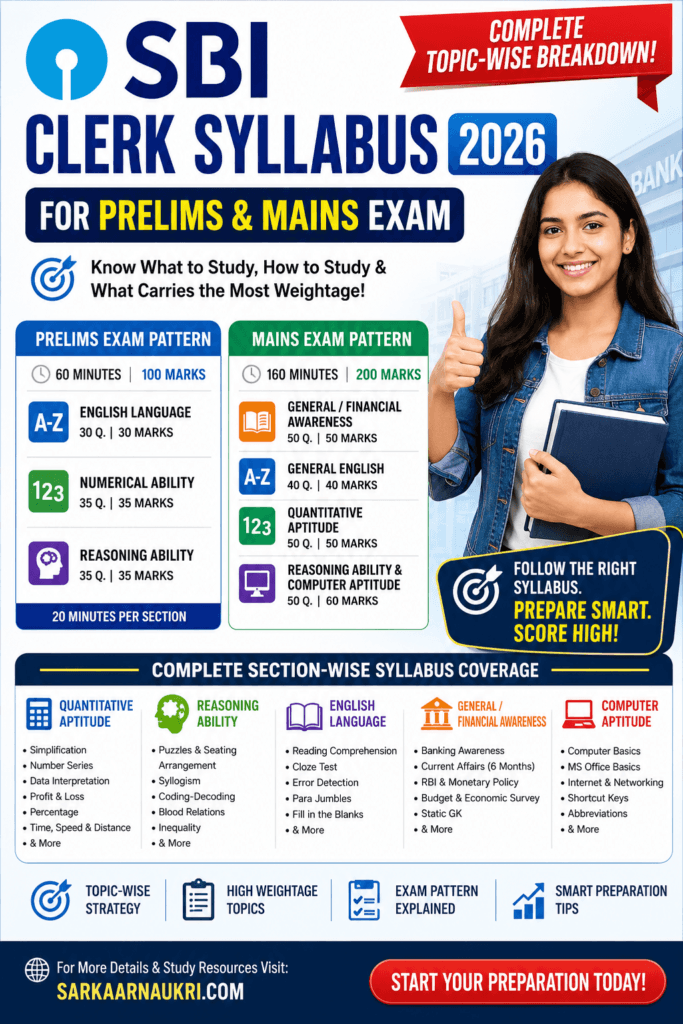
Lakhs of candidates apply for SBI Clerk every year, but a surprising number lose marks not because they don’t study but because they study the wrong topics in the wrong order. Understanding the exact SBI Clerk syllabus before you start preparing can save you months of misdirected effort. This guide breaks down the SBI Clerk syllabus section by section, for both Prelims and Mains, along with the exam pattern and a practical strategy to cover it efficiently.
The SBI Clerk syllabus is divided into three sections for Prelims and four sections for Mains. Each section tests a different skill set, and knowing which topics carry the most weight helps you allocate your study time correctly instead of spreading yourself thin across everything equally.
Why Understanding the SBI Clerk Syllabus Matters
Many candidates jump straight into solving mock tests without first mapping out the SBI Clerk syllabus in detail. This leads to uneven preparation — strong in some areas, weak in others, with no clear sense of why. A proper topic-wise understanding of the SBI Clerk syllabus lets you:
- Identify high-weightage topics that appear almost every year
- Skip low-yield topics until core areas are covered
- Build a realistic revision timeline
- Avoid last-minute panic over “surprise” question types that were actually part of the syllabus all along
The SBI Clerk syllabus doesn’t change drastically year to year, which means past-year question analysis is a reliable guide to what matters most.
SBI Clerk Syllabus: Prelims Exam Pattern
The Prelims stage of the SBI Clerk syllabus covers three sections in a single 60-minute test:
| Section | Topics Covered | Questions | Marks |
|---|---|---|---|
| English Language | Reading comprehension, cloze test, error detection, sentence rearrangement | 30 | 30 |
| Numerical Ability | Simplification, quadratic equations, data interpretation, arithmetic word problems | 35 | 35 |
| Reasoning Ability | Puzzles, seating arrangement, syllogism, coding-decoding, inequalities | 35 | 35 |
There’s sectional timing — 20 minutes per section — so the SBI Clerk syllabus at the prelims level also tests speed and time management, not just accuracy.
SBI Clerk Syllabus: Mains Exam Pattern
Mains is more comprehensive. The SBI Clerk Syllabus at this stage adds two new sections:
| Section | Topics Covered | Questions | Marks |
|---|---|---|---|
| General/Financial Awareness | Banking awareness, current affairs, static GK, financial terms | 50 | 50 |
| General English | Vocabulary, grammar, comprehension, parajumbles | 40 | 40 |
| Quantitative Aptitude | Data interpretation, number series, simplification, arithmetic | 50 | 50 |
| Reasoning Ability & Computer Aptitude | Puzzles, blood relations, computer fundamentals, MS Office basics | 50 | 60 |
The inclusion of computer aptitude is a part of the SBI Clerk syllabus that many candidates underestimate, despite it being a scoring section if prepared early.
Section-Wise Breakdown of SBI Clerk Syllabus Topics
Quantitative Aptitude / Numerical Ability
This portion of the syllabus tests calculation speed and conceptual clarity. Core topics include simplification and approximation, number series, quadratic equations, data interpretation (bar graphs, pie charts, tables, and caselets), profit and loss, simple and compound interest, ratio and proportion, average, time and work, and time-speed-distance.
Reasoning Ability
Reasoning is often the most time-consuming part of the syllabus. Key topics are puzzles and seating arrangements (circular, linear, and floor-based); syllogisms; coding-decoding; blood relations; direction sense; inequality; and machine input-output.
English Language
The English section of the syllabus focuses on practical language skills rather than pure grammar theory: reading comprehension, cloze tests, error spotting, sentence improvement, para jumbles, and fill-in-the-blanks.
General/Financial Awareness
This is unique to Mains and forms a distinct part of the syllabus. It covers banking history and structure; RBI functions and monetary policy; government schemes; budget and economic survey highlights; static GK (headquarters, currencies, and national parks); and current affairs from the past 6 months.
Computer Aptitude
A smaller but scoring section of the syllabus. Topics include computer fundamentals, MS Office basics, internet and networking basics, shortcut keys, and abbreviations (RAM, ROM, CPU, etc.).
Common Mistakes in Preparing the SBI Clerk Syllabus
Ignoring sectional cutoffs. Candidates often focus only on the overall score and forget that the syllabus requires clearing each section individually at prelims.
Ignoring computer aptitude until the last week. Because it’s clubbed with Reasoning in Mains, many candidates treat it as an afterthought, losing easy marks.
Studying static GK without a revision cycle. Financial awareness in the SBI Clerk syllabus needs repeated revision, not one-time reading, since retention drops quickly with GK content.
Skipping puzzle practice. Reasoning puzzles carry heavy weightage but need consistent daily practice, not occasional attempts.
Not analysing previous year papers. The syllabus is best understood through actual question patterns, not just topic lists.
Practical Tips to Cover the SBI Clerk Syllabus Efficiently
- Start with Quant and Reasoning, since these carry the most marks across both stages
- Dedicate 15–20 minutes daily to current affairs from the start, not just before Mains
- Use topic-wise mock tests before attempting full-length ones
- Revise Computer Aptitude and Financial Awareness weekly, since both are memory-heavy
- Track your section-wise accuracy, not just your overall score, to know where the Syllabus needs more attention
Frequently Asked Questions
Is the SBI Clerk syllabus the same for prelims and mains?
No, Prelims covers three sections, while Mains adds General/Financial Awareness and Computer Aptitude on top of the core sections, making the syllabus broader at the Mains stage.
How many topics are there in the SBI Clerk Syllabus for Quantitative Aptitude?
Roughly 12–15 recurring topics, with data interpretation, simplification, and number series being the most frequently tested.
Does the SBI Clerk Syllabus include Computer Knowledge as a separate section?
No, Computer Aptitude is combined with Reasoning Ability in the mains exam, not tested separately.
Is negative marking applicable across the SBI Clerk syllabus sections?
Yes, 0.25 marks are deducted for each wrong answer in both the prelims and the mains.
How much time should I give to general awareness in the SBI Clerk syllabus?
Ideally 20–30 minutes daily throughout preparation, since this section relies on consistent exposure rather than last-minute cramming.
Is the SBI Clerk syllabus different from the SBI PO syllabus?
The broad sections overlap, but SBI PO includes an additional descriptive test and group exercise/interview stage not present in the SBI Clerk syllabus.
Conclusion
Mastering the SBI Clerk Syllabus is less about covering every topic superficially and more about identifying which sections carry consistent weightage and building depth there. A structured, topic-wise approach to the SBI Clerk syllabus – backed by regular mock tests and previous-year analysis – puts you in a far stronger position than random, unstructured practice.
For more exam-specific preparation guidance, check our [SBI Clerk Recruitment Notification] page and browse other [Bank Job Guides] for related exams.
