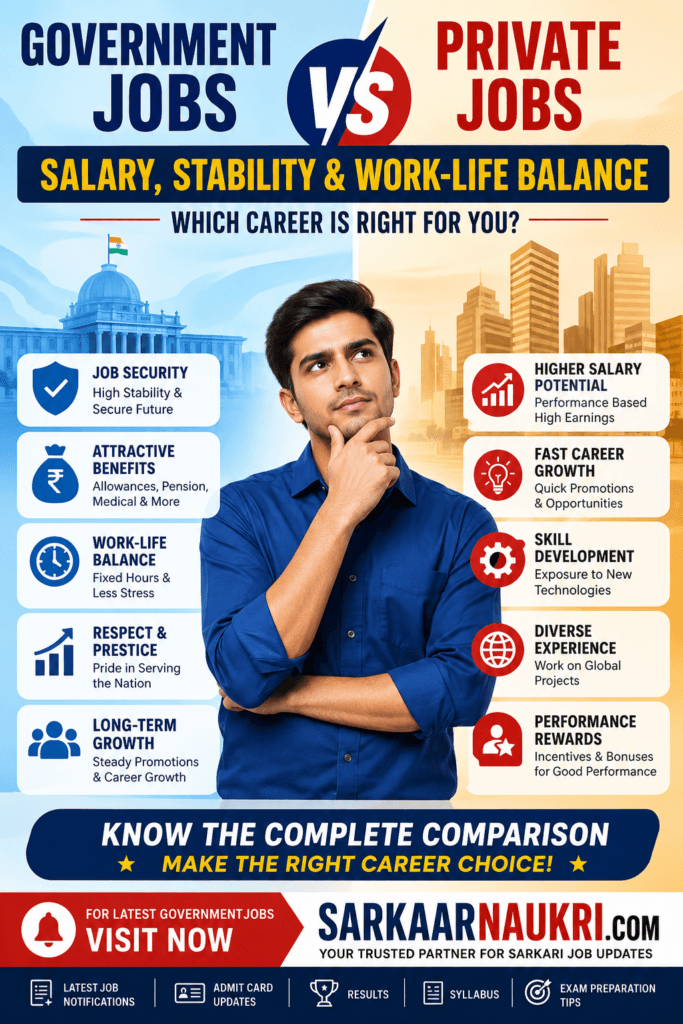
Choosing between a government job and a private-sector job is one of the most important career decisions for students and professionals in India. Every year, millions of candidates prepare for competitive examinations with the dream of securing a Sarkari Naukri, while others pursue opportunities in corporate organizations and startups.
The debate around Government Jobs vs Private Jobs has existed for decades. While private companies often offer faster career growth and attractive salary packages, government jobs continue to attract candidates because of their stability, benefits, and work-life balance.
If you are confused about which career path is right for you, this guide will help you understand the key differences. From salary and job security to promotions and retirement benefits, we will compare Government Jobs vs Private Jobs in detail so that you can make an informed career choice.
Why This Comparison Matters
A career is not just about earning money. It also affects your lifestyle, family life, financial security, stress levels, and future opportunities.
Many candidates focus only on the starting salary when comparing jobs. However, factors such as pension benefits, medical facilities, job security, promotions, and work pressure play an equally important role in long-term career satisfaction.
Understanding the advantages and disadvantages of both sectors helps candidates choose a path that aligns with their goals and expectations.
Government Jobs vs Private Jobs: Salary Comparison
Salary is often the first factor candidates consider when evaluating career opportunities.
In the private sector, starting salaries can vary significantly depending on the company, industry, and employee skills. IT professionals, management graduates, and specialized engineers often receive high salary packages early in their careers.
Government jobs generally follow structured pay scales established through Pay Commissions. Employees receive basic pay along with allowances such as:
- Dearness Allowance (DA)
- House Rent Allowance (HRA)
- Travel Allowance (TA)
- Medical benefits
- Special duty allowances in some departments
While the initial salary in government jobs may sometimes be lower than top private-sector roles, the total compensation package becomes highly competitive when allowances and long-term benefits are considered.
For average graduates, government jobs often provide more predictable income growth compared to private-sector employment.
Government Jobs vs Private Jobs: Job Security and Stability
Job security remains one of the strongest reasons candidates prefer government employment.
Government employees rarely face sudden layoffs during economic downturns. Once recruited through a proper selection process, employees generally enjoy stable employment until retirement, provided they follow service rules.
Private-sector jobs, on the other hand, are closely linked to market conditions. Economic slowdowns, company restructuring, mergers, or declining profits can result in layoffs or workforce reductions.
The discussion around Government Jobs vs Private Jobs often centers on stability because long-term employment security allows individuals to plan their finances, home purchases, and family responsibilities with greater confidence.
For candidates seeking a secure and predictable career path, government jobs typically have a clear advantage.
Government Jobs vs Private Jobs: Work-Life Balance
Work-life balance has become increasingly important in today’s professional environment.
Government employees generally work fixed hours and enjoy clearly defined leave policies. Most departments follow regular office timings, making it easier to maintain a healthy balance between work and personal life.
Common leave benefits include:
- Earned Leave
- Casual Leave
- Medical Leave
- Maternity Leave
- Paternity Leave
- Public Holidays
Private-sector employees may experience longer working hours, project deadlines, weekend work, and higher performance expectations, particularly in competitive industries.
Although many modern companies are improving employee welfare programs, government jobs still remain attractive for those prioritizing family time and personal well-being.
When evaluating Government Jobs vs Private Jobs, work-life balance is often a deciding factor for many aspirants.
Government Jobs vs Private Jobs: Career Growth and Promotions
Career growth differs significantly between the two sectors.
Government organizations usually follow structured promotion systems based on:
- Seniority
- Departmental examinations
- Performance reviews
- Vacancy availability
Promotions may take time, but they are generally transparent and governed by established rules.
Private companies offer faster growth opportunities for high performers. Employees who consistently deliver results can receive promotions, salary hikes, and leadership roles much earlier in their careers.
However, private-sector growth often comes with higher pressure and increased accountability.
Candidates who prefer predictable progression may find government jobs more suitable, while ambitious professionals seeking rapid advancement may prefer private-sector careers.
Retirement Benefits and Long-Term Financial Security ( Government Jobs vs Private Jobs )
One major advantage of government employment is long-term financial security.
Government employees often receive benefits such as:
- National Pension System (NPS)
- Gratuity
- Provident Fund
- Medical facilities
- Family pension benefits in eligible cases
These benefits provide financial support after retirement and reduce uncertainty during old age.
Private-sector employees also receive retirement benefits through EPF and corporate retirement plans, but the extent of these benefits varies by employer.
For individuals focused on financial stability after retirement, government employment remains highly attractive.
Workplace Pressure and Job Stress
Every profession involves some level of stress, but the nature of that stress varies.
Government jobs may involve administrative responsibilities, public interaction, and regulatory compliance. However, performance targets are usually less aggressive than those found in private corporations.
Private-sector organizations often operate in highly competitive environments. Employees may face:
- Revenue targets
- Performance metrics
- Tight deadlines
- Client expectations
- Frequent evaluations
As a result, stress levels can be higher in many private-sector roles.
This factor frequently influences discussions about Government Jobs vs Private Jobs, particularly among candidates who prioritize mental well-being and stability.
Skill Development and Learning Opportunities (Government Jobs vs Private Jobs )
A common misconception is that government jobs offer limited learning opportunities.
In reality, many government departments provide specialized training programs, workshops, and professional development initiatives.
However, private companies generally adapt more quickly to technological changes and industry trends. Employees often gain exposure to cutting-edge tools, international projects, and rapidly evolving business practices.
Candidates interested in innovation and continuous industry transformation may find private-sector careers more dynamic.
Common Myths About Government Jobs vs Private Jobs
Myth 1: Government Jobs Always Pay Less
Many government positions offer competitive salaries once allowances and benefits are included.
Myth 2: Private Jobs Have No Security (Government Jobs vs Private Jobs )
While private jobs are generally less secure than government jobs, employees with strong skills and experience often enjoy stable careers.
Myth 3: Government Employees Do Not Work Hard
Many government departments handle critical responsibilities involving public services, administration, healthcare, defense, and infrastructure development.
Myth 4: Promotions Are Impossible in Government Jobs
Promotions may be slower, but structured career progression exists in most government organizations.
Myth 5: Private Jobs Guarantee Rapid Success
Career growth depends on performance, market conditions, and organizational needs rather than sector alone.
Practical Tips for Choosing the Right Career
Choose Government Jobs If You:
- Value job security
- Prefer stable income
- Want a better work-life balance
- Seek long-term benefits
- Prefer structured career progression
Choose Private Jobs If You:
- Want faster promotions
- Enjoy competitive environments
- Seek higher earning potential
- Prefer innovation-driven work
- Are comfortable with performance-based growth
Evaluate your personality, goals, and risk tolerance before making a decision.
Frequently Asked Questions
Is a government job better than a private job in India?
Government jobs generally offer better job security, benefits, and work-life balance, while private jobs may provide faster career growth and higher salaries.
Which sector offers better job security?
Government employment offers significantly stronger job security compared to most private-sector positions.
Can private-sector salaries exceed government salaries?
Yes. Top-performing professionals in industries such as IT, finance, and consulting often earn significantly higher salaries.
Which is better for work-life balance?
Government jobs generally provide better work-life balance because of fixed working hours and generous leave policies.
Are government job promotions slower?
In many cases, yes. Government promotions follow structured systems, whereas private companies may promote high performers more quickly.
What should fresh graduates choose?
Fresh graduates should choose based on their career goals, financial expectations, risk tolerance, and preferred work environment.
Conclusion
The debate over Government Jobs vs Private Jobs does not have a single answer because every candidate has different priorities. Government jobs offer unmatched stability, strong retirement benefits, and a healthier work-life balance. Private-sector careers provide faster growth, higher earning potential, and exposure to dynamic industries.
Before making a decision, carefully evaluate your long-term goals, lifestyle preferences, and professional ambitions. A well-informed choice today can lead to a more satisfying and successful career in the future.
Related Guides:
