Every year, lakhs of aspirants across Rajasthan set their sights on becoming an RAS officer, Tehsildar, or school lecturer, but very few sit down to actually understand how the selection process works before they begin preparing. If that sounds familiar, this RPSC Exam Guide 2026 is meant to fix that right at the start. RPSC Exam Guide 2026: Everything You Need to Know Before You Apply
Every year, lakhs of aspirants across Rajasthan set their sights on becoming an RAS officer, Tehsildar, or school lecturer, but very few sit down to actually understand how the selection process works before they begin preparing. If that sounds familiar, this RPSC Exam Guide 2026 is meant to fix that right at the start. The Rajasthan Public Service Commission conducts some of the most sought-after state-level exams in the country, and getting the fundamentals right, eligibility, exam pattern, syllabus, and selection stages, is the real first step toward cracking it. This guide breaks down every part of the process in plain language, so you know exactly what you are preparing for and why each stage matters.
Why This RPSC Exam Guide Matters
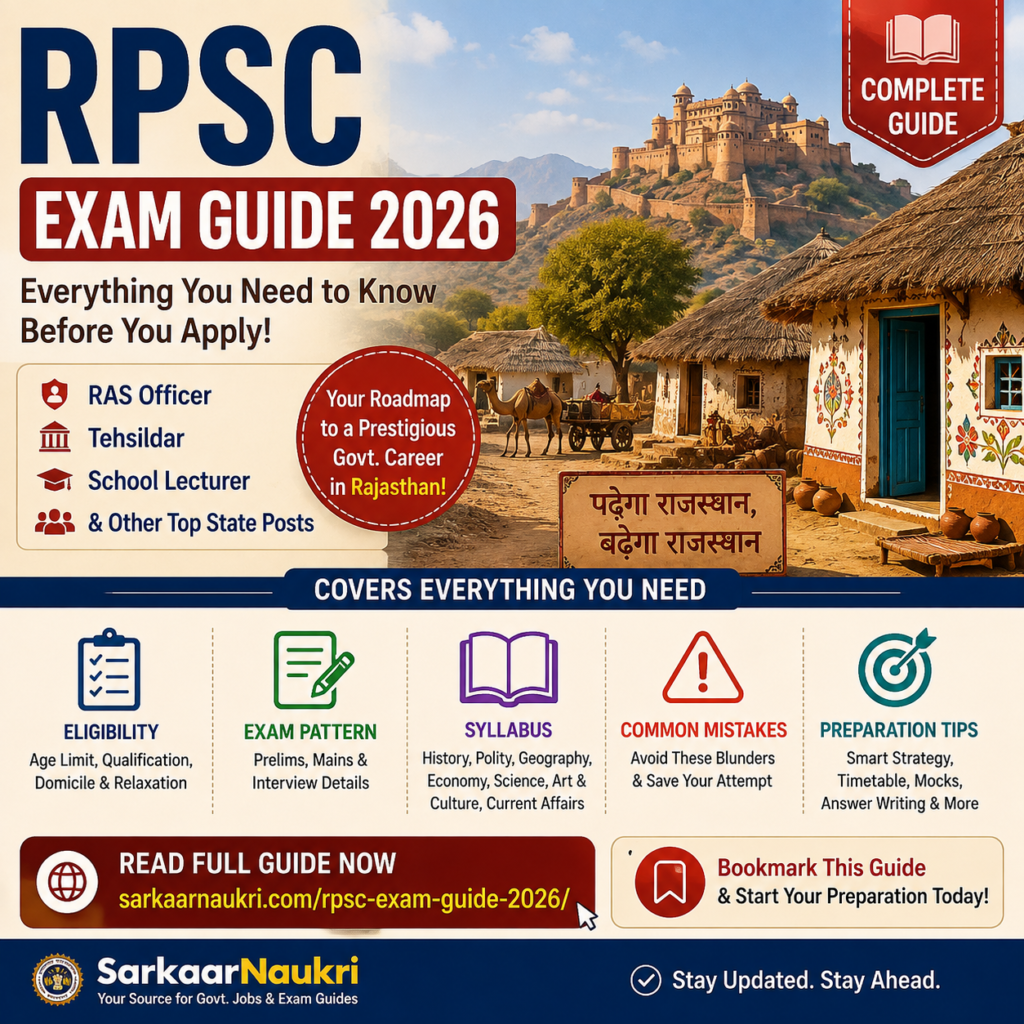
Before jumping into books and coaching material, most aspirants lose months simply because they don’t fully understand the exam structure. A proper RPSC Exam Guide 2026 saves that time by laying out the eligibility rules, the stages of the exam, the syllabus weightage, and the common traps that catch first-time candidates off guard. RPSC recruits for a wide range of posts through the Rajasthan Administrative Service (RAS) exam and other combined competitive exams, including RAS Officer, Tehsildar, Assistant Registrar, Lecturer, and various Class 1 and Class 2 state posts. Because competition is intense and the syllabus is vast, aspirants who understand the exam framework early tend to plan their preparation far more efficiently than those who dive straight into random study material. That is exactly why this guide exists, to walk you through eligibility, exam pattern, and syllabus in one place before you commit months of preparation to it.
RPSC Eligibility Criteria
Every RPSC Exam Guide 2026 has to start with eligibility, since a large number of applications get rejected simply because candidates didn’t check the basic conditions first.
- Nationality: Candidates must be Indian citizens.
- Age Limit: The general age limit is typically 21 to 40 years as on 1 January of the exam year, though this can shift slightly depending on the specific notification.
- Age Relaxation: SC, ST, and OBC candidates from Rajasthan get age relaxation as per state rules, with additional relaxations available for female candidates, PwD candidates, and Ex-servicemen.
- Educational Qualification: A bachelor’s degree from a recognized university is the minimum requirement for most posts under this RPSC Exam Guide 2026, though certain technical or specialized posts may require a specific degree.
- Domicile: Most posts are open to candidates from Rajasthan, with reservations and relaxations tied to state domicile rules.
Since eligibility conditions can vary slightly between the RAS exam and other RPSC-conducted exams, it is worth cross-checking the latest official notification for the specific post you are targeting rather than relying only on this RPSC Exam Guide 2026 or last year’s rules.
RPSC Exam Pattern: Three Stages Explained
Understanding the RPSC Exam Guide 2026 selection process starts with knowing that it runs in three stages, and each one filters candidates differently.
Stage 1: Preliminary Exam This is an objective-type screening exam, usually a single General Studies paper covering Rajasthan-specific and general topics. It is meant purely to shortlist candidates for the Mains and does not count toward the final merit.
Stage 2: Main Exam The Main exam is descriptive and considerably tougher, typically spread across multiple General Studies papers. This stage is central to any serious RPSC Exam Guide 2026 preparation timeline, since it carries the highest weightage in the final merit and demands strong answer-writing practice, not just content recall.
Stage 3: Interview (Personality Test) Candidates who clear the Main exam are called for an interview that evaluates communication skills, general awareness, decision-making ability, and suitability for administrative roles. The interview marks are added to the Main exam score to prepare the final merit list.
RPSC Syllabus Overview
The syllabus for this RPSC Exam Guide 2026 covers a wide mix of static and dynamic topics, and understanding the weightage helps prioritize study time.
- History: Ancient, Medieval, and Modern Indian History, with heavy focus on Rajasthan’s regional history, culture, and freedom movement contributions.
- Geography: Indian and Rajasthan geography, including physical features, desert ecology, water resources, and economic geography.
- Polity: Indian Constitution, governance structures, panchayati raj, and public administration.
- Economy: National and Rajasthan state economy, budget, government schemes, and development plans.
- General Science: Basic science concepts along with current developments in science and technology.
- Current Affairs: National and state-level events, government policies, and Rajasthan-specific developments form a significant chunk of both Prelims and Mains.
- Rajasthan Art & Culture: Folk traditions, festivals, monuments, and heritage sites unique to the state carry notable weightage.
Rajasthan-specific content carries noticeably more weightage in this RPSC Exam Guide 2026 syllabus compared to other state exams, so candidates preparing only from generic UPSC-style material often underperform unless they add dedicated Rajasthan-focused reading.
Common Mistakes and Misconceptions
Many aspirants approach this RPSC Exam Guide 2026 preparation with assumptions that end up costing them a full attempt.
- Assuming Prelims marks count toward the final result: They don’t. Prelims is purely a screening stage, and only the Mains and Interview scores build the final merit.
- Underestimating Rajasthan-specific topics: Treating RPSC like a smaller UPSC exam and skipping state history, geography, and art and culture is one of the most common reasons for low Prelims scores.
- Starting Mains preparation too late: Since Mains is descriptive and answer-writing heavy, candidates who begin practicing only after the Prelims result struggle to build speed and structure in time.
- Ignoring Rajasthan Art & Culture: This section is often treated as an afterthought in most preparation plans, yet within this RPSC Exam Guide 2026 it carries enough weightage to meaningfully affect the final score.
- Relying on a single source: As this RPSC Exam Guide 2026 points out, the syllabus is broad enough that depending on just one book or one coaching module usually leaves gaps, especially in current affairs and state-specific content.
Practical Tips for RPSC Preparation
These practical tips for RPSC Exam Guide 2026 preparation can help you build a more efficient study plan from day one.
- Build a subject-wise timetable that gives extra weightage to Rajasthan history, geography, and art and culture, since these topics are unique to this exam.
- Practice previous years’ RPSC papers to understand the exact difficulty level and question pattern rather than relying only on generic state PSC material.
- Start answer writing practice for Mains well before the Prelims result is out, since descriptive writing speed takes months to build.
- Dedicate a fixed daily slot to current affairs, focusing especially on Rajasthan government schemes, budget announcements, and state-level appointments.
- Take regular mock tests for both Prelims and Mains to track improvement as part of your overall RPSC Exam Guide 2026 preparation, and to identify weak areas early rather than close to the exam date.
Frequently Asked Questions
1. What is the age limit for RPSC Exam 2026? As covered earlier in this RPSC Exam Guide 2026, the general age limit is usually 21 to 40 years as on 1 January of the exam year, with relaxation for reserved categories as per Rajasthan government rules.
2. Is the RPSC Prelims exam qualifying in nature? Yes, as this RPSC Exam Guide 2026 explains, the Prelims exam is a screening stage, and only the Mains and Interview marks count toward the final merit list.
3. How many stages are there in the RPSC selection process? There are three stages: Preliminary Exam, Main Exam, and Interview (Personality Test).
4. Do I need a specific degree to be eligible for RPSC? No, as this RPSC Exam Guide 2026 explains, a bachelor’s degree in any discipline from a recognized university is generally sufficient for most posts, though a few technical posts may need a specific qualification.
5. How much weightage does Rajasthan-specific content carry in the syllabus? A significant portion of both Prelims and Mains, particularly in History, Geography, and Art & Culture, focuses specifically on Rajasthan rather than only national-level content.
6. Can candidates from outside Rajasthan apply for RPSC? As noted in this RPSC Exam Guide 2026, most posts require Rajasthan domicile, though the exact domicile and reservation rules should always be checked in the latest official notification since they can vary by post.
7. What is the best way to start preparing for the RPSC exam? Begin by understanding the exam pattern and syllabus thoroughly, as covered in this RPSC Exam Guide 2026, then build a timetable that balances static subjects, current affairs, and regular answer writing practice.
Conclusion
This RPSC Exam Guide 2026 covers the eligibility rules, three-stage exam pattern, syllabus weightage, and preparation tips that every serious aspirant should know before starting their preparation. Understanding these fundamentals early helps you avoid the common mistakes that cost other candidates a full attempt, especially around Rajasthan-specific content and Mains answer writing. For post-wise vacancy details and the latest application timeline, check our [RPSC Recruitment 2026 notification page], and for broader exam-wise preparation strategies, visit our [State PSC Exams category]. Bookmark this guide and revisit it as you move from Prelims to Mains preparation. conducts some of the most sought-after state-level exams in the country, and getting the fundamentals right, eligibility, exam pattern, syllabus, and selection stages, is the real first step toward cracking it. This guide breaks down every part of the process in plain language, so you know exactly what you are preparing for and why each stage matters.
Why This RPSC Exam Guide Matters
Before jumping into books and coaching material, most aspirants lose months simply because they don’t fully understand the exam structure. A proper RPSC Exam Guide 2026 saves that time by laying out the eligibility rules, the stages of the exam, the syllabus weightage, and the common traps that catch first-time candidates off guard. RPSC recruits for a wide range of posts through the Rajasthan Administrative Service (RAS) exam and other combined competitive exams, including RAS Officer, Tehsildar, Assistant Registrar, Lecturer, and various Class 1 and Class 2 state posts. Because competition is intense and the syllabus is vast, aspirants who understand the exam framework early tend to plan their preparation far more efficiently than those who dive straight into random study material. That is exactly why this guide exists, to walk you through eligibility, exam pattern, and syllabus in one place before you commit months of preparation to it.
RPSC Eligibility Criteria
Every RPSC Exam Guide 2026 has to start with eligibility, since a large number of applications get rejected simply because candidates didn’t check the basic conditions first.
- Nationality: Candidates must be Indian citizens.
- Age Limit: The general age limit is typically 21 to 40 years as on 1 January of the exam year, though this can shift slightly depending on the specific notification.
- Age Relaxation: SC, ST, and OBC candidates from Rajasthan get age relaxation as per state rules, with additional relaxations available for female candidates, PwD candidates, and Ex-servicemen.
- Educational Qualification: A bachelor’s degree from a recognized university is the minimum requirement for most posts under this RPSC Exam Guide 2026, though certain technical or specialized posts may require a specific degree.
- Domicile: Most posts are open to candidates from Rajasthan, with reservations and relaxations tied to state domicile rules.
Since eligibility conditions can vary slightly between the RAS exam and other RPSC-conducted exams, it is worth cross-checking the latest official notification for the specific post you are targeting rather than relying only on this RPSC Exam Guide 2026 or last year’s rules.
RPSC Exam Pattern: Three Stages Explained
Understanding the RPSC Exam Guide 2026 selection process starts with knowing that it runs in three stages, and each one filters candidates differently.
Stage 1: Preliminary Exam This is an objective-type screening exam, usually a single General Studies paper covering Rajasthan-specific and general topics. It is meant purely to shortlist candidates for the Mains and does not count toward the final merit.
Stage 2: Main Exam The Main exam is descriptive and considerably tougher, typically spread across multiple General Studies papers. This stage is central to any serious RPSC Exam Guide 2026 preparation timeline, since it carries the highest weightage in the final merit and demands strong answer-writing practice, not just content recall.
Stage 3: Interview (Personality Test) Candidates who clear the Main exam are called for an interview that evaluates communication skills, general awareness, decision-making ability, and suitability for administrative roles. The interview marks are added to the Main exam score to prepare the final merit list.
RPSC Syllabus Overview
The syllabus for this RPSC Exam Guide 2026 covers a wide mix of static and dynamic topics, and understanding the weightage helps prioritize study time.
- History: Ancient, Medieval, and Modern Indian History, with heavy focus on Rajasthan’s regional history, culture, and freedom movement contributions.
- Geography: Indian and Rajasthan geography, including physical features, desert ecology, water resources, and economic geography.
- Polity: Indian Constitution, governance structures, panchayati raj, and public administration.
- Economy: National and Rajasthan state economy, budget, government schemes, and development plans.
- General Science: Basic science concepts along with current developments in science and technology.
- Current Affairs: National and state-level events, government policies, and Rajasthan-specific developments form a significant chunk of both Prelims and Mains.
- Rajasthan Art & Culture: Folk traditions, festivals, monuments, and heritage sites unique to the state carry notable weightage.
Rajasthan-specific content carries noticeably more weightage in this RPSC Exam Guide 2026 syllabus compared to other state exams, so candidates preparing only from generic UPSC-style material often underperform unless they add dedicated Rajasthan-focused reading.
Common Mistakes and Misconceptions
Many aspirants approach this RPSC Exam Guide 2026 preparation with assumptions that end up costing them a full attempt.
- Assuming Prelims marks count toward the final result: They don’t. Prelims is purely a screening stage, and only the Mains and Interview scores build the final merit.
- Underestimating Rajasthan-specific topics: Treating RPSC like a smaller UPSC exam and skipping state history, geography, and art and culture is one of the most common reasons for low Prelims scores.
- Starting Mains preparation too late: Since Mains is descriptive and answer-writing heavy, candidates who begin practicing only after the Prelims result struggle to build speed and structure in time.
- Ignoring Rajasthan Art & Culture: This section is often treated as an afterthought in most preparation plans, yet within this RPSC Exam Guide 2026 it carries enough weightage to meaningfully affect the final score.
- Relying on a single source: As this RPSC Exam Guide 2026 points out, the syllabus is broad enough that depending on just one book or one coaching module usually leaves gaps, especially in current affairs and state-specific content.
Practical Tips for RPSC Preparation
These practical tips for RPSC Exam Guide 2026 preparation can help you build a more efficient study plan from day one.
- Build a subject-wise timetable that gives extra weightage to Rajasthan history, geography, and art and culture, since these topics are unique to this exam.
- Practice previous years’ RPSC papers to understand the exact difficulty level and question pattern rather than relying only on generic state PSC material.
- Start answer writing practice for Mains well before the Prelims result is out, since descriptive writing speed takes months to build.
- Dedicate a fixed daily slot to current affairs, focusing especially on Rajasthan government schemes, budget announcements, and state-level appointments.
- Take regular mock tests for both Prelims and Mains to track improvement as part of your overall RPSC Exam Guide 2026 preparation, and to identify weak areas early rather than close to the exam date.
Frequently Asked Questions
1. What is the age limit for RPSC Exam 2026? As covered earlier in this RPSC Exam Guide 2026, the general age limit is usually 21 to 40 years as on 1 January of the exam year, with relaxation for reserved categories as per Rajasthan government rules.
2. Is the RPSC Prelims exam qualifying in nature? Yes, as this RPSC Exam Guide 2026 explains, the Prelims exam is a screening stage, and only the Mains and Interview marks count toward the final merit list.
3. How many stages are there in the RPSC selection process? There are three stages: Preliminary Exam, Main Exam, and Interview (Personality Test).
4. Do I need a specific degree to be eligible for RPSC? No, as this RPSC Exam Guide 2026 explains, a bachelor’s degree in any discipline from a recognized university is generally sufficient for most posts, though a few technical posts may need a specific qualification.
5. How much weightage does Rajasthan-specific content carry in the syllabus? A significant portion of both Prelims and Mains, particularly in History, Geography, and Art & Culture, focuses specifically on Rajasthan rather than only national-level content.
6. Can candidates from outside Rajasthan apply for RPSC? As noted in this RPSC Exam Guide 2026, most posts require Rajasthan domicile, though the exact domicile and reservation rules should always be checked in the latest official notification since they can vary by post.
7. What is the best way to start preparing for the RPSC exam? Begin by understanding the exam pattern and syllabus thoroughly, as covered in this RPSC Exam Guide 2026, then build a timetable that balances static subjects, current affairs, and regular answer writing practice.
Conclusion
This RPSC Exam Guide 2026 covers the eligibility rules, three-stage exam pattern, syllabus weightage, and preparation tips that every serious aspirant should know before starting their preparation. Understanding these fundamentals early helps you avoid the common mistakes that cost other candidates a full attempt, especially around Rajasthan-specific content and Mains answer writing. For post-wise vacancy details and the latest application timeline, check our [RPSC Recruitment 2026 notification page], and for broader exam-wise preparation strategies, visit our [State PSC Jobs]. Bookmark this guide and revisit it as you move from Prelims to Mains preparation.
