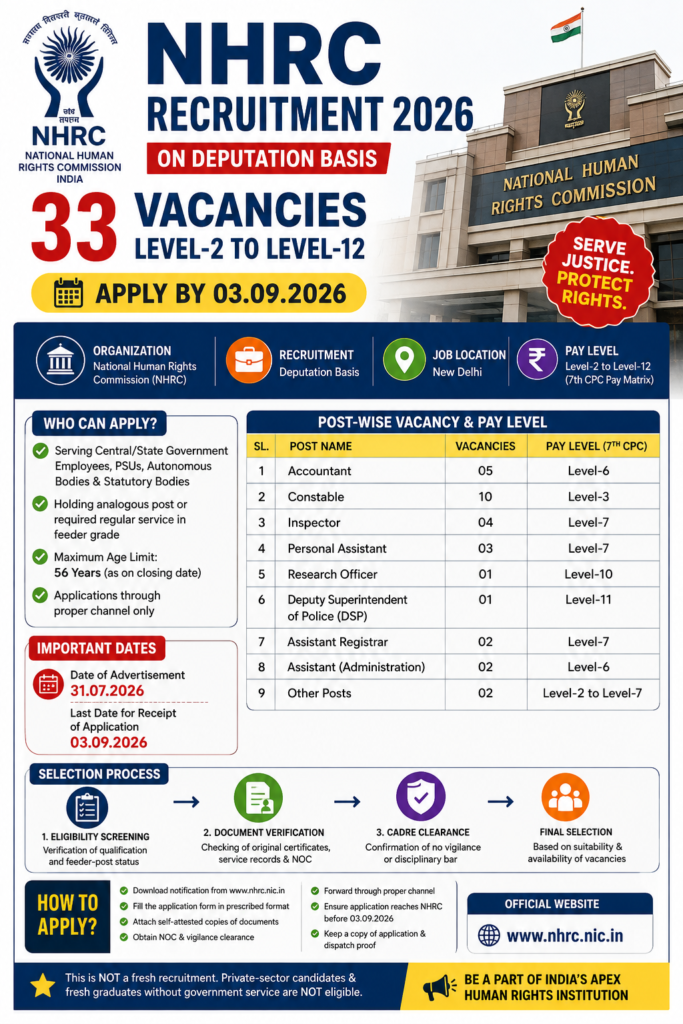
Only officers with regular service in a matching pay level and comparable post in their parent department or cadre can apply for NHRC Recruitment 2026. This is not a fresh recruitment drive open to private-sector candidates or the general public — it is a deputation-basis exercise conducted by the National Human Rights Commission (NHRC) to fill 33 posts spanning Pay Level-2 to Level-12, ranging from Constable to Deputy Superintendent of Police. Serving Central Government, State Government, PSU, Autonomous Body, and Statutory Body employees who hold an analogous post, or who meet the required years of regular service in the feeder grade, form the eligible pool. The notification was issued under Advertisement No. NHRC/Admn./Recruitment/01/2026, dated 31.07.2026, with applications to be routed through the proper channel and received by the Commission on or before 03.09.2026. This article breaks down the eligibility, pay levels, and application process for every post covered under this notification.
Recruitment Overview
| Detail | Information |
|---|---|
| Organization | National Human Rights Commission (NHRC) |
| Advertisement No. | NHRC/Admn./Recruitment/01/2026 |
| Date of Advertisement | 31.07.2026 |
| Total Posts | 33 |
| Nature of Recruitment | Deputation Basis |
| Pay Level(s) | Level-2 to Level-12 (7th CPC Pay Matrix) |
| Age Limit | Maximum 56 years (as on closing date) |
| Application Mode | Offline, through proper channel |
| Job Location | New Delhi |
| Official Website | www.nhrc.nic.in |
Important Dates
| Event | Date |
|---|---|
| Date of Advertisement | 31.07.2026 |
| Last Date for Receipt of Application | 03.09.2026 |
Applications received after the last date will be rejected, so officers interested in NHRC Recruitment 2026 should ensure their forwarded application reaches the Commission well before the deadline, since proper-channel applications can take time to move through the parent department.
Post-wise Vacancy & Pay Level Breakdown
| Sl. No. | Post Name | Vacancies | Pay Level (7th CPC) |
|---|---|---|---|
| 1 | Accountant | 05 | Level-6 |
| 2 | Constable | 10 | Level-3 |
| 3 | Inspector | 04 | Level-7 |
| 4 | Personal Assistant | 03 | Level-7 |
| 5 | Research Officer | 01 | Level-10 |
| 6 | Deputy Superintendent of Police (DSP) | 01 | Level-11 |
| 7 | Assistant Registrar | 02 | Level-7 |
| 8 | Assistant (Administration) | 02 | Level-6 |
| 9 | Other Posts | 02 | Level-2 to Level-7 |
Who Can Apply (Eligibility & Feeder Categories)
Eligibility for NHRC Recruitment 2026 is post-specific and tied to the applicant’s existing service record rather than a fresh degree alone. For the Accountant post, candidates need a Bachelor’s Degree in Commerce (B.Com) from a recognized university, alongside the matching feeder grade in their parent office. The Constable post asks for a 10th Pass qualification, making it the most accessible entry point in this notification for eligible feeder-cadre staff. Inspector and Assistant (Administration) posts require a graduate degree, while the Personal Assistant post additionally asks for a typing speed of 35 words per minute in English, reflecting the secretarial nature of the role.
The Research Officer post calls for a postgraduate degree in Law, Human Rights, Social Sciences, or International Studies, combined with an analogous post already held in the parent cadre. The Deputy Superintendent of Police (DSP) post is reserved for officers already holding an analogous rank in their parent police cadre, and the Assistant Registrar post requires a Law degree from a recognized university. Candidates applying for “Other Posts” should check the official notification directly, since qualifications for these vary by role and pay level.
Deputation Terms
As with most Central Government deputation postings, the initial tenure and any extension for NHRC Recruitment 2026 will follow the standard Department of Personnel and Training (DoPT) deputation guidelines applicable to statutory bodies, including the usual initial period followed by extension on mutual consent of the lending and borrowing organizations. Pay during the deputation tenure is regulated as per extant DoPT instructions on deputation allowance and pay protection, meaning officers typically draw pay in the deputation post’s level or their own grade, whichever is more beneficial, along with applicable deputation allowance. The notification does not specify additional tenure conditions beyond this, so applicants should confirm exact deputation period details with their cadre-controlling authority before applying.
Pay, Allowances & What Makes This Opportunity Worth Considering
The pay levels on offer, from Level-3 for Constable up to Level-11 for DSP, place NHRC Recruitment 2026 solidly within the standard Central Government pay structure, with deputation allowance typically adding to the base pay draw. What makes this particular notification stand out is the range of specialized roles, such as Research Officer, which gives officers with a human rights or legal background a rare chance to work directly within India’s apex human rights institution rather than a general administrative posting. For officers in state police cadres, the DSP-level deputation post offers direct exposure to national-level human rights casework, a distinct career profile from routine field postings.
Age Limit & Other Conditions
The maximum age limit across all posts under NHRC Recruitment 2026 is 56 years, calculated as on the closing date of application. There is no separate age slab mentioned by post in the notification, so this ceiling applies uniformly across Accountant, Constable, Inspector, Personal Assistant, Research Officer, DSP, Assistant Registrar, Assistant (Administration), and Other Posts.
Selection Process
Selection under NHRC Recruitment 2026 will be conducted in three stages. Eligibility Screening comes first, where the Commission verifies whether the applicant’s qualification and feeder-post status match the requirements for the post applied for; keeping documentary proof of years of service ready at this stage avoids rejection. Document Verification follows, where original certificates, service records, and No Objection Certificates are checked against the application; carrying attested photocopies alongside originals is a practical prep tip. Cadre Clearance is the final stage, where the parent cadre confirms there is no vigilance or disciplinary bar on releasing the officer for deputation, so applicants should proactively check their own vigilance status before applying.
How to Apply – Step by Step
- Download the official NHRC Recruitment 2026 notification from www.nhrc.nic.in and read the post-wise eligibility carefully.
- Confirm you hold an analogous post or the required years of regular service for your chosen post.
- Fill out the application form in the format prescribed in the official notification.
- Attach self-attested copies of educational certificates, service records, and experience proof.
- Obtain a No Objection Certificate (NOC) from your current employer or cadre-controlling authority.
- Get the application forwarded through the proper channel, as direct applications are not accepted for deputation posts.
- Ensure the complete application, along with NOC and vigilance clearance, reaches NHRC before 03.09.2026.
- Retain a photocopy of the forwarded application and dispatch proof for your own records.
Is This Deputation Right for You?
NHRC Recruitment 2026 suits serving Central or State Government employees, PSU staff, and Autonomous or Statutory Body officers who already hold an analogous post or the matching years of regular service, and who want exposure to human rights administration at the national level. It is not the right fit for private-sector employees, fresh graduates without government service, or officers currently facing a vigilance or disciplinary bar, since cadre clearance will not go through in such cases. Officers eyeing long-term career value should note that a deputation stint at NHRC adds a distinct, specialized line to a service record built mostly around routine cadre postings. One real prep tip: start the NOC and vigilance clearance process with your parent department early, since this step alone can take longer than filling the application form.
Frequently Asked Questions
1. Who is eligible to apply for NHRC Recruitment 2026?
Only serving employees of Central Government, State Government, PSUs, or Autonomous/Statutory Bodies who hold an analogous post or the required years of regular service in the feeder grade are eligible.
2. Can private-sector employees apply for NHRC Recruitment 2026?
No. This is a deputation-basis recruitment, so private-sector candidates and those without qualifying government service are not eligible.
3. What is the last date to submit the application for NHRC Recruitment 2026?
Applications must reach NHRC on or before 03.09.2026, through the proper channel.
4. How many total posts are covered under NHRC Recruitment 2026?
A total of 33 posts are covered, across nine post categories ranging from Level-2 to Level-12.
5. Is direct application accepted for NHRC Recruitment 2026, or does it have to go through the employer?
Applications must be forwarded through the proper channel by the applicant’s current employer or cadre-controlling authority; direct applications are not accepted.
6. What is the age limit for NHRC Recruitment 2026?
The maximum age limit is 56 years, as on the closing date of the application, applicable uniformly across all posts.
Conclusion
NHRC Recruitment 2026 gives eligible government employees a chance to serve at India’s apex human rights body across 33 posts, from Constable to DSP. Eligible officers should start their NOC and vigilance clearance early, given the 03.09.2026 deadline. Full post-wise details and the application format are available at www.nhrc.nic.in. For more roles open to serving government staff, check our Latest Jobs, Central Jobs & Graduate Jobs category.
