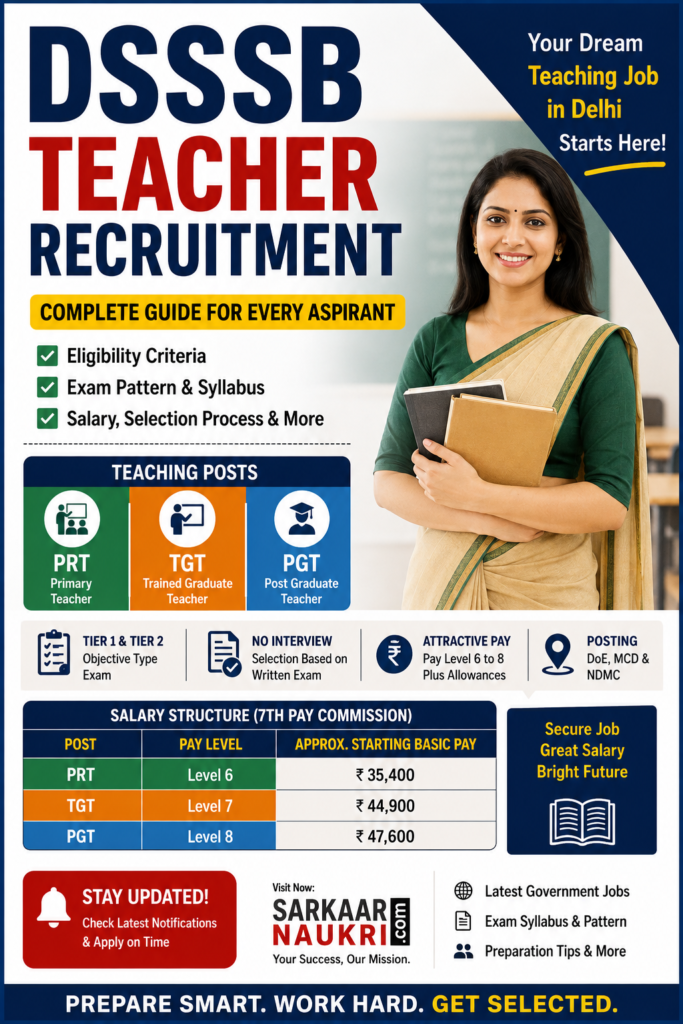
Every year, lakhs of candidates apply for DSSSB Teacher Recruitment, yet only a small fraction clear the exam on their first attempt. The reason is rarely a lack of subject knowledge. It is usually a lack of clarity about eligibility, exam pattern, and the selection process itself. If you are preparing for DSSSB Teacher Recruitment or planning to apply soon, this guide walks you through everything you need to know, from eligibility criteria to salary structure, in one place.
The Delhi Subordinate Services Selection Board conducts DSSSB Teacher Recruitment for posts like PRT, TGT, and PGT in schools run by the Directorate of Education, MCD, and NDMC. Because notifications for different teaching posts are released at different times, many candidates end up confused about which post fits their qualification. This guide clears that confusion and gives you a practical roadmap.
Why DSSSB Teacher Recruitment Matters
A career through DSSSB Teacher Recruitment offers job security, a defined pay scale, pension benefits under the applicable government scheme, and a fixed working structure that few private sector teaching jobs can match. For candidates from Delhi and nearby regions, DSSSB Teacher Recruitment is often the single most sought after route into government school teaching, ahead of even state TET based recruitment in some cases because of the pay and posting location.
Eligibility Criteria for DSSSB Teacher Recruitment
Eligibility is not uniform across posts, and this is where most rejections happen at the scrutiny stage.
- PRT (Primary Teacher): Candidates need a Senior Secondary certificate with at least 50 percent marks along with a two year Diploma in Elementary Education, or a four year Bachelor of Elementary Education degree. Passing CTET Paper 1 is compulsory for this category.
- TGT (Trained Graduate Teacher): A bachelor’s degree in the relevant subject combination with at least 50 percent marks, along with a B.Ed degree, is the standard requirement. CTET or DSSSB’s own teaching eligibility test qualification is generally needed depending on the specific notification.
- PGT (Post Graduate Teacher): A master’s degree in the concerned subject with a minimum of 50 percent marks, plus a B.Ed qualification, forms the base eligibility for this tier of DSSSB Teacher Recruitment.
Age limits usually fall between 18 and 30 years for PRT and TGT posts, and up to 35 years for PGT posts, though exact limits vary by notification. Reserved category candidates get standard government age relaxation.
Exam Pattern and Syllabus
DSSSB Teacher Recruitment follows a tier based selection process, and understanding the weightage of each section saves months of misdirected preparation.
Tier 1 (Objective Type): This paper generally carries 200 marks and is divided into General Awareness, Reasoning, Quantitative Aptitude, and a subject specific section that varies by post. Negative marking of 0.25 marks per wrong answer typically applies.
Tier 2 (Subject Specific, where applicable): For certain PGT and TGT posts, a second tier tests deeper subject knowledge and pedagogy concepts relevant to the teaching post applied for.
Candidates preparing for DSSSB Teacher Recruitment should split study time roughly as 40 percent subject knowledge, 30 percent teaching aptitude and pedagogy, and 30 percent general awareness and reasoning, since this mirrors the actual marks distribution in most notifications.
Selection Process and Document Verification
Selection under DSSSB Teacher Recruitment is primarily merit based on the written exam score, followed by document verification. There is generally no interview for teaching posts, which makes the written exam the single deciding factor. Candidates should keep original certificates, category documents, and experience letters (where applicable) ready well before the verification date, since incomplete documentation is one of the most common reasons candidates lose an otherwise secured position.
Salary and Pay Scale
Pay for these posts follows the 7th Pay Commission matrix. PRT posts typically start around Level 6, TGT posts around Level 7, and PGT posts around Level 8, before allowances. Actual in hand salary after HRA, DA, and other allowances is usually noticeably higher than the basic pay alone, particularly for postings within Delhi.
| Post | Pay Level | Approx. Starting Basic Pay |
|---|---|---|
| PRT | Level 6 | Roughly Rs 35,400 |
| TGT | Level 7 | Roughly Rs 44,900 |
| PGT | Level 8 | Roughly Rs 47,600 |
These figures are indicative and can change with revised notifications, so candidates should always confirm the exact pay level mentioned in the specific vacancy notice rather than relying only on previous years’ figures. Postings within Delhi typically carry a higher HRA slab than postings in some other regions, which further widens the gap between basic pay and actual take home salary.
MCD, Directorate of Education, and NDMC Postings: What Is the Difference
Candidates often assume all teaching posts advertised through this recruitment process lead to the same employer, but that is not the case. Postings can fall under three separate bodies, each with slightly different service rules.
- Directorate of Education (DoE): Covers government schools directly under the Delhi government, generally considered the most stable posting category with predictable transfer policies.
- Municipal Corporation of Delhi (MCD): Primarily hires PRT level teachers for municipal primary schools, with a service structure that differs slightly from DoE in terms of transfer and promotion norms.
- New Delhi Municipal Council (NDMC): A smaller cadre with limited annual vacancies, but postings are concentrated within a compact area of New Delhi, which some candidates prefer for commute reasons.
Checking which body a specific notification belongs to, before applying, helps candidates set realistic expectations about posting location, transfer frequency, and promotion timelines.
Common Mistakes and Misconceptions
- Assuming CTET alone guarantees selection: CTET is only an eligibility filter for DSSSB Teacher Recruitment, not a merit list criterion. The actual DSSSB written exam score decides selection.
- Applying for the wrong post code: Many candidates apply under a post code that does not match their subject combination, leading to rejection at scrutiny despite being otherwise qualified.
- Ignoring the syllabus updates: DSSSB periodically revises weightage between sections. Preparing from an outdated syllabus PDF is a frequent and avoidable error in DSSSB Teacher Recruitment preparation.
- Underestimating general awareness: Candidates often over invest in subject knowledge and under prepare general awareness, even though it carries meaningful weightage in Tier 1.
Practical Tips for DSSSB Teacher Recruitment Aspirants
- Register on the official DSSSB website early and keep your One Time Registration profile updated, since post applications are linked to it.
- Solve at least three years of previous DSSSB Teacher Recruitment question papers to understand the actual difficulty level rather than relying only on guides.
- Join a structured revision cycle for pedagogy and child development topics, since these appear consistently across PRT and TGT papers.
- Track admit card release dates closely, since DSSSB typically releases them close to the exam date with limited advance notice.
- Keep scanned copies of all certificates ready in the specified format before applying, to avoid last minute upload issues.
Frequently Asked Questions
Is CTET compulsory for DSSSB Teacher Recruitment? CTET Paper 1 is compulsory for PRT posts. For TGT and PGT posts, requirements vary by notification, so candidates should check the specific post’s eligibility criteria before applying.
How many attempts are allowed? There is generally no cap on the number of attempts as long as the candidate meets the age and qualification criteria at the time of application.
What is the age limit for these teaching posts? Age limits typically range from 18 to 30 years for PRT and TGT posts and up to 35 years for PGT posts, with standard relaxation for reserved categories.
Is there an interview round in DSSSB Teacher Recruitment? No, most teaching posts here are selected purely on written exam merit, followed by document verification.
What is the negative marking scheme in the DSSSB exam? A deduction of 0.25 marks per wrong answer is commonly applied in Tier 1 of this exam, though candidates should confirm this against the specific notification.
Can B.Ed graduates apply for PRT posts? This depends on the specific notification, since PRT posts traditionally require a Diploma in Elementary Education or B.El.Ed rather than a standard B.Ed, though some notifications have made exceptions in the past.
How is the merit list prepared? The merit list is prepared based on marks scored in the written examination, subject to category wise reservation norms applicable to the post.
Conclusion
DSSSB Teacher Recruitment remains one of the most stable and rewarding entry points into government school teaching for candidates who meet the eligibility criteria and prepare with a clear strategy. Understanding the exact post code, keeping documentation ready, and preparing according to the real marks distribution rather than assumptions will put you ahead of most applicants. For the latest live postings, check our Latest Government Jobs section & Teacher Jobs section, and for a broader view of eligibility rules across departments, see our Age Relaxation Rules guide.
