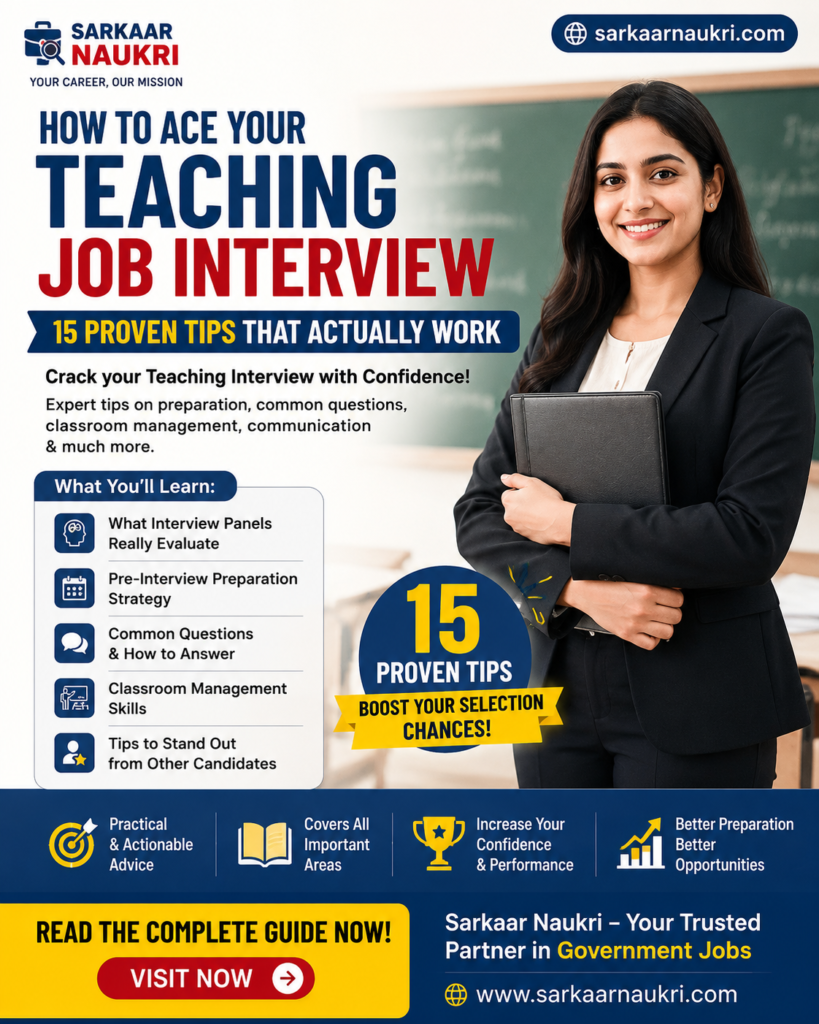
Every year, lakhs of candidates apply for teaching posts in government schools, but only a fraction clear the interview round. If you are searching for reliable Teaching Interview Tips, you are probably staring down a TET, CTET, or state-level teacher recruitment interview and wondering what actually separates a selected candidate from a rejected one. Getting the right teaching interview tips at this stage can be the difference between a rushed, generic answer and one that genuinely stands out to the panel. The good news is that teaching interviews follow a fairly predictable pattern, and with the right preparation strategy, you can walk in with confidence instead of guesswork. This guide breaks down exactly what interview panels look for, the mistakes that quietly cost candidates their selection, and practical Teaching Interview Tips you can start using today.
Why Teaching Interview Preparation Matters
Written exams test your subject knowledge, but the interview tests something written papers cannot: whether you can actually manage a classroom, communicate clearly, and handle real students. Panels are not just checking your degree certificates during this stage; they are evaluating your temperament, your command over pedagogy, and your ability to think on your feet. This is exactly why generic Teaching Interview Tips found in scattered forums often fall short. They cover surface-level advice like “dress well” and “be confident” without explaining the actual evaluation criteria panels use. Understanding this evaluation lens is the first step toward genuinely useful preparation, and it’s the foundation every good set of Teaching Interview Tips should be built on.
Understanding What Interview Panels Actually Evaluate
Most government school and PSU-run institution panels assess five broad areas: subject command, teaching methodology awareness, classroom management approach, communication skills, and alignment with the institution’s values. A candidate who scores well on subject knowledge but stumbles on classroom scenarios often loses out to a candidate with solid fundamentals and a calmer, more practical approach. Keep this balance in mind while working through Teaching Interview Tips, because over-preparing one area while neglecting another is one of the most common reasons capable candidates don’t clear this round. Knowing this framework before you start practicing is one of the simplest yet most effective Teaching Interview Tips available.
Pre-Interview Preparation Strategy
Preparation should start at least two to three weeks before the interview date, not two days before. Begin by revisiting your subject syllabus at the level you’ll be teaching, since panels frequently ask basic conceptual questions to check whether you can explain fundamentals simply. Alongside this, read up on the National Education Policy (NEP) 2020 basics, as many state panels now ask at least one question connecting classroom practice to policy direction. Research the specific school or department you’re interviewing for: its medium of instruction, student demographic, and any recent initiatives mentioned on its website or notices. This groundwork is one of the most underrated Teaching Interview Tips because it signals genuine interest rather than a generic, one-size-fits-all application. Building a simple two-week revision timeline around these points is a practical way to put these Teaching Interview Tips into action rather than leaving preparation to the last minute.
Mastering Common Teaching Interview Questions
Certain questions appear across nearly every teaching interview, regardless of subject or state. “Why do you want to become a teacher?” tests motivation and should be answered with a specific, personal reason rather than a rehearsed line. “How would you handle a disruptive student in class?” tests practical temperament; panels want a calm, structured response, not a punitive one. “What teaching methods do you use to explain difficult concepts?” checks pedagogical awareness, so mention specific techniques like activity-based learning, peer teaching, or real-life examples rather than vague terms like “interactive teaching.” Practicing answers to these core questions out loud, not just mentally, is one of the most effective Teaching Interview Tips because it removes hesitation on interview day. Writing out short bullet-point answers first, then converting them into natural spoken responses, is another one of the practical Teaching Interview Tips that experienced candidates swear by.
Demonstrating Classroom Management Skills
Panels often present hypothetical classroom scenarios to see how you think under pressure. A common one is “Two students are fighting in your class, what do you do?” The strongest answers show a sequence: de-escalate calmly, separate the students, address the issue privately rather than publicly shaming anyone, and follow up with the school’s disciplinary process if needed. Avoid answers that sound purely punitive or purely permissive; panels look for balance and fairness. If you have any real classroom experience, even from teaching practice or tuition, reference a brief, specific example rather than a hypothetical one. Among all Teaching Interview Tips, scenario-based preparation like this tends to have the biggest impact because it shows judgment rather than memorized theory.
Body Language and Communication During the Interview
Subject knowledge alone rarely secures selection if communication falls flat. Maintain steady eye contact with all panel members, not just the one asking questions. Speak at a measured pace since nervous candidates often rush their answers, making them harder to follow. Avoid filler words and long pauses by structuring your answers mentally before speaking: a brief introduction to your point, one or two supporting details, and a clear conclusion. This structured approach is one of the more overlooked Teaching Interview Tips, yet panels frequently note it as a distinguishing factor between similarly qualified candidates. Recording a mock answer on your phone and reviewing it is a simple way to self-check against these Teaching Interview Tips before the actual day.
Common Mistakes Candidates Make
One frequent mistake is memorizing answers word-for-word, which sounds robotic and falls apart the moment a panel asks a follow-up question. Another is being overly modest about achievements, when panels genuinely want to hear about your strengths and past teaching-related experience. Candidates also commonly fail to research the specific institution, giving generic answers that could apply to any school. Overloading answers with jargon instead of clear, simple language is another pitfall, ironic for a role centered on explaining things clearly to students. Finally, many candidates neglect to prepare questions of their own for the panel, which can come across as a lack of genuine interest in the role. Avoiding these mistakes is just as important as following positive Teaching Interview Tips, since panels notice red flags as quickly as they notice strengths.
Practical Tips for Interview Day
Arrive at least 20-30 minutes early to settle nerves and review your notes one last time. Carry physical copies of your certificates, ID proof, and any teaching portfolio or lesson plan samples in an organized folder. Dress in simple, professional attire that would be appropriate for an actual classroom, since this itself signals practical understanding of the role. Keep your phone switched off, not just silent, before entering the interview room. If asked a question you genuinely don’t know, it is far better to admit it honestly and show willingness to learn than to guess incorrectly and lose credibility. These small, practical Teaching Interview Tips often matter as much as subject preparation itself, and candidates who follow them consistently tend to appear noticeably calmer than those who skip this stage of preparation.
Subject-Specific Preparation Angle
While general Teaching Interview Tips apply across subjects, panels do expect subject-specific depth appropriate to the post, so it helps to layer subject-specific practice on top of general Teaching Interview Tips rather than relying on one or the other alone. For language teaching posts, be ready to demonstrate a sample explanation of grammar or literature concepts. For science and math posts, expect at least one question asking you to simplify a complex concept for a young student, testing your explanatory skill directly in the interview itself. For primary-level posts, panels often focus more on child psychology and engagement techniques than deep subject theory. Tailoring your preparation to the specific level and subject you’re applying for, rather than generic preparation, meaningfully improves your chances and rounds out a complete set of Teaching Interview Tips.
Frequently Asked Questions
1. What should I wear for a teaching interview? Simple, formal, and comfortable clothing works best. Men typically wear shirts and trousers, while women often wear sarees or formal salwar suits. Avoid overly casual or flashy outfits.
2. How long does a typical teaching interview last? Most government teaching interviews last between 10 and 20 minutes, though this can vary by state and post level.
3. What documents should I carry to a teaching interview? Carry original and photocopied certificates, ID proof, recent photographs, your call letter, and any teaching experience or training certificates.
4. How do I answer “Why should we hire you” in a teaching interview? Focus on specific strengths relevant to teaching, such as subject command, patience, or prior classroom exposure, rather than generic personality traits.
5. Is it necessary to know NEP 2020 for a teaching interview? While not always mandatory, having a basic understanding of NEP 2020’s key ideas is increasingly expected and can strengthen your answers on modern teaching methods.
6. How can I stay calm during a teaching interview? Practicing mock interviews beforehand, arriving early, and using slow, structured breathing before entering the room are effective ways to manage nerves.
7. What is the best way to answer classroom management questions? Describe a calm, step-by-step approach: de-escalate the situation, address it privately, and follow the institution’s standard disciplinary process if required.
Conclusion
Clearing a teaching interview comes down to preparation that goes beyond subject knowledge alone. From understanding what panels evaluate to practicing classroom management scenarios and refining your communication style, these Teaching Interview Tips are designed to help you walk in prepared rather than anxious. Revisit this list of Teaching Interview Tips a day or two before your interview as a final check. For a broader look at eligibility and exam patterns, check our detailed guide on [Government Job Age Relaxation Rules] and browse the latest [Teaching Recruitment Notifications] to find current openings that match your subject and state.
