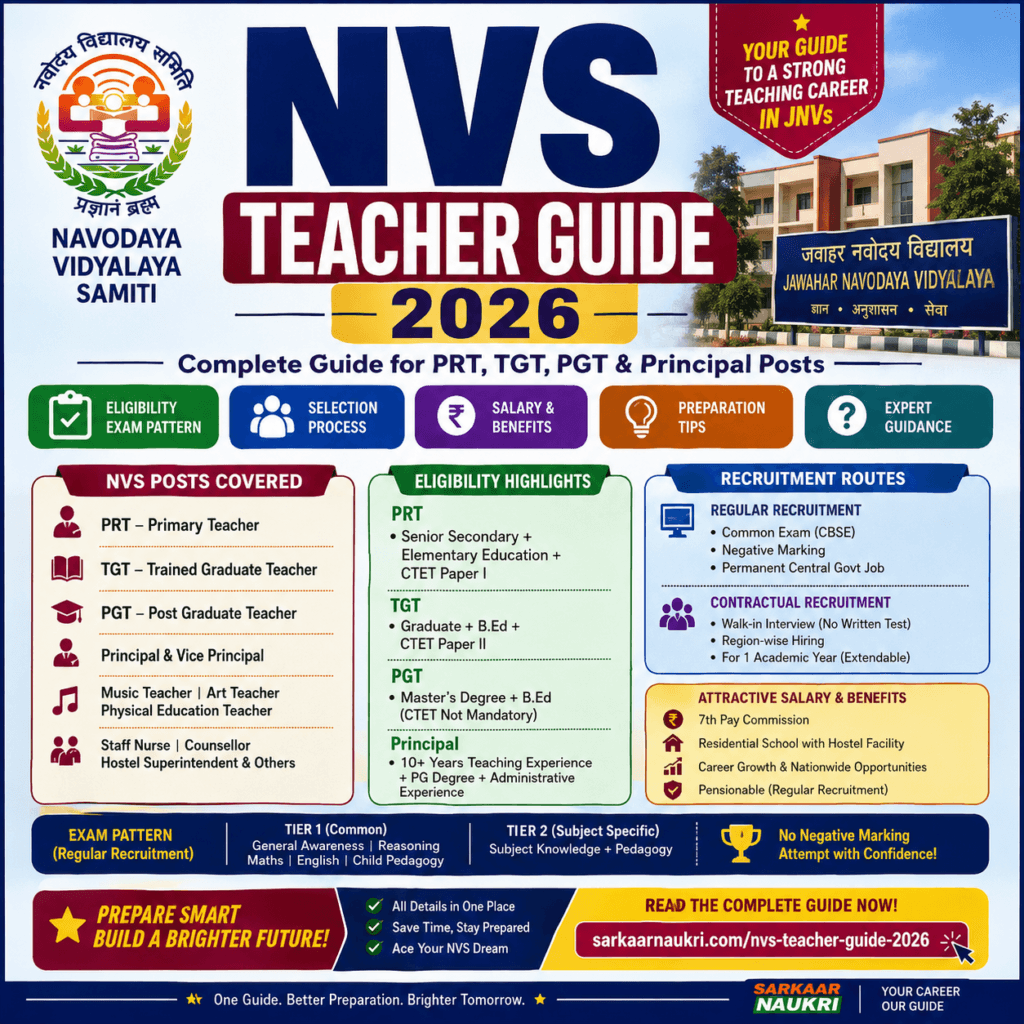
Not every teaching job under Navodaya Vidyalaya Samiti works the same way, and that single fact confuses more applicants than almost anything else about NVS recruitment. Some posts come through a formal computer based exam with negative marking, while others get filled through a regional walk in interview with no written test at all. This NVS Teacher Guide 2026 exists to clear up exactly which path applies to which post, along with the eligibility, exam pattern, and salary details you actually need before you apply.
Why This NVS Teacher Guide 2026 Matters
Navodaya Vidyalaya Samiti runs Jawahar Navodaya Vidyalayas, a network of fully residential schools under the Ministry of Education aimed at providing quality education to talented rural children, one selected per district across India. Teaching at a JNV means working in a residential campus setting, often in a rural or semi urban location, with the added responsibility of hostel duty alongside classroom teaching. That residential structure is exactly what makes this NVS Teacher Guide 2026 worth reading closely, since it changes both the eligibility expectations and the day to day nature of the job compared to a typical school posting.
Regular NVS Recruitment vs Contractual NVS Recruitment
The single most important thing this NVS Teacher Guide 2026 can tell you is that NVS fills vacancies through two genuinely different routes, and mixing them up leads to wasted preparation.
Regular Direct Recruitment: This is the permanent recruitment track, historically conducted jointly with Kendriya Vidyalaya Sangathan through a common exam administered by CBSE. It follows a formal computer based test, often with negative marking, followed by document verification and in some cases an interview. This route leads to a confirmed, pensionable central government teaching post.
Contractual Recruitment: This is a session specific, region wise hiring process run independently by each NVS regional office for a single academic year, sometimes extended based on performance. There is generally no written exam under this route. Instead, shortlisting happens on qualification and experience, followed directly by a walk in interview or personal interaction at the regional office. Posts filled this way include Contractual PGT, TGT, Staff Nurse, Counsellor, and Hostel Superintendent, and the upper age limit for contractual posts is often noticeably higher than for regular recruitment, sometimes extending up to 50 or even 62 years for specific posts like Hostel Superintendent.
Every serious NVS Teacher Guide 2026 needs to flag this distinction upfront, because the preparation strategy, the timeline, and even the nature of job security differ substantially between the two tracks.
Posts Explained: PRT, TGT, PGT and Principal
The core academic cadre covered in this NVS Teacher Guide 2026 mirrors the general structure of central school teaching roles, with some JNV specific additions.
PRT (Primary Teacher): Handles primary level classes and forms a smaller share of NVS vacancies compared to KVS, since JNVs generally begin from class VI.
TGT (Trained Graduate Teacher): Teaches classes VI to X across subjects including regional languages, which is a distinctive feature of NVS recruitment given the residential, state quota based intake of students.
PGT (Post Graduate Teacher): Teaches classes XI and XII in a specialized subject and requires a postgraduate degree.
Principal and Vice Principal: Senior administrative posts that require significant prior teaching and, often, prior administrative experience, along with a strong academic record.
Miscellaneous Teachers: Music, Art, and Physical Education Teacher posts are filled regularly under NVS recruitment and are a category this NVS Teacher Guide 2026 would be incomplete without mentioning, since they are often overlooked by candidates focused only on PGT and TGT.
Eligibility Criteria and Age Limit
Eligibility varies meaningfully depending on whether you are applying for a regular or contractual post, which is the section of this NVS Teacher Guide 2026 candidates tend to misread most often.
Educational Qualification:
- PRT: Senior Secondary plus a diploma or degree in elementary education, along with CTET Paper I.
- TGT: A bachelor’s degree with at least 50% marks in the relevant subject, a B.Ed or equivalent degree, and CTET Paper II.
- PGT: A master’s degree in the relevant subject with at least 50% marks, along with a B.Ed or equivalent degree.
- Principal: Substantial prior teaching experience, typically ten years or more, along with a strong postgraduate academic record and administrative exposure.
CTET Requirement: CTET is mandatory for PRT and TGT posts under both regular and contractual NVS recruitment tracks. It is generally not required for PGT posts, though it strengthens a candidate’s profile.
Age Limit: For regular recruitment, the upper age limit typically sits between 35 and 40 years depending on the post, similar to the pattern followed by other central school teaching bodies. For contractual recruitment, the age band is often wider and can extend up to 50 years for PGT and TGT, and even higher for specific support posts like Hostel Superintendent. Standard central government age relaxation applies for SC, ST, OBC, PwBD, and ex-servicemen candidates on top of these limits. Always confirm the exact cut off date against the live regional notification, since this NVS Teacher Guide 2026 reflects the general pattern rather than a single fixed date.
Exam Pattern and Selection Process
For regular NVS recruitment, the process typically follows a two stage written examination, often bilingual in Hindi and English, with negative marking of a quarter mark for each wrong answer. The paper tests General Awareness, Reasoning, Teaching Aptitude, and a subject specific section for TGT and PGT candidates. Shortlisted candidates then proceed to document verification and, for certain posts, an interview.
For contractual NVS recruitment, there is usually no written exam at all. Candidates apply through the regional office, either online or via email based registration, and are shortlisted purely on qualification and relevant experience. Shortlisted candidates are called for a walk in interview or personal interaction, and final selection is based entirely on that interaction combined with document verification. This is arguably the most practical piece of information in this entire NVS Teacher Guide 2026, since candidates who prepare for a written exam that does not exist waste valuable time that should go into interview preparation instead.
Salary and Benefits
Regular NVS teaching posts follow 7th Pay Commission scales similar to other central government teaching roles, with Principal, PGT, TGT, and PRT slotted at progressively lower pay levels, plus dearness allowance and other standard central government allowances. Since JNVs are residential schools, staff also typically get on campus accommodation, which is a meaningful practical benefit this NVS Teacher Guide 2026 should not gloss over. Contractual posts are paid on a fixed consolidated monthly remuneration rather than a formal pay scale, and this remuneration is generally lower than the regular pay structure since the appointment is temporary and tied to a single academic session.
Common Mistakes and Misconceptions
Several avoidable errors show up repeatedly among candidates following NVS recruitment cycles, and this NVS Teacher Guide 2026 covers the ones that matter most.
Confusing contractual and regular vacancies: Candidates often see a contractual NVS notification and assume it follows the same written exam process as the older KVS-NVS joint recruitment. Preparing for a nonexistent written test wastes time that should go into strengthening your interview and document readiness.
Missing the regional application window: Contractual recruitment is handled region by region, not centrally, so a candidate checking only the main NVS website may miss a specific regional notification that closes within a short two week window.
Assuming CTET is optional for TGT: CTET Paper II is mandatory for TGT posts across both recruitment tracks. Candidates who delay clearing CTET, expecting to submit it later, are usually rejected at the document verification stage.
Underestimating the residential aspect: Some candidates apply without fully considering that JNV postings often involve hostel duty and rural locations, only to find the role does not match their expectations after joining.
Practical Tips
Check the specific NVS regional office website for your target state or zone regularly, since contractual vacancies are announced independently by each region and do not always appear on national job portals immediately. Keep your degree, B.Ed, and CTET certificates ready as scanned copies well in advance, since contractual recruitment timelines are often short, sometimes under two weeks from notification to closing date. If you are targeting a regular post, prioritize subject revision and general awareness alongside teaching aptitude, since the written exam carries real weightage in the regular recruitment track. If you are targeting a contractual post, focus your preparation on the interview itself, including a clear explanation of your teaching approach and willingness to take on hostel responsibilities, since there is no written stage to fall back on.
Frequently Asked Questions
1. Is there a written exam for every NVS teaching post?
No. Regular NVS recruitment typically includes a written exam, while contractual NVS recruitment is usually based only on shortlisting and a walk in interview.
2. Is CTET compulsory for NVS TGT posts?
Yes, CTET Paper II is mandatory for TGT posts under both regular and contractual NVS recruitment tracks.
3. What is the age limit for contractual NVS teaching posts?
It varies by post but is often wider than regular recruitment, commonly up to 50 years for PGT and TGT, and sometimes higher for support roles like Hostel Superintendent.
4. Can a candidate apply for both regular and contractual NVS posts?
Yes, as long as the eligibility criteria for each are met separately, though applications and any applicable fees must generally be submitted separately for each.
5. Do NVS postings always involve hostel duty?
Most JNVs are residential schools, so teaching staff are commonly expected to take on hostel supervision duties alongside classroom teaching, though the exact extent varies by school.
6. How is the final merit list decided for regular NVS recruitment?
It is generally based on the written examination score, with document verification and, for some posts, an interview stage factored into the final selection.
Conclusion
This NVS Teacher Guide 2026 comes down to one central decision point: figure out early whether the post you want falls under regular recruitment or contractual recruitment, since the two tracks demand completely different preparation. Regular posts reward strong subject and written test preparation, while contractual posts reward fast application turnaround and strong interview presentation. For live openings as they get notified, check our Latest Government Jobs and Teacher Jobs section, and if you want to compare this against the sister recruitment body, our KVS Teacher Guide 2026 covers the equivalent process for Kendriya Vidyalayas.
