Most candidates preparing for constable or sub-inspector posts spend weeks solving random question papers without ever confirming the actual Police Written Exam Pattern for their target state. This is a costly mistake, since every state police recruitment board sets its own mix of subjects, marking scheme, and negative marking rules, and preparing blind often means wasting time on topics that barely appear in the real paper. Understanding the Police Written Exam Pattern in detail, before you open a single mock test, is what separates focused preparation from guesswork. This guide breaks down every component of the pattern so you know exactly what to study and how it will be scored.
Why the Exam Pattern Matters
Knowing the Police Written Exam Pattern in advance shapes your entire preparation timeline. A candidate who understands the exact subject-wise weightage can allocate more hours to sections carrying higher marks, instead of spreading effort evenly across topics that matter unequally. It also removes surprises on exam day, since candidates who walk in without knowing the number of sections, time limit, or negative marking rules of the Police Written Exam Pattern often panic or mismanage their time, even when their actual subject knowledge is strong.
Subject-Wise Breakdown
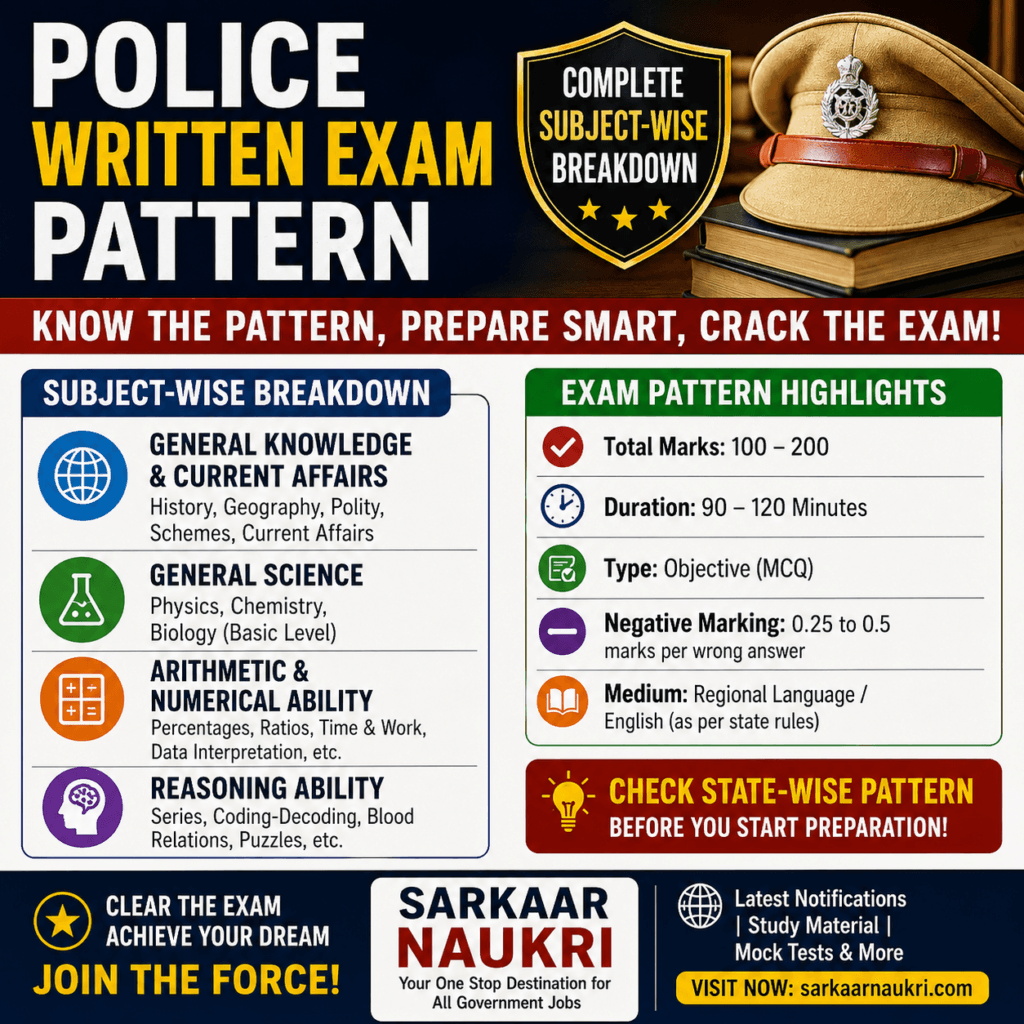
The Police Written Exam Pattern for most state police constable exams is divided into four broad sections: General Knowledge and Current Affairs, General Science, Arithmetic and Numerical Ability, and Reasoning. General Knowledge typically carries the highest weightage and includes state-specific history, geography, government schemes, and national and international current affairs from the preceding twelve months. General Science covers school-level Physics, Chemistry, and Biology, testing basic conceptual clarity rather than advanced theory. The Arithmetic section includes percentages, ratios, time and work, and simple data interpretation, while Reasoning covers verbal and non-verbal questions such as series completion, coding-decoding, and blood relations.
Marking Scheme and Negative Marking
Understanding the marking scheme is a core part of mastering the Police Written Exam Pattern, since most states apply negative marking of 0.25 to 0.5 marks per wrong answer. This changes exam strategy significantly, because guessing blindly can pull down an otherwise strong score. Total marks for the written exam usually range between 100 and 200, depending on the state and post, with the paper typically conducted in objective, multiple-choice format across a duration of 90 to 120 minutes. Sub-inspector level exams under the Police Written Exam Pattern often include an additional paper on English comprehension or basic legal awareness, which constable-level papers usually skip.
Qualifying Marks and Sectional Cutoffs
Most states require candidates to secure an overall qualifying percentage, commonly between 30 and 40 percent, though some states additionally impose sectional cutoffs within the Police Written Exam Pattern, meaning a candidate must clear a minimum score in each individual subject rather than relying on overall performance alone. This detail is frequently missed by candidates who score well in Reasoning or Arithmetic but underperform in General Knowledge, only to be surprised when they fail despite a decent aggregate. Always check your specific state notification for sectional cutoff rules before assuming overall marks are sufficient. Reserved category candidates should also confirm whether relaxed qualifying percentages apply to them, since these relaxations are usually listed separately from the general qualifying criteria and are easy to overlook, and missing them can mean leaving marks on the table unnecessarily.
Language and Medium of the Paper
The Police Written Exam Pattern in most states allows the paper to be attempted in either the state’s regional language or English, and sometimes Hindi as a third option. Candidates should confirm which languages are offered in their specific state, since not every state provides a bilingual question paper, and choosing the wrong medium during application can limit comprehension speed during the actual exam. Some states also print questions in dual-language format on the same page, which candidates should practice reading during mock tests to build familiarity with the exact printed layout.
State-Wise Variations to Watch For
While the broad structure of General Knowledge, Science, Arithmetic, and Reasoning holds across most states, the finer details shift noticeably from board to board. Some states combine Arithmetic and Reasoning into a single composite section rather than scoring them separately, which changes how sectional cutoffs are applied. Others weight General Knowledge more heavily for constable posts than for sub-inspector posts, on the assumption that sub-inspector candidates will be tested more rigorously on Reasoning and English instead. A handful of states also rotate in an additional section on computer awareness or basic law, particularly for sub-inspector and armed reserve posts, which candidates preparing from a generic all-India template often miss entirely. Total question count, section-wise time allocation, and even whether the paper is single-shift or multi-shift can vary from one recruitment cycle to the next within the same state, so relying on last year’s pattern without checking the current notification is risky. The safest approach is to treat every past year’s pattern as a reference point rather than a guarantee, and to confirm the current cycle’s structure directly from the official PDF before finalizing your study plan.
Common Mistakes and Misconceptions
A common misconception is that the Police Written Exam Pattern is identical across all states, when in reality subject weightage, total marks, and negative marking rules vary considerably from one state police board to another. Candidates also frequently underestimate the General Science section, assuming it carries little weight, and end up losing easy marks that could have been secured with basic revision. Another mistake is ignoring sectional cutoffs entirely and over-preparing for a single favorite subject at the cost of balanced coverage across the full Police Written Exam Pattern. Many aspirants also delay checking whether negative marking applies in their specific state, leading to overly cautious or overly reckless attempt strategies on exam day.
Practical Tips for Preparation
Get the official notification PDF for your target state and read the exact Police Written Exam Pattern section line by line before starting preparation, rather than relying on generic online summaries. Attempt at least one full-length mock test every week under timed conditions to build familiarity with the actual duration and negative marking rules. Focus extra revision time on state-specific General Knowledge, since this section is the hardest to prepare from generic study material and carries significant weightage in most versions of the Police Written Exam Pattern. Keep a running note of topics you consistently get wrong in Reasoning and Arithmetic, and revisit them weekly instead of only during the final week before the exam.
Frequently Asked Questions
1. Does the Police Written Exam Pattern differ between constable and sub-inspector posts? Yes, sub-inspector exams often include an additional paper on English or legal awareness, and generally carry higher total marks than constable-level papers.
2. Is there negative marking in every state’s police written exam? Not universally. Most states apply negative marking between 0.25 and 0.5 marks per wrong answer, but a few states conduct the exam without any negative marking, so always verify this in your specific notification.
3. How many questions are usually asked in the police written exam? This varies by state, but most constable-level papers range between 100 and 200 questions, matching the total marks allotted under the Police Written Exam Pattern.
4. Can the written exam be attempted in regional languages? In most states, yes. The Police Written Exam Pattern typically allows candidates to choose between English and the state’s regional language, though the exact options vary.
5. What is a safe attempt strategy given negative marking? Focus on accuracy over speed. Attempt questions you are fully confident about first, and only guess on remaining questions if you can eliminate at least two incorrect options.
6. Are sectional cutoffs common across states? No, only some states enforce sectional cutoffs within the Police Written Exam Pattern. Many states use a single overall qualifying percentage instead, so this must be checked state-wise.
7. How much time is usually given for the written exam? Most constable-level papers under the Police Written Exam Pattern run for 90 to 120 minutes, though sub-inspector papers with additional sections may run longer.
8. Is coaching necessary to understand the exam pattern properly? Not necessarily. Reading the official notification carefully and practicing with state-specific mock tests is usually enough to fully grasp the Police Written Exam Pattern without formal coaching.
Conclusion
Mastering the Police Written Exam Pattern before you begin serious preparation gives you a clear roadmap of what to study and how your effort will be scored. Once you understand the subject-wise weightage, marking scheme, and sectional cutoff rules for your target state, your preparation becomes focused rather than scattered. For state-specific vacancy details, check our State Police Recruitment Notifications section, and for full-length practice papers, visit our Government Exam Study Material page.
