Introduction
Every year, lakhs of candidates apply for police constable posts across states, yet only a small fraction clear both the written exam and physical test. Most of them fail not because they lack effort, but because their constable preparation is unstructured and scattered across too many sources. This guide lays out a complete constable preparation roadmap covering the exam pattern, physical standards, study plan, and common mistakes so you can prepare with a clear direction instead of guesswork. Whether you are just starting out or restarting after a failed attempt, having a single reliable reference point saves weeks of trial and error and helps you focus your energy where it actually counts.
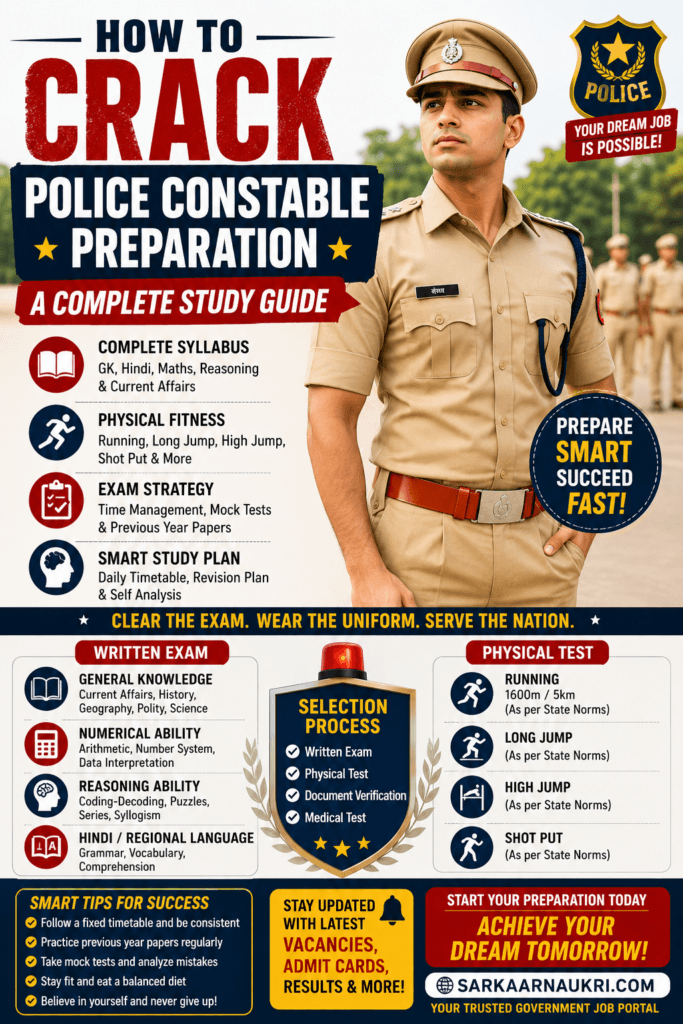
Why Structured Constable Preparation Matters
Police Constable recruitment is different from most government exams because it tests both academic knowledge and physical fitness under a strict timeline. A candidate who ignores either side of this equation, no matter how talented, usually falls short. This is why constable preparation needs to be planned as two parallel tracks from day one rather than treating physical training as an afterthought once the written exam is cleared. Treating both tracks with equal seriousness from the start is what separates focused constable preparation from last-minute cramming.
Understanding the Exam Pattern Before You Start
Most state Police Constable exams follow a similar pattern of General Knowledge, general science, Arithmetic and Reasoning, though weightage and difficulty vary by state. Reading the official notification carefully before starting your Constable Preparation is essential, since marking schemes, negative marking rules and sectional cutoffs differ between recruitment boards and can change your study priorities significantly. Mapping the syllabus to a weekly schedule early keeps your Constable Preparation aligned with the actual exam pattern rather than guesswork.
General Knowledge sections usually cover current affairs, static GK, Indian history, and basic geography, while General Science tests school-level physics, chemistry, and biology concepts. Arithmetic sections typically focus on percentages, ratios, time and work, and simple interest, all of which can be mastered through repeated practice rather than memorization. Reasoning sections test logical patterns, coding-decoding, and analytical thinking and improve fastest through daily timed practice sets rather than long theory sessions.
Physical Efficiency Test and Physical Standard Test
Physical fitness forms a core part of constable preparation that many aspirants underestimate until it is too late. Running timings, height, and chest measurements vary by state and category, and candidates are usually disqualified for missing these standards rather than failing the written paper. Building running stamina, strength, and flexibility should start months before the exam date, not after receiving the admit card, since fitness gains take sustained, gradual effort. Treating fitness as a daily habit rather than a last-minute task is central to complete constable preparation.
Most states require male candidates to run 1.6 to 5 kilometers within a set time, while women candidates typically face a shorter distance with a proportionate time limit. Long jump, high jump, and shot put may also be included depending on the state, and each has its own qualifying standard listed in the official notification. Since these standards vary widely by state and category, always cross-check the exact figures from your specific recruitment board rather than relying on numbers seen elsewhere online.
Building an Effective Study Plan
A realistic study plan is the backbone of any successful constable preparation strategy. Divide your day between general knowledge revision, numerical practice, reasoning drills, and physical training, keeping each session focused rather than long and unproductive. Weekly mock tests help track progress and reveal weak sections early, which is far more useful during constable preparation than passively re-reading notes without testing recall under time pressure. A sample daily timetable could look like this: two hours for general knowledge and current affairs in the morning, one hour of arithmetic practice, one hour of reasoning drills in the afternoon, and an hour of running or strength training in the evening, leaving weekends free for full-length mock tests and revision of weak areas.
Common Mistakes in Constable Preparation
Many candidates spend excessive time on one subject, usually general knowledge, while neglecting arithmetic and reasoning sections that are easier to score consistently. Another common mistake during constable preparation is delaying physical training until after the written exam, which leaves too little time to meet running and fitness standards. Aspirants also frequently skip previous year papers, missing valuable insight into repeated question patterns and difficulty levels specific to their state’s recruitment board. Avoiding these gaps early keeps your constable preparation balanced across every section of the exam. Over-relying on coaching material without solving official past papers is another frequent error, since actual question difficulty and phrasing often differ from generic practice sets found online. Ignoring negative marking rules while attempting the paper is equally costly, as guessing recklessly on unfamiliar questions can pull down an otherwise strong score.
Practical Tips to Strengthen Your Preparation
Set a fixed daily schedule that blocks time for both study and physical training, since consistency matters more than occasional long sessions. Track your running timings weekly so improvements in fitness are visible alongside academic progress. Solve previous year question papers under timed conditions to build exam temperament, and revise current affairs weekly rather than cramming months of news at the end. Reviewing your progress every fortnight helps keep constable preparation realistic and adjustable as the exam date approaches. These habits, applied consistently, form the core of effective constable preparation. Sleep and recovery deserve equal attention, since sustained physical training without adequate rest often leads to injury or burnout right when exam pressure is highest. Staying hydrated, eating balanced meals, and avoiding overtraining in the final two weeks before the exam also protect both fitness levels and mental sharpness on exam day.
Recommended Resources and Study Materials
Standard state-board-level books for general knowledge, arithmetic, and reasoning cover most of what is needed, and there is rarely any need to buy multiple books for the same subject. NCERT textbooks from classes six to ten remain one of the most reliable sources for general science and basic history and geography questions, since many state exams draw questions directly from this level. A dedicated current affairs magazine or a trusted daily news digest, read consistently rather than occasionally, works better than trying to cover months of news in one sitting closer to the exam. Previous year question papers from your specific state’s recruitment board are arguably the single most valuable resource, since they reveal the exact difficulty level, recurring topics, and question-phrasing style used by that board. Free or low-cost mock test series, whether from a coaching institute or a reliable app, help simulate exam-day time pressure and are worth prioritizing over passive reading in the final two months.
Frequently Asked Questions
1. How many months are ideal for constable preparation before the exam? Most successful candidates dedicate four to six months of focused constable preparation, balancing academics with physical training throughout.
2. What subjects carry the highest weightage in constable exams? General knowledge and arithmetic typically carry the highest weightage, though state-specific patterns should always be confirmed from the official notification.
3. Is physical training as important as written exam preparation? Yes, since candidates are frequently disqualified for missing running or physical standards regardless of how well they perform in the written paper.
4. How can I improve running timings quickly for the physical test? Gradual interval training combined with consistent daily practice over several weeks improves running timings more safely than sudden intense effort, and this steady approach is a proven part of physical condition preparation.
5. Should I join a coaching institute for constable exams? Coaching can help with structure and mock tests, but self-study with a disciplined schedule works equally well for many successful candidates.
6. What is the biggest reason candidates fail despite good preparation? Neglecting physical standards or mismanaging exam time during the written paper are the most common reasons well-prepared candidates fall short, which is why balanced constable preparation across both areas matters so much.
7. What documents should I keep ready before the physical test? Original identity proof, admit card, category certificates, and recent passport-size photographs are typically required, so keep certified copies ready in advance.
Conclusion
Cracking the police constable exam comes down to disciplined, structured constable preparation across both academics and fitness, not last-minute effort. Following a realistic study plan, tracking physical progress and practicing previous papers consistently puts you well ahead of most competing candidates. For eligibility details, check the Age Relaxation Rules guide, and for exam-specific vacancy updates, refer to the latest police recruitment notifications on this site. Start early, stay consistent, and treat both the written and physical rounds as equally important parts of the same goal.
