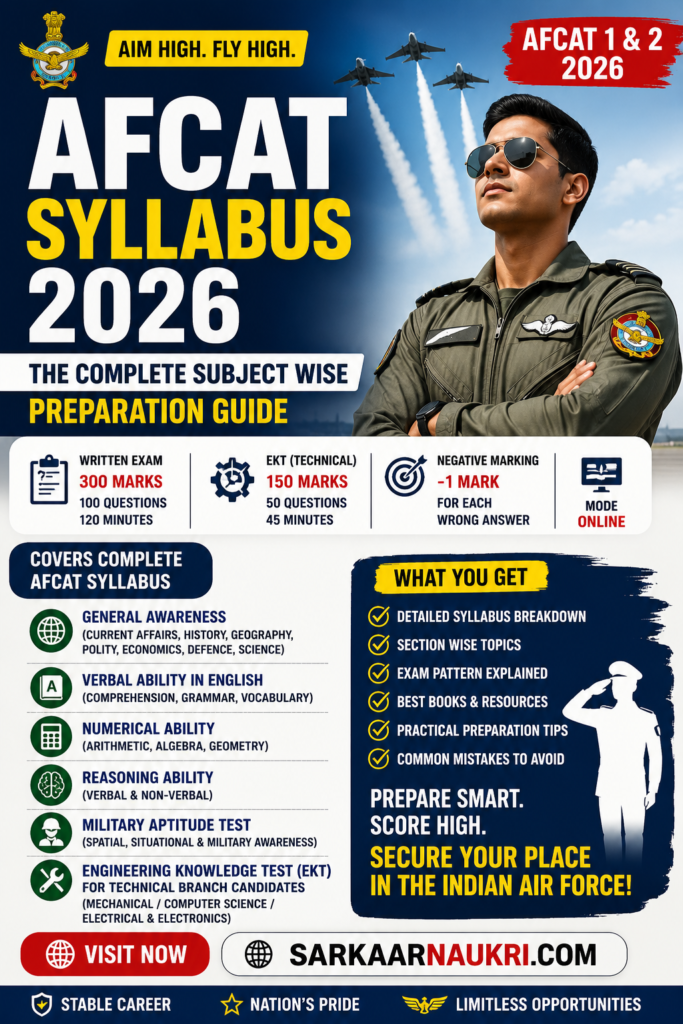
Every year, lakhs of graduates apply for the Air Force Common Admission Test, yet a large number of them lose marks simply because they never studied the AFCAT syllabus properly before starting their preparation. Most candidates jump straight into solving question papers without understanding which topics actually carry weight in the exam. This guide breaks down the AFCAT Syllabus section by section, explains the exam pattern in detail, and gives you a practical roadmap so that your preparation time is spent on the right topics instead of guesswork.
Whether you are a fresh engineering graduate targeting the technical branch or an arts or commerce graduate aiming for the flying and ground duty non-technical streams, the AFCAT syllabus applies to every candidate who wants to wear the Air Force uniform. Understanding it thoroughly is the first real step toward clearing the written exam and moving on to the AFSB interview.
Why Understanding the AFCAT Syllabus Matters
The Air Force Common Admission Test is a computer-based test conducted twice a year, commonly referred to as AFCAT 1 and AFCAT 2. The written exam carries 300 marks spread across 100 questions, and candidates get 120 minutes to complete it. Every wrong answer attracts a penalty of one mark, which means guesswork can actually hurt your score more than it helps.
Candidates applying for technical branches also have to sit for the Engineering Knowledge Test, a separate 45-minute paper worth 150 marks. Since the general paper and the EKT test completely different skill sets, knowing the exact AFCAT syllabus for each section lets you divide your study hours sensibly instead of spending equal time everywhere.
General Awareness Section of the AFCAT Syllabus
General awareness usually carries the highest weight in terms of scoring speed because answers either come from memory or they do not, unlike reasoning questions that take time to solve. This part of the AFCAT Syllabus covers current affairs from the past six to twelve months, history, geography, polity, economics, general science and defence related awareness including recent operations, ranks and appointments in the armed forces. Candidates preparing for this section should build a daily newspaper reading habit and revise a monthly current affairs digest instead of trying to cover a full year at once close to the exam date.
Verbal Ability in English
The English portion of the AFCAT Syllabus tests comprehension, grammar and vocabulary at a level comparable to graduation standard. Expect questions on reading comprehension passages, error detection, sentence completion, synonyms, antonyms, idioms and one word substitution. Since this section rewards accuracy over speed for most candidates, daily reading of editorials and short passages, along with grammar revision, tends to improve scores faster than rote vocabulary lists alone.
Numerical Ability and Reasoning
This is often the section candidates fear the most, but the AFCAT Syllabus here is not as vast as it looks. Numerical Ability includes topics like percentage, profit and loss, ratio and proportion, time and work, time speed and distance, simple and compound interest, and basic algebra and geometry. Reasoning questions cover series completion, coding decoding, blood relations, syllogisms, direction sense, seating arrangement and non verbal reasoning based on figures. Since both numerical and reasoning questions are time bound, regular timed practice matters more here than in any other section of the AFCAT Syllabus.
Military Aptitude Test
Unique to defence exams, the Military Aptitude Test portion of the AFCAT Syllabus checks spatial reasoning, situation reaction, and general awareness of military terms and hierarchy. Candidates are tested on their ability to visualize spatial relationships, judge picture based situations logically, and understand basic military knowledge such as ranks, decorations and organisational structure of the Indian Air Force. This section rewards candidates who have some familiarity with defence culture, so reading about the armed forces regularly helps even outside formal preparation.
Engineering Knowledge Test for Technical Branch Candidates
Candidates applying through the technical branch must also prepare the EKT portion of the AFCAT Syllabus, which is stream specific and covers Mechanical, Computer Science, and Electrical and Electronics engineering. The paper carries 50 questions for 150 marks in 45 minutes, and questions are based on core engineering subjects taught at the degree level. Since this paper is optional and only applies to technical branch applicants, non technical stream candidates can skip this part of the AFCAT Syllabus entirely and focus their full attention on the general paper.
Common Mistakes Candidates Make
Many aspirants approach the AFCAT Syllabus with the same strategy they used for other government exams, which often backfires. A frequent mistake is spending excessive time on numerical ability while neglecting general awareness, even though general knowledge questions can be solved in seconds once the fact is known. Another common error is ignoring the negative marking rule and attempting every question blindly, which drags down the overall score. Candidates also tend to underestimate the Military Aptitude Test section simply because it looks unfamiliar, when in reality it can be mastered with focused practice on spatial and situation based questions. Lastly, technical branch aspirants sometimes prepare the EKT syllabus in isolation and run out of time for the general paper, forgetting that both papers are equally important for final selection.
Practical Tips to Cover the AFCAT Syllabus Efficiently
Start by mapping out the four sections of the AFCAT syllabus against the number of days left before your exam and allocate more time to weaker areas without completely ignoring your strong sections. Solve at least one full-length mock test every week under timed conditions so that speed and accuracy improve together rather than in isolation. Maintain a small revision notebook for current affairs and general science facts, since these are easy to forget without periodic review. Practice previous year papers specifically to understand the difficulty pattern of each section, because the AFCAT syllabus on paper can look broader than what actually gets tested in a given attempt. For reasoning and numerical ability, focus on accuracy first and speed second, since a wrong answer costs more than a skipped question.
Recommended Books and Resources for the AFCAT Syllabus
Once you understand the structure of the AFCAT syllabus, the next step is picking the right study material instead of collecting too many books and finishing none of them. For General Awareness, a good current affairs monthly digest combined with a static GK book covering history, geography, polity and economics works well. For Verbal Ability, any standard graduation level English grammar book paired with daily editorial reading builds both accuracy and speed. Numerical Ability and Reasoning are best covered through a dedicated quantitative aptitude book along with a reasoning practice book that includes previous year AFCAT style questions. For the Military Aptitude Test, spatial reasoning and picture-based situation-reaction question banks specifically designed for defence exams are far more useful than generic reasoning material. Technical branch candidates preparing the EKT portion of the AFCAT Syllabus should rely on their core degree level textbooks in Mechanical, Computer Science or Electrical and Electronics rather than exam specific guides, since the questions are drawn directly from standard engineering fundamentals.
How to Build a Study Timetable Around the AFCAT Syllabus
A realistic timetable is what separates candidates who clear the exam from those who simply attempt it. Divide your available preparation days into three phases. In the first phase, go through every topic in the AFCAT Syllabus once, without worrying about speed, just to build familiarity with question types across all four sections. In the second phase, shift to topic wise timed practice, solving sectional tests for General Awareness, English, Numerical Ability and Reasoning, and Military Aptitude separately so weak areas become clearly visible. In the final phase, switch entirely to full length mock tests under exact exam conditions, including the negative marking rule, so that your accuracy and time management match what the actual AFCAT paper will demand. Reserve the last few days before the exam purely for revision of notes and current affairs rather than learning anything new, since fresh topics attempted too close to the exam date often create confusion instead of confidence.
How the AFCAT Syllabus Differs From Other Defence Exams
Candidates who have also prepared for exams like UPSC CDS or NDA sometimes assume the AFCAT syllabus is identical, but there are real differences worth noting. Unlike CDS, which has separate papers for different service wings, the AFCAT general paper is common for both flying and ground duty non technical candidates, with only the EKT paper being stream specific for technical applicants. The difficulty level of Numerical Ability in the AFCAT syllabus is generally considered a notch easier than CDS mathematics, while the General Awareness section leans more heavily toward current affairs and Air Force specific knowledge than static history and geography. Recognizing these differences early helps candidates who are preparing for multiple defence exams simultaneously allocate their revision time correctly instead of assuming one syllabus fully covers the other.
Frequently Asked Questions
Is the AFCAT Syllabus the same for AFCAT 1 and AFCAT 2? Yes, the AFCAT Syllabus remains identical for both AFCAT 1 and AFCAT 2 cycles conducted during the year. Only the notification dates and exam windows change, not the subjects or exam pattern.
How many sections are there in the AFCAT Syllabus? The general paper covers four sections: General Awareness, Verbal Ability in English, Numerical Ability and Reasoning, and Military Aptitude Test. Technical branch candidates additionally attempt the Engineering Knowledge Test.
Do I need to prepare the EKT syllabus if I am applying for a non technical post? No, the Engineering Knowledge Test is only compulsory for candidates applying to the technical branch. If you are targeting flying or ground duty non-technical roles, you can skip this part of the AFCAT Syllabus.
Which section of the AFCAT Syllabus carries the most weight? All sections in the general paper carry equal marks per question, but General Awareness is usually considered the fastest to score in because it does not require lengthy calculation like the numerical and reasoning sections.
Is there negative marking in the AFCAT exam? Yes, one mark is deducted for every wrong answer in both the general paper and the Engineering Knowledge Test, so candidates should avoid random guessing.
How can I cover current affairs for the General Awareness section? Read a daily newspaper along with a monthly current affairs compilation, with special focus on defense news, government schemes, sports, and appointments, since these areas are frequently tested.
Is coaching necessary to complete the AFCAT syllabus? Coaching is not mandatory. Many candidates clear the exam through self-study using standard reference books, previous year papers, and consistent mock test practice, provided they follow the AFCAT syllabus systematically.
Conclusion
The AFCAT syllabus is wide but manageable once you break it down section by section and build a study plan around your strengths and weaknesses. Focus on daily current affairs, timed practice for numerical ability and reasoning, steady revision of English grammar, and dedicated preparation for the Military Aptitude Test if you want a well-rounded score. Candidates preparing for the technical branch should treat the EKT syllabus as a separate track and give it equal attention alongside the general paper. For more exam updates, check our detailed guide on Air Force Recruitment Notifications and the Defence Jobs Latest Jobs Eligibility Criteria section on SarkaarNaukri.com.
