Most NDA aspirants start their preparation the wrong way. They pick up a maths book or a GK guide and start solving questions without ever mapping out what the exam actually covers. That approach wastes months. The NDA Syllabus 2026 is not a mystery; it is a clearly defined set of topics released by UPSC, and once you understand how the two papers are structured, your entire study plan becomes sharper and far more efficient. This guide breaks down the NDA Syllabus 2026 subject by subject, explains the exam pattern and marking scheme, and points out the mistakes that quietly cost candidates their rank every year.
Why This Matters More Than You Think
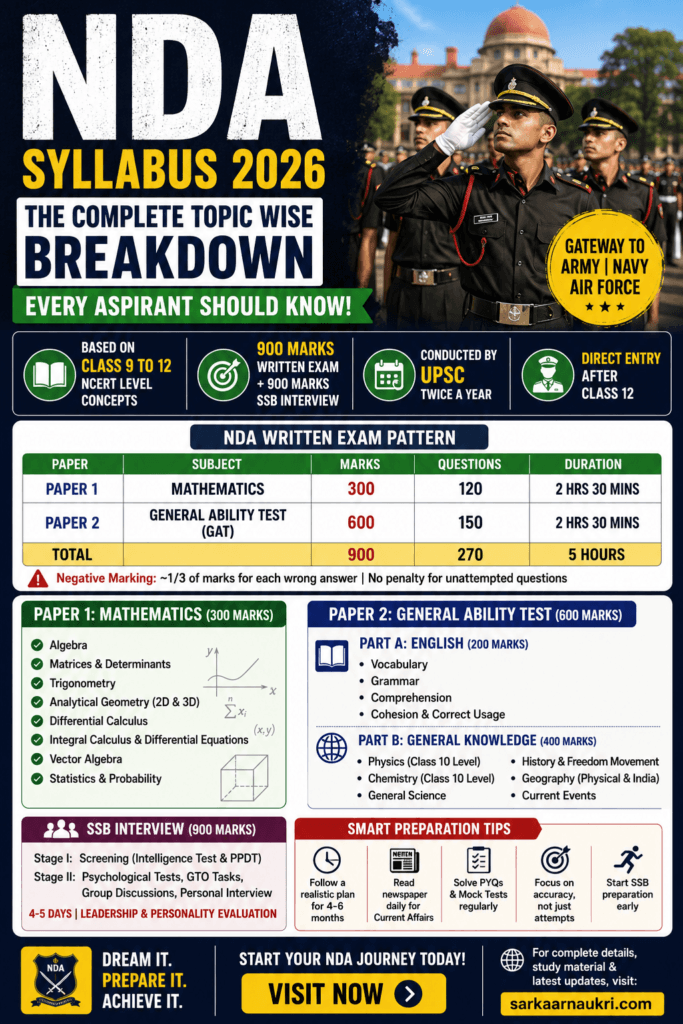
The National Defence Academy exam is the gateway into the Indian Army, Navy, and Air Force straight after Class 12, and it is conducted twice a year by the UPSC. Under the NDA Syllabus 2026, the written exam carries 900 marks across two papers: Mathematics and the General Ability Test, commonly called GAT. Clearing the written stage is only half the journey, since a further 900 marks come from the SSB interview, but nothing in that later stage matters if you cannot clear the written cutoff first. Every topic in the syllabus is drawn from Class 9 to Class 12 level concepts, so nothing here is beyond what a serious Class 12 student can master with focused effort.
NDA Exam Pattern at a Glance
Before diving into topics, it helps to see how the NDA Syllabus 2026 marks are distributed.
| Paper | Subject | Marks | Questions | Duration |
|---|---|---|---|---|
| Paper 1 | Mathematics | 300 | 120 | 2 hours 30 minutes |
| Paper 2 | General Ability Test | 600 | 150 | 2 hours 30 minutes |
| Total | Written Exam | 900 | 270 | 5 hours |
Both papers are objective type with four options per question, and the NDA Syllabus 2026 marking scheme applies negative marking for every wrong answer, roughly 0.83 marks deducted in Mathematics and 1.33 marks in GAT. Unanswered questions carry no penalty, which matters more for your strategy than most candidates realise.
NDA Syllabus 2026 Mathematics Explained
Under the NDA Syllabus 2026, Mathematics is worth 300 marks, and the topics span the full Class 11 and 12 curriculum. The major areas are Algebra, Matrices and Determinants, Trigonometry, Analytical Geometry of two and three dimensions, Differential Calculus, Integral Calculus and Differential Equations, Vector Algebra, and Statistics and Probability. Algebra and Trigonometry together typically form the largest chunk of questions, so candidates who build a strong base here tend to score consistently across attempts. Calculus, split between differential and integral concepts, is the second heaviest zone and rewards candidates who practise a wide variety of problem types rather than memorising formulas alone. Vector Algebra and Statistics and Probability are comparatively smaller sections but are also the fastest to master, which makes them excellent for quick revision closer to the exam.
NDA Syllabus 2026 General Ability Test Explained
Within the NDA Syllabus 2026, the General Ability Test carries 600 marks and is split into two distinct parts, English worth 200 marks and General Knowledge worth 400 marks. This weighting surprises many first time candidates who assume Maths carries more weight simply because it is a standalone paper, when in reality GAT alone outweighs Mathematics two to one.
Part A, English (200 marks): This section tests vocabulary, grammar, comprehension, cohesion, and correct usage of prepositions and idioms. It is largely a test of reading speed and language fundamentals rather than advanced literature, so consistent reading habits matter more than last minute cramming.
Part B, General Knowledge (400 marks): This is the largest single component of the NDA Syllabus 2026 written exam, and it covers Physics, Chemistry, General Science, History and the Freedom Movement, Geography, and Current Events. Physics and Chemistry are tested at a Class 10 level for non science background candidates, while General Science covers broader everyday scientific concepts. History focuses heavily on India’s freedom struggle and constitutional basics, Geography covers physical and Indian geography, and Current Events demands regular reading of national and international news in the months leading up to the exam.
SSB Interview Stage
Once a candidate clears the written cutoff defined under the NDA Syllabus 2026, the next stage is the Services Selection Board interview, worth 900 marks and spread across four to five days. It includes Stage I screening with an intelligence test and picture perception exercise, followed by Stage II, which covers psychological tests, group testing tasks like group discussions and command tasks, and a personal interview. This stage evaluates leadership qualities and personality traits rather than academic knowledge, so it sits outside the traditional syllabus but is equally decisive for final selection.
How to Structure Your Preparation Around the Syllabus
Once the NDA Syllabus 2026 is mapped out clearly, a realistic study plan usually needs four to six months of consistent effort. Start by covering Class 11 and 12 NCERT Mathematics thoroughly, since nearly every Maths question in the exam traces back to NCERT-level concepts before moving into higher difficulty practice sets. For General Knowledge, build a habit of reading a newspaper daily rather than trying to cram current affairs in the final weeks, since Current Events questions reward sustained awareness over short term memorisation. English preparation benefits most from regular reading and vocabulary building rather than grammar rules alone.
Common Mistakes and Misconceptions
A large number of candidates underestimate the General Knowledge portion of the NDA Syllabus 2026 because it feels less structured than Mathematics, and end up losing marks in a section that is actually worth more than the entire Maths paper combined with English. Another common mistake is ignoring negative marking, candidates guess aggressively on questions they are unsure about and lose more marks than they gain, when a more disciplined approach of attempting only reasonably confident questions usually yields a better net score. Many aspirants also treat the written exam as the finish line and start SSB preparation only after results are declared, which leaves very little time to build the physical fitness and communication skills the interview stage demands. Finally, some candidates assume Physics and Chemistry in GAT require deep subject expertise, when the actual difficulty level sits closer to Class 10 fundamentals.
Practical Tips for NDA Aspirants
Solve previous years’ question papers early in your preparation, not just at the end, since they reveal exactly how theoretical topics get converted into exam style questions. Time yourself on full length mock tests at least once every two weeks in the final few months to build the speed and stamina that a five hour written exam genuinely demands. Keep a dedicated Current Events notebook rather than relying on memory, since General Knowledge questions often hinge on specific names, dates, and events from recent months. For Mathematics, maintain a formula sheet you revise daily instead of relearning formulas from scratch each time you sit down to study.
Frequently Asked Questions
Q1. What is the total weightage between Maths and GAT under the NDA Syllabus 2026? Mathematics carries 300 marks and the General Ability Test carries 600 marks, making a total of 900 marks in the written exam.
Q2. Is the NDA Syllabus 2026 based on Class 12 level concepts only? No, it spans Class 9 to Class 12 level concepts, with Mathematics leaning more heavily on Class 11 and 12, and General Knowledge drawing from earlier classes as well.
Q3. How much does English carry in the NDA exam? English forms Part A of the General Ability Test and is worth 200 marks out of the total 600 marks in that paper.
Q4. Do arts background students need to study Physics and Chemistry for NDA? Yes, all candidates regardless of stream must attempt the General Knowledge section, which includes Physics and Chemistry questions typically at a Class 10 difficulty level.
Q5. Is there negative marking under the NDA Syllabus 2026 written exam? Yes, roughly one third of the marks allotted to a question is deducted for every wrong answer, while unanswered questions carry no penalty.
Q6. How long does it take to complete the NDA Syllabus 2026 properly? Most serious aspirants take around four to six months of consistent daily preparation to cover the syllabus with adequate revision and practice.
Q7. What comes after clearing the written exam in the NDA selection process? Candidates who clear the written cutoff move to the SSB interview, a separate 900 mark evaluation spread across four to five days covering psychological tests, group tasks, and a personal interview.
Conclusion
Understanding the NDA Syllabus 2026 in full detail, rather than jumping straight into random practice questions, is the single biggest advantage a serious aspirant can build early. Once Mathematics and GAT are broken down into their actual weightage and topics, preparation stops feeling overwhelming and starts feeling like a plan you can execute. Candidates preparing for this cycle can also check our Defence Jobs & Latest Jobs section for the latest NDA notification updates or browse 12th Pass Jobs for other entry routes into the armed forces.
