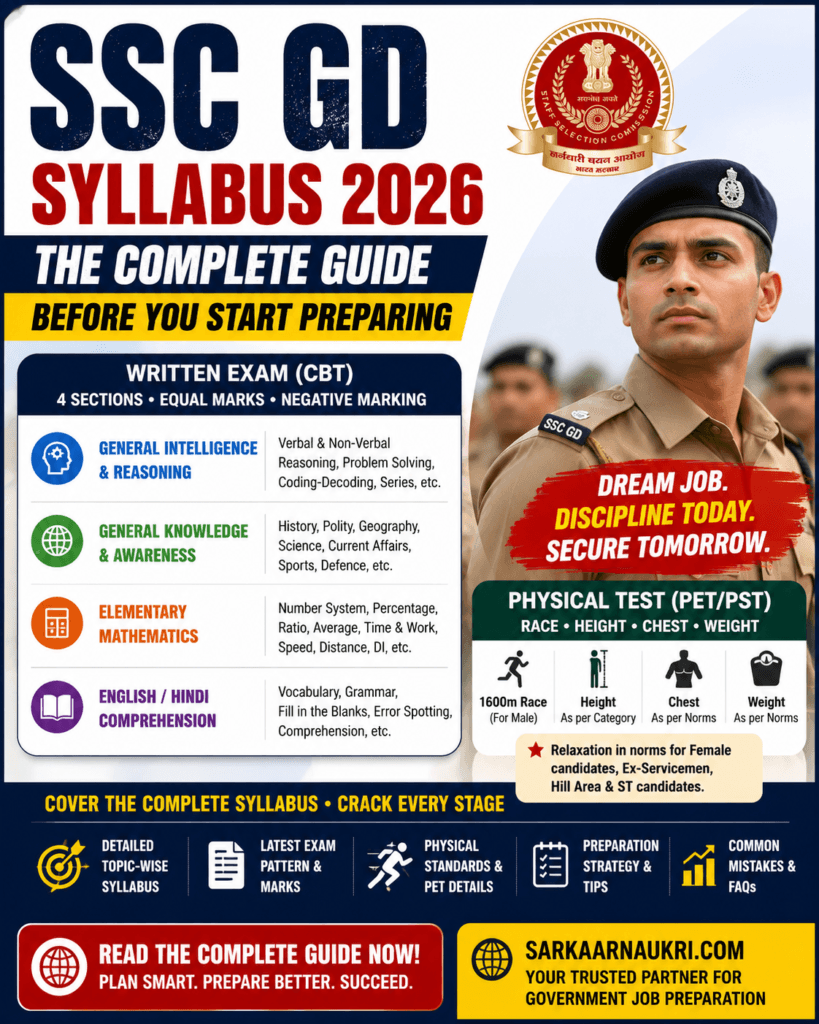
Most aspirants download the SSC GD Syllabus PDF, glance at the subject names, and start studying without a real plan — and end up realizing months later that they’ve over-prepared in one area and barely touched another. The Staff Selection Commission’s General Duty Constable exam has a fixed structure, and understanding the SSC GD Syllabus properly from day one saves you from that mistake. This guide walks through the SSC GD Syllabus section by section, explains how the Physical Efficiency Test fits in, and gives you a realistic way to plan your preparation around it.
Unlike many government exams, the SSC GD Syllabus combines a written test with physical standards, which means candidates preparing only for the CBT often get caught off guard by the PET/PST stage. This guide covers both sides of the SSC GD Syllabus so you’re not left scrambling closer to the exam date.
Why the SSC GD Syllabus Matters More Than It Looks
At first glance, the SSC GD Syllabus looks similar to other SSC exams — General Intelligence, General Knowledge, Elementary Mathematics, and English/Hindi. But the exam serves a very different purpose: selecting candidates for paramilitary and border security forces, where physical fitness and quick decision-making matter as much as academic knowledge. Because of this, the SSC GD syllabus is deliberately kept at a matriculation level for the written portion, but the overall selection process is far more demanding once you factor in the physical stage. Treating the SSC GD syllabus as “just another written exam” is the single biggest planning mistake candidates make.
SSC GD Exam Pattern: How the Syllabus Is Tested
Before going topic by topic, it helps to understand how the SSC GD Syllabus is actually tested. The recruitment process built around it has two main stages:
- Computer Based Test (CBT): Objective, multiple-choice questions across four sections, with negative marking for wrong answers.
- Physical Efficiency Test (PET) and Physical Standard Test (PST): Race, height, chest, and weight requirements that vary by category, gender, and region (including relaxed norms for candidates from hill areas and specific states).
Only candidates who clear the CBT are called for PET/PST, and a medical examination follows after that. Every stage feeds into final selection, so no part of the process can be skipped in preparation.
General Intelligence and Reasoning
This section of the SSC GD Syllabus tests logical thinking through both verbal and non-verbal questions. Typical topics include:
- Analogies, similarities, and differences
- Coding-decoding and blood relations
- Spatial orientation and visualization
- Non-verbal series and figure classification
- Arithmetic and social reasoning
- Analysis and problem-solving
This part of the paper rewards regular practice with figure-based questions, since the pattern of questions repeats closely across recruitment cycles.
General Knowledge and General Awareness
This part of the SSC GD Syllabus focuses on static and current knowledge relevant to India and its neighboring countries, including:
- History, culture, and geography of India
- Indian polity, constitution, and economic scene
- General science and everyday scientific developments
- Sports, defence-related current affairs, and important days
- Current events from the past 6–8 months
Because border security and paramilitary roles are the end goal here, defence-related current affairs carry slightly more relevance than in typical SSC exams, and candidates preparing seriously should track that space specifically rather than relying only on generic current affairs capsules.
Elementary Mathematics
This section of the SSC GD Syllabus is kept at a Class 10 level and covers foundational numerical topics:
- Number systems and simplification
- Percentages, ratio, and proportion
- Average, profit and loss, and discount
- Time, speed, distance, and work
- Basic mensuration and data interpretation
Speed matters more than depth in this section, since most questions are direct one- or two-step calculations rather than layered problems.
English/Hindi Comprehension
Candidates choose either English or Hindi for this part of the SSC GD Syllabus, which checks basic language and comprehension skills:
- Vocabulary, synonyms, and antonyms
- Grammar, sentence correction, and error spotting
- Fill in the blanks
- Basic comprehension passages
This section is often the easiest to improve quickly, since consistent daily reading and short grammar drills tend to show results within a few weeks.
Physical Efficiency Test and Physical Standards
Preparation for this exam isn’t complete without factoring in the physical stage, which runs alongside the written portion in terms of importance. Candidates are expected to complete a timed race, and height, chest, and weight standards apply based on category and region. Female candidates, ex-servicemen, and candidates from certain hill states have separate, relaxed norms. Because PET/PST comes after the CBT result, many candidates start physical training too late — building running stamina and strength should begin well before the written exam, not after it.
SSC GD Syllabus: Marks Distribution and Weightage
Each of the four sections in the SSC GD Syllabus typically carries equal marks in the CBT, but that doesn’t mean they deserve equal study time. General Intelligence and Elementary Mathematics tend to need more practice hours per mark, since accuracy comes only through repeated problem-solving. General Knowledge and English/Hindi, by contrast, reward daily short revision more than long study blocks, since retention matters more than problem-solving speed. Mapping the SSC GD Syllabus against this scoring reality — rather than studying every section for the same number of hours — is one of the simplest ways to improve overall efficiency in the weeks before the exam.
Common Mistakes and Misconceptions
- Ignoring physical preparation until after the CBT result: Waiting to start running practice after clearing the written exam leaves very little time before the PET.
- Treating General Knowledge as low-priority: This section can be a strong scoring area if defence and current affairs topics are tracked consistently.
- Skipping mock tests for Elementary Mathematics: Since calculators aren’t allowed, timed practice is the only way to build genuine speed.
- Assuming the syllabus doesn’t change: Always check the latest official notification, since minor pattern or marks changes to the SSC GD Syllabus can occur between recruitment cycles.
- Studying every topic equally: Some topics in the SSC GD Syllabus appear far more frequently in past papers than others, so blind, equal-effort preparation wastes time.
Practical Tips for SSC GD Preparation
- Start basic physical training (running, stamina-building) from day one, alongside SSC GD Syllabus preparation, not after the CBT.
- Track previous years’ question papers to identify which topics repeat most often across each section.
- Dedicate a fixed daily slot to current affairs, with extra focus on defence and security-related news.
- Use timed mock tests weekly once the basic syllabus is covered, to build both speed and accuracy.
- Keep a revision sheet of formulas for Elementary Mathematics and go through it daily instead of relearning concepts from scratch.
- Practice reasoning through timed question sets rather than untimed reading, since exam-day speed is the real differentiator.
Frequently Asked Questions
1. Is the SSC GD Syllabus the same for male and female candidates? The written portion of the SSC GD Syllabus is identical for all candidates, but physical standards for the PET/PST stage differ by gender and category, so it’s worth checking the official notification for exact norms.
2. How many sections are there in the SSC GD Syllabus for the written exam? There are four sections: General Intelligence and Reasoning, General Knowledge and General Awareness, Elementary Mathematics, and English/Hindi.
3. Is there negative marking in the SSC GD exam? Yes, incorrect answers in the CBT typically carry a marking deduction, so accuracy is just as important as speed while attempting the paper.
4. Do I need to clear the physical test and written test both? Yes, candidates must clear the CBT first, followed by PET/PST and a medical examination, before final selection is made.
5. Is coaching necessary to cover this syllabus? Not necessarily — the topics are largely self-study friendly, and many selected candidates prepare using NCERT books, previous papers, and free mock tests without formal coaching.
6. How much time is needed to prepare from scratch? Most candidates with a matriculation-level academic base can prepare adequately in three to four months if physical training runs alongside written preparation from the start.
7. Are there relaxed physical standards for any category? Yes, ex-servicemen, candidates from certain hill states, and Scheduled Tribe candidates often have relaxed height and chest requirements as specified in the official notification.
Conclusion
Preparing from the SSC GD Syllabus means treating the written exam and the physical stage as equally important from day one, rather than as two separate phases to handle one after the other. A candidate who studies General Intelligence, General Knowledge, Elementary Mathematics, and English/Hindi consistently, while building running stamina in parallel, stands a realistic chance of clearing every stage of selection. For related preparation resources, see our guides on [SSC GD Physical Standards and PET Details] and [Government Job Age Relaxation Rules], both of which complement this breakdown.
