Every year, lakhs of candidates apply for the SSC CHSL exam without fully understanding how it’s actually structured—and end up losing precious marks to avoidable mistakes. If you’ve ever wondered how many tiers there are, how negative marking works, or what the typing test really demands, you’re not alone. Understanding the SSC CHSL exam pattern properly, before you even open a single mock test, can be the difference between a wasted attempt and a selection.
This guide breaks down the SSC CHSL exam pattern tier by tier, explains the marking scheme in plain language, and clears up the misconceptions that trip up first-time candidates most often.
Why Understanding the SSC CHSL Exam Pattern Matters
Most candidates jump straight into solving previous year papers without first mapping out the SSC CHSL exam pattern in their heads. This is a mistake. The SSC CHSL exam pattern isn’t just a formality listed in the notification PDF — it directly shapes how you should allocate your preparation time across sections, how you approach negative marking, and how you pace yourself on exam day. A candidate who has internalized the SSC CHSL exam pattern walks into the exam hall with a plan; a candidate who hasn’t is essentially guessing in real time.
Understanding the syllabus & post preferences is a must to know
The SSC CHSL exam pattern has evolved over the years, and the current structure is split into two main tiers, each testing a different set of skills. Knowing exactly what each tier demands lets you build a preparation strategy that’s targeted rather than generic.
Tier 1: Computer-Based Examination
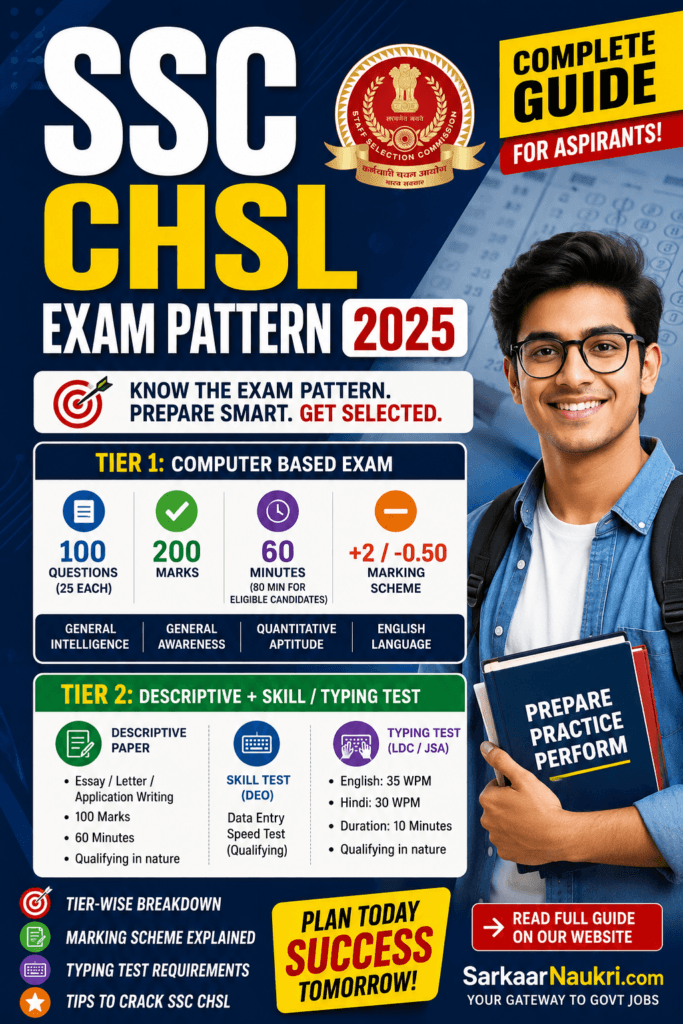
The first stage of the SSC CHSL exam pattern is a computer-based objective test. This tier is common to all applicants and acts as the primary screening round.
- Total Questions: 100 (25 from each section)
- Sections: General Intelligence, General Awareness, Quantitative Aptitude, English Language
- Total Marks: 200
- Duration: 60 minutes (80 minutes for candidates eligible for scribe/compensatory time)
- Marking Scheme: +2 for every correct answer, -0.50 for every incorrect answer
This tier of the SSC CHSL exam pattern is designed to be a broad filter — it checks whether you have baseline competency across reasoning, awareness, math, and language, rather than testing deep specialization in any one area. Because the negative marking is relatively steep at this stage, accuracy matters more than attempting every question in this part of the SSC CHSL exam pattern.
General Intelligence
This section tests analogies, classification, series completion, coding-decoding, and non-verbal reasoning. It’s one of the more scoring sections if you practice pattern recognition regularly.
General Awareness
Covers static GK, current affairs, science, and economics. This section rewards consistent daily reading far more than last-minute cramming.
Quantitative Aptitude
Tests arithmetic, algebra, geometry, trigonometry, and data interpretation at a 10th-standard level. Speed matters as much as accuracy here.
English Language
Covers grammar, vocabulary, comprehension, and sentence correction. Many candidates underestimate this section within the SSC CHSL exam pattern and lose easy marks.
Tier 2: Descriptive Paper, Skill Test, and Typing Test
Once you clear Tier 1, the next stage of the SSC CHSL exam pattern shifts focus from objective screening to applied skills.
Descriptive Paper (Pen and Paper Mode)
- Essay/Letter/Application writing
- Total Marks: 100
- Duration: 60 minutes
- Qualifying in nature but marks are added for final merit in some posts
Skill Test / Typing Test
- For Data Entry Operator posts: a Data Entry Speed Test is conducted
- For LDC/JSA posts: a typing test in English or Hindi is required
- English typing speed requirement: 35 words per minute
- Hindi typing speed requirement: 30 words per minute
- Duration: 10 minutes
This part of the SSC CHSL exam pattern is qualifying in nature for most posts, meaning you don’t need to score exceptionally—you need to clear the minimum threshold. However, candidates often underestimate how much practice the typing test demands, especially those who aren’t used to typing on a standard keyboard layout under time pressure.
Marking Scheme: The Detail Most Candidates Get Wrong
A recurring misconception about the SSC CHSL exam pattern is that all sections carry the same negative marking weight or that Tier 2 is entirely “no-risk.” In reality, the descriptive paper in the SSC CHSL exam pattern has its own qualifying cutoff, and skipping it or scoring too low can disqualify you even if your Tier 1 score was strong. Always check the latest official notification for the exact marking breakdown before your attempt, since minor tweaks to the SSC CHSL exam pattern are occasionally announced.
Common Mistakes and Misconceptions
Mistake 1: Ignoring the typing test until the last month. Many candidates treat the typing round as an afterthought within the broader SSC CHSL exam pattern, only to discover weeks before the test that their speed falls short of the required benchmark.
Mistake 2: Over-preparing for Tier 1 and under-preparing for Tier 2. Because Tier 1 feels like the “real” exam, candidates often assume Tier 2 will sort itself out. The descriptive paper genuinely tests writing structure and grammar and needs dedicated practice.
Mistake 3: Misunderstanding the negative marking impact. Some aspirants attempt every question in Tier 1 assuming guesses will average out. Given the -0.50 penalty, random guessing across all sections typically costs more than it gains.
Mistake 4: Not checking post-specific requirements. Not every post under SSC CHSL requires the same skill test. LDC/JSA and DEO posts have different typing requirements, and confusing the two is a common and costly error.
Practical Tips to Prepare Smart
- Map your preparation calendar directly to the four Tier 1 sections rather than studying randomly
- Take at least one full-length mock test weekly to build stamina for the 60-minute window
- Practice typing on a standard keyboard daily if you’re targeting LDC/JSA or DEO posts
- Revise current affairs from the last 6 months specifically, since General Awareness questions lean recent
- Keep a formula sheet for Quantitative Aptitude and revise it every few days
- Read the official notification PDF fully at least once—don’t rely only on secondary sources for exam pattern details
Frequently Asked Questions
Q1. How many tiers are there in the SSC CHSL exam pattern? There are two tiers — a computer-based objective test (Tier 1) and a descriptive plus skill/typing test (Tier 2).
Q2. Is there negative marking in the SSC CHSL exam pattern? Yes, Tier 1 carries a negative marking of 0.50 marks for every incorrect answer, while each correct answer earns 2 marks.
Q3. What is the typing speed required for SSC CHSL LDC posts? Candidates need a typing speed of 35 words per minute in English or 30 words per minute in Hindi.
Q4. Is the descriptive paper in Tier 2 qualifying, or does it count toward merit? It is generally qualifying in nature, though the exact treatment can vary by post, so candidates should verify against the current notification.
Q5. How long is the Tier 1 computer-based exam? The duration is 60 minutes, extended to 80 minutes for candidates eligible for compensatory time.
Q6. Can I skip the typing test if I only want a data entry operator post? No—DEO posts require a Data Entry Speed Test instead of the standard typing test, so some form of skill test is mandatory regardless of the post applied for.
Q7. Does the SSC CHSL exam pattern change every year? The core structure has remained largely stable in recent years, but minor adjustments to duration, marking, or sections are occasionally notified, so always cross-check the latest official PDF.
Conclusion
Getting familiar with the SSC CHSL exam pattern before you start preparing isn’t just useful — it’s the foundation everything else is built on. Once you know exactly how Tier 1 and Tier 2 are structured, how marks are awarded and deducted, and what the typing test actually demands, your preparation stops being guesswork and starts being strategy. For a deeper dive into scoring well under negative marking, check out our guide on SSC exam preparation strategies, and if you’re specifically targeting data entry operator posts, our typing test practice guide is a useful next read.
